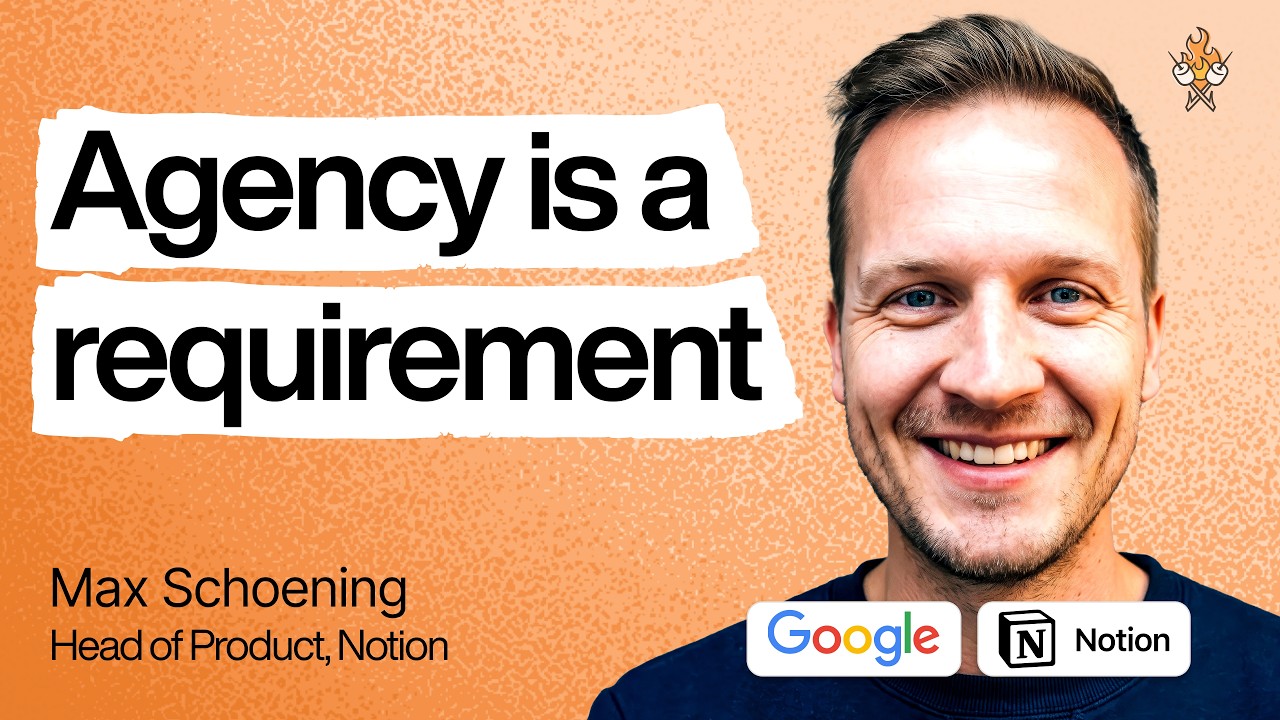
📺 Today’s recommended deep-dive video: https://www.youtube.com/watch?v=mCO-D3pkviM
The Agency Revolution: Building Software in the Age of AI
Max Schoening, Head of Product at Notion and former design leader at GitHub and Heroku, argues that the technical barriers to creation are collapsing, shifting the competitive advantage from specialized skills to pure human agency. In a world where AI makes the first 10% of any project “free,” the winners will be those who stop designing “dead fish” in static tools and start interrogating the medium of code.
Core Question: How does the integration of AI change the roles of PMs and designers from cogs in a delivery mechanism to masters of malleable software?
Highlights
- Agency over Skill: The realization that the world is built by people no smarter than you is the ultimate catalyst for high-agency product building.
- Prototyping in Code: Why Notion encourages designers and PMs to use the terminal to understand the “material” of software rather than just manipulating static Figma files.
- The Tiny Core Superpower: Truly great products succeed not by feature bloat, but by perfecting one “tiny core” (like the GitHub Pull Request or Notion’s blocks).
- Taste as a Virtual Machine: Defining taste as the ability to run a mental simulation of how a specific in-group will react to a product idea.
⏱️ Reading time: approx. 9 minutes · Saves you about 78 minutes vs. watching.
Want to take notes while watching? Click the image below and let AI Notebook capture the key points for you 👇

The Death of the “Dead Fish”
Interrogating the Material
Static design files are “dead fish”—they lack the pulse and interactivity of the actual medium. Max argues that when Notion started building chat interfaces, the team realized that designing in Figma was insufficient; you have to feel the AI to understand it. By creating a code-based playground for designers, Notion lowered the “fear of the terminal,” allowing non-engineers to prototype agentic loops directly in the substrate where they will eventually live.
This shift isn’t about turning everyone into a production-level engineer.
Instead, it is about becoming a “master of the material.” When a PM or designer understands how an agent loop functions or how code behaves under pressure, they stop being a cog in a delivery mechanism and start becoming a master of the material. This interrogation of the medium ensures that the final product isn’t just a surface-level aesthetic, but a functional tool that respects the constraints and possibilities of modern software.

💡 Digging Deeper
Q: Why should designers code if they aren’t shipping to production?
A: Because it forces you to consider the medium. You shouldn’t just be a delivery mechanism for an idea; you should understand the agent loops and logic that make the software work.
Q: What is “Vibe Coding”?
A: It’s the recent trend of using LLMs to generate software quickly based on “vibes” rather than rigorous engineering, which Max warns can lead to a drop in software reliability despite an increase in volume.
Q: How do you encourage designers to use the terminal?
A: By providing a “oneshot-able” playground—a small, LLM-friendly codebase that minimizes friction and allows them to see immediate results without the complexity of a decade-old production codebase.
Malleable Software and the SaaS Evolution
The Garden vs. The Ivory Tower
Malleable software is the philosophy that tools should work closer to the interests of the user than the interests of the corporation that created them. Max contrasts the “Ivory Tower” approach of rigid apps with the flexibility of a spreadsheet or a home that adapts to its inhabitants over time. In this view, software is like a garden that requires tending, and the “As a Service” part of SaaS is really a payment for professional maintenance and specialized gardening.
The predicted “SaaS Apocalypse” is likely an exaggeration.
While AI allows individuals to build their own bespoke tools, most people don’t actually want to maintain a full stack of software or hunt for their own digital “steak.” They want the convenience of a platform like Notion that handles security, collaboration, and permissions while providing the building blocks for customization. The future likely holds a return to general-purpose “operating system” tools—like the Word processors and FileMaker Pros of the 90s—but supercharged by AI tutors.

💡 Digging Deeper
Q: Is the SaaS apocalypse real?
A: Partially. Generic SaaS that acts as a “fancy form around a spreadsheet” is at risk, but platforms that offer maintenance, security, and specialized problem-solving will remain essential.
Q: How does AI make software more malleable?
A: It acts as a tutor. Users who previously found complex tools like Notion intimidating can now use AI to help them structure their workspace, effectively lowering the barrier to “building” their own tools.
Q: What is the “physical metaphor” for software?
A: Think of 3D printing vs. mass manufacturing. 3D printing (prototyping) shows the layer lines and flaws, while engineering is the optimization of the factory to serve 100 million people with precision.
The Strategy of the Tiny Core
Identifying the Superpower
Every generational product has a “tiny core” that is so exceptionally good it acts as a superpower for the user. For GitHub, it was the Pull Request; for Heroku, it was git push heroku master; for Dropbox, it was the seamless syncing icon in the menu bar. Max warns against the “death spiral” of adding just one more feature to make a product great, noting that if the core isn’t “obviously good,” no amount of peripheral bloat will save it.
Finding this core is often a mix of luck and relentless iteration.
Once identified, the product team must protect that core from the friction of modern corporate software. Max observes that many companies fail because they try to solve too many problems at once rather than perfecting the one interaction that makes their product intoxicating to the user. At Notion, that core is the block and the slash command—primitives that allow for infinite combinatorics.

💡 Digging Deeper
Q: How do you know if a product is “obviously good”?
A: It’s an intuitive bar. You didn’t have to argue that the first iPhone or ChatGPT was good; you knew it when you saw it.
Q: What is the “Death Spiral”?
A: The mistaken belief that adding one more feature will finally make a mediocre product successful. Truly great products start with a core that works even if the rest is “terrible.”
Q: Why doesn’t being “first to market” matter?
A: Because durability and “doing it right” (like AirPods vs. earlier Bluetooth headphones) matter more than being the earliest. You have to be right, not just first.
The Future of Knowledge Work
The 10% Free Era
AI has fundamentally changed the “start” of projects by making the first 10% of the work—the brainstorming, the basic scaffolding, the initial PRD—essentially free. Max highlights that while the first 90% of a project might now be reachable with almost no effort, the last 10% remains 90% of the actual work. This last mile is where craft, engineering precision, and human delight reside, and it is the area where specialists must continue to focus.
Max offers a provocative “hot take”: we already have Universal Basic Income (UBI), and it is called knowledge work.
By this, he means that many modern professionals are paid high salaries to perform tasks that are increasingly automatable, essentially enjoying a high-standard of living for “sitting in front of a computer.” As AI takes over these tasks, humans will need to find new ways to insert themselves into the loop, likely through higher-level agency and the cultivation of “taste.”

💡 Digging Deeper
Q: How should teams handle “token spend”?
A: Right now, Notion treats it as unlimited for exploration. It is the wrong thing to optimize for early on, but in 6–12 months, ROI conversations will become necessary.
Q: What is the danger of AI-generated code?
A: The “software factory” must remain verifiable. If a human has to manually intervene in a coding agent’s loop, it should be treated like a bug in the process.
Q: What defines “Taste”?
A: It is “iterations with feedback.” It’s like training a model: input an idea, see the reaction, and back-propagate that information to refine your internal “virtual machine.”
Key Takeaways
The most important shift in the AI era is the redistribution of agency. Max emphasizes that the “Steve Jobs realization”—that the world is made by people no smarter than you—is more relevant now than ever. By using AI to lower the cost of exploration, individuals can “tinker” their way into high-agency roles, effectively changing their environment rather than just operating within it.
Specialization still matters, but the edges are blurring. While designers and PMs should understand the material of code, we must not lose the specialists who focus on “machined unibody” levels of software quality. The goal is to use AI as an exoskeleton, not a replacement for human ingenuity.
Finally, the secret to building successful products remains the “tiny core.” Instead of succumbing to the pressure of feature parity, teams should focus on the one interaction that makes their tool “obviously good.” In a world of AI slop and rapidly produced software, durability and craft will be the ultimate differentiators.
Q&A
Q1: What is the “playground” concept used at Notion?
A1: It is a simplified, LLM-friendly codebase where designers and PMs can prototype AI chat interfaces in code without having to navigate the complexities of the main production environment.
Q2: How does Max define “Agency”?
A2: It is the realization that the world is malleable and that you have the power to change things rather than just following a prescribed job description.
Q3: What is the “Jevons Paradox” in the context of Figma?
A3: The idea that as AI makes coding easier, the demand for design (and thus Figma usage) might actually increase rather than decrease, as more people are empowered to create.
Q4: Why does Max compare software to a “garden”?
A4: Because software requires constant maintenance and “tending” by specialists to remain useful, which is why the “As a Service” model will likely survive the AI revolution.
Q5: What is the “virtual machine” theory of taste?
A5: It’s the ability to mentally simulate how a specific group of people will react to a product idea based on years of gathered feedback and “reps.”
Q6: What was the “fail” Max experienced with his Notion competitor in 2014?
A6: His team spent too much time polishing the editing experience (markdown folding, etc.) while Notion focused on the “core” of block-based collaboration, proving that the right core matters more than initial polish.
Q7: What is “Knowledge Work as UBI”?
A7: The satirical but grounded idea that many current high-paying desk jobs are essentially a form of subsidization for human presence, which AI will soon challenge.