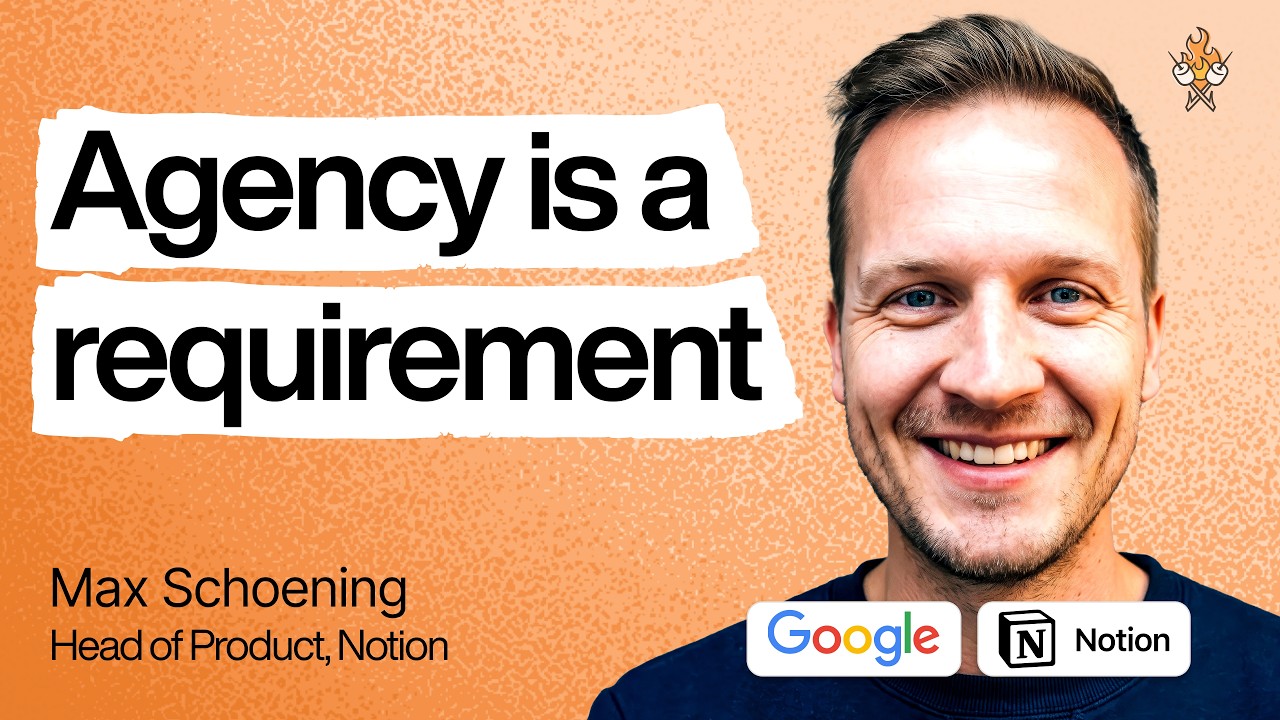
📺 Today’s recommended deep-dive video: https://www.youtube.com/watch?v=mCO-D3pkviM
Driving Notion Like It’s Stolen: Building Product in the Age of AI
In an era where AI can generate the first version of a startup for free, the traditional boundaries between designers, PMs, and engineers are dissolving into a single, high-agency role. Max Shying, Head of Product at Notion, explores why “taste” is a mental virtual machine and how the most successful products are built around a “tiny core” superpower.
Core Question: How does the integration of AI shift the focus of product building from technical skill execution to human agency and the pursuit of “obviously good” software?
Highlights
- The “First 10% is Free”: How AI has collapsed the cost of initial prototyping and exploration.
- Agency over Skill: Why the realization that the world is “malleable” is the most critical trait for modern builders.
- Malleable Software: Moving away from “Ivory Tower” app design toward tools that users can truly own and reshape.
- The Tiny Core Theory: Why successful products like GitHub and Dropbox rely on one exceptionally good superpower rather than feature bloat.
⏱️ Reading time: approx. 7 minutes · Saves you about 80 minutes vs. watching.
Want to take notes while watching? Click the image below and let AI Notebook capture the key points for you 👇

The Collapsing Venn Diagram: AI and the Master of Material
Prototyping in Code
At Notion, the shift toward designers and PMs shipping code wasn’t driven by a desire for efficiency alone, but by a philosophy of “feeling” the material. Max explains that static Figma designs are often “dead fish”—they lack the dynamic feedback loops required to understand how an AI agent actually behaves. By building a low-barrier, LLM-friendly playground, the team encouraged non-engineers to overcome their fear of the terminal and start “vibe coding.”
It isn’t about the utility of the code landing in production; it is about interrogating the medium through active, functional prototyping.
The goal is mastership of the material rather than being a mere cog in a delivery mechanism. When a designer understands the constraints and possibilities of an agent loop by building it, they move from drawing interfaces to designing experiences that work for 100 million people. Shying notes that while the quantity of software is exploding, the quality often isn’t—meaning the differentiator for future teams will be their ability to bridge the gap between a janky prototype and a refined, “obviously good” product.

💡 Digging Deeper
Q: Why should designers code if an engineer will eventually rewrite it?
A: Because thinking in code forces you to consider the medium. It’s the difference between drawing a chair and understanding how the wood actually holds weight.
Q: Is “vibe coding” a risk to software quality?
A: Yes. While the amount of software is increasing, finding reliable, high-quality software is getting harder. The “last 10%” of engineering—the precision and yield—is still where the real work happens.
High Agency and Malleable Software
The Steve Jobs Realization
The most important trait in the new software landscape is agency—the innate understanding that the world around you is malleable and built by people no smarter than you. Max suggests that this “Steve Jobs realization” isn’t evenly distributed, but it can be cultivated through tinkering and making things. Those who wait for a definition of their role will struggle, while those who “drive the company like it’s stolen” will define the future of their organizations.
If you aren’t changing your role to fit how you think it should be, you aren’t exercising true agency.
High-agency individuals don’t just solve problems within their lane; they act as the company’s best recruiters and strategists because they care more about affecting change than maintaining boundaries. This mindset is what allowed Notion to pivot and innovate early on—a culture where employees (Ninos) are encouraged to treat the product as something they can fundamentally reshape rather than just maintain.
The End of the “Ivory Tower”
Malleable software is the idea that tools should work closer to the interest of the person using them than the corporation that made them. Max argues that we currently live in a world of “apps”—rigid squares on our phones where every layer of UI and data is glued together. He envisions a return to the 90s-era of general tools like spreadsheets and FileMaker Pro, but supercharged by AI “tutors” that lower the barrier to entry.
AI acts as the bridge that makes complex, malleable systems accessible to the average user.
Building “Obviously Good” Products
The Tiny Core Superpower
One of the biggest pitfalls in product management is the “death spiral” of adding just one more feature to make a product great. Max contends that every truly successful product has a “tiny core” that is so exceptionally good it feels like a superpower. For GitHub, it was the Pull Request; for Dropbox, it was the menu bar icon that synced files better than the OS itself; for Notion, it was the block-based architecture.
Adding features to a product with a weak core never works; you must find the one “naked robotic core” that provides immediate value.
This focus on the core allows for “incremental correctness”—the ability to iterate relentlessly until the product clicks with its audience. Max admits that even at Notion, they struggle with “feature sprawl,” often having multiple automation primitives that eventually need to be reconciled into a simpler, more powerful foundation. The bar for any release should be “obviously good,” a standard where the value is so apparent that no one argues its merit.

💡 Digging Deeper
Q: How do you build “Taste”?
A: Taste is a virtual machine in your head. You train it through thousands of reps—inputting ideas, seeing how an in-group reacts, and performing back-propagation on your own assumptions.
Q: Does being first to market matter?
A: Not as much as being right. AirPods weren’t the first Bluetooth headphones, but they were the first ones that worked so well they felt like magic.
Key Takeaways
The transition into an AI-forward building environment requires a shift from execution to interrogation. Builders must treat software as a malleable material, using AI to collapse the “first 10%” of a project so they can spend more time on the “last 10%”—the refinement, craft, and quality that leads to an “obviously good” product. Agency remains the primary differentiator; those who view the world as something they can change will thrive, while those who wait for role definitions will be left behind.
Ultimately, the goal is to create “superhero” experiences. Whether it is through a “tiny core” superpower or software that adapts to the user’s needs, the best products move out of the way and empower human ingenuity. As roles merge and software “eats the world” at an accelerated pace, the focus must remain on the human elements: taste, agency, and the courage to iterate until a product is not just functional, but undeniably excellent.
Q&A
Q1: What is the “SAS Apocalypse” take?
A: It’s exaggerated. People don’t want to maintain their own full-stack software or go “hunting” for every tool. They pay for “Software as a Service” for the maintenance and the expertise of specialists.
Q2: How is AI changing the role of the PM at Notion?
A: It makes the thinking phase cheaper. PMs can now build janky, functional versions of their ideas to “react to” rather than writing long PRDs.
Q3: What is Max’s favorite German word for builders?
A: “Tüftler”—it means someone who tinkers, but with a more positive, industrious connotation than the English equivalent.
Q4: Why does Max recommend the book “Seeing Like a State”?
A: It warns against “fake legibility”—the tendency for executives to create status reports that feel organized but completely neglect the messy reality of how teams actually work.
Q5: What is the most important metric for token spend?
A: There isn’t one. Bragging about token spend is like bragging about lines of code; it’s a vanity metric. What matters is the “software factory” you build to automate the outer loops of your work.
Q6: Is Universal Basic Income already here?
A: Max jokingly suggests that “knowledge work” is the current form of UBI. We are inventive enough to keep inserting ourselves into loops even as AI takes over technical tasks.
Q7: What is the advice for young people in Silicon Valley?
A: Don’t let the frenzy of the “last train” distract you. Work incredibly hard from 18 to 25, but do it because you love the intellectual challenge of computers, not just to escape a “permanent underclass.”