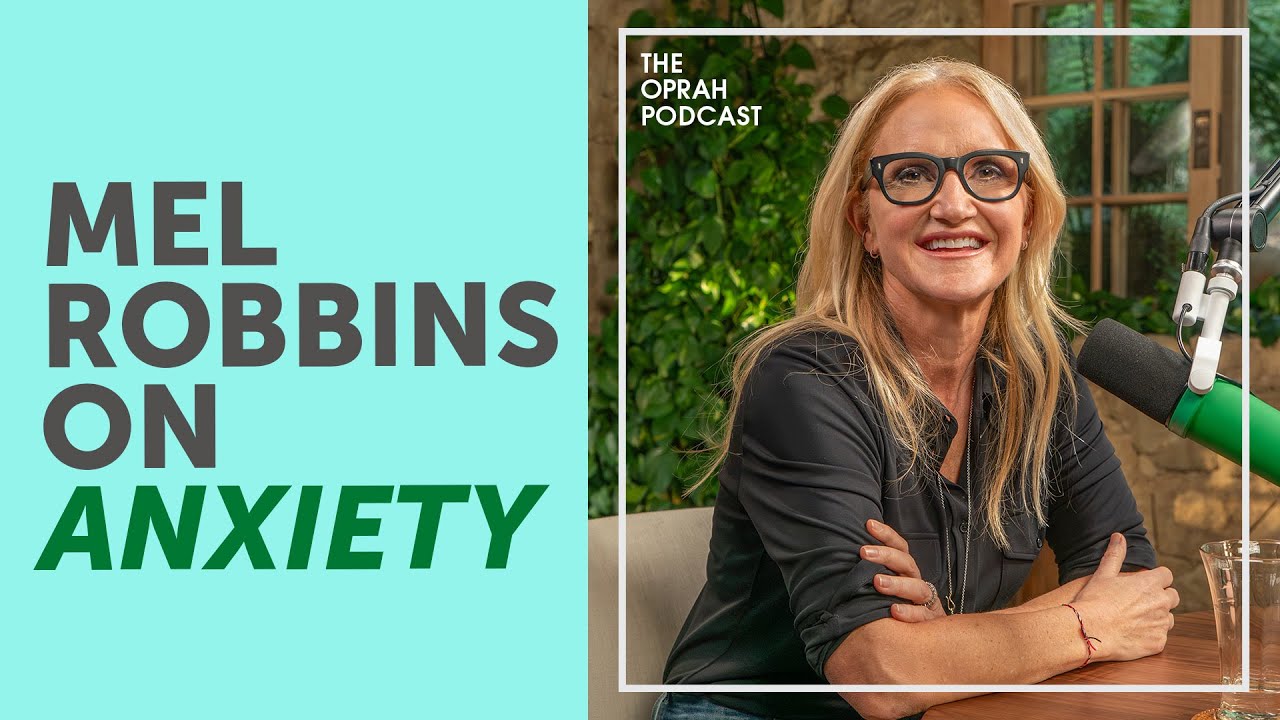
📺 Today’s recommended deep-dive video: https://www.youtube.com/watch?v=1hV912UP8qs
Stop the Spiral: Mel Robbins and Oprah on Mastering Your Anxiety
Most of us live “neck up,” trapped in a mental cage of overthinking that disconnects us from our inner power and source. In this illuminating discussion, Mel Robbins explains why anxiety is actually an alarm system—one that you can learn to regulate through simple, science-backed physiological tools.
Core Question: How can we stop being “anxious about being anxious” and reconnect with our biological capability to handle life’s uncertainty?
Highlights
- The definition of anxiety as a “separation” from self, power, and source.
- Why your morning anxiety might be a sign of stored childhood trauma rather than current stress.
- The “High-Five Your Heart” technique for stimulating the vagus nerve and quieting the amygdala.
- Why reframing nerves as “excitement” is the most effective way to maintain your edge.
⏱️ Reading time: approx. 8 minutes · Saves you about 33 minutes vs. watching.
Want to take notes while watching? Click the image below and let AI Notebook capture the key points for you 👇

The Biology of the Alarm
Neck Up vs. Body Down
Anxiety is not a personality trait or a life sentence; it is simply an alarm system designed to keep you safe. When the brain senses uncertainty, it shifts control from the prefrontal cortex to the amygdala, triggering a fight-or-flight response that demands your immediate attention.
You must stop saying “I have anxiety” because that label defines you by your alarm rather than your capability to handle it.
Dr. Russell Kennedy describes anxiety as separation anxiety—specifically, the separation from your own power and source. When we feel the internal “buzz” of nerves, we tend to go “neck up” into our thoughts, trying to think our way out of a physical feeling. This only escalates the alarm. To heal, you must drop back into your body, where your power actually resides, rather than ruminating in the clouds of overthinking.

💡 Digging Deeper
Q: Why do I feel the need to pee or get butterflies before a big event?
A: Your body is redirecting blood flow from the digestive tract to the heart and brain to help you pay attention and perform.
Q: What is the “separation” Mel mentions?
A: It is the moment you leave your physical body to live in your racing thoughts, disconnecting from your sense of safety and capability.
Q: Can I really turn the alarm off?
A: Yes, by utilizing the vagus nerve, which acts as a physical on-off switch for your stress response.
Reframing Your Edge
Excitement is Anxiety in Disguise
Physiologically, your body does not know the difference between being terrified and being thrilled. Both states produce the same racing heart, sweaty palms, and “butterflies” in the stomach. Research from Harvard suggests that instead of telling yourself to “calm down,” you should state, “I am excited.” This simple pivot aligns your brain with your body’s high-energy state rather than fighting against it.
Anxiety often feels like a thief that steals your ability to think strategically or perform under pressure.
When you allow the alarm to spiral into “head-talk,” you lose your edge because your brain can no longer access the executive functions needed for complex tasks. By acknowledging the adrenaline as a tool for focus, you keep your capability intact. You don’t lose your tenacity by being calm; you actually gain the clarity required to use it effectively.

Breaking the Generational Cycle
Avoidance and Parenting
Many parents inadvertently make their children’s anxiety worse by allowing “avoidance” behaviors, such as letting them skip school or sleep in the parents’ room. While this feels like protection, it actually signals to the child that they are not capable of facing difficult things. The single most powerful thing a parent can do is to regulate their own anxiety first, providing a calm “anchor” for the child to mirror.
You cannot protect a child from the world by helping them run away from it.
Oftentimes, what we diagnose as anxiety in young girls is actually an underlying neurodivergent trait like ADHD or an auditory processing disorder. These children are experiencing a healthy stress response to a world that feels overwhelming to their specific brain type. By building resilience and reminding them of their capability, we break the lineage of chronic worry and teach them to trust their own strength.
The Impact of Inundation
We have become “tools of the tool” by allowing smartphones to dictate our internal state from the moment we wake up. Checking headlines or social media before you are even vertical in bed forces your brain into a stress response before the day has begun. Mel insists on a hard boundary: never sleep with your phone in the room. This prevents you from being “inundated” rather than just “informed.”
The 5-Second Solution to Procrastination
Getting Out of the Gravity Blanket
Mel Robbins describes her rock-bottom moment as “marinating like a human pot roast” in bed, unable to move due to the heavy weight of debt and fear. She discovered that there is a five-second window between having an impulse to act and your brain’s ability to kill that impulse with overthinking. By counting backward—5, 4, 3, 2, 1—you physically shift gears in your brain, bypassing the hesitation and moving directly into action.
Action is the only thing that can override the swirling thoughts of a panicked mind.
This technique is used globally in clinical settings to treat everything from OCD to suicidal ideation because it interrupts the habit loop of worry. When you count backward, you engage the prefrontal cortex, which is the part of the brain responsible for focus and intentionality. It is a simple tool that allows you to “high-five your heart” and take the next right step toward your goals.

Key Takeaways
Anxiety is a physical alarm, not a personality flaw. To manage it, you must move from “neck up” (thinking) to “body down” (feeling). By utilizing techniques like the 5-4-3-2-1 countdown and stimulating the vagus nerve through deep breathing and mantras, you can regain control of your nervous system.
Breaking the cycle of anxiety requires strict boundaries with technology and an end to avoidance behaviors. Whether you are dealing with stored trauma from childhood or the pressure of a high-stakes career, the solution remains the same: reconnect with your physical body and remind yourself that you are capable of handling whatever uncertainty comes your way.
Q&A
Q1: Why shouldn’t I say “I have anxiety”?
A: Using “I have” makes the condition part of your identity. Saying “I feel anxious” or “My alarm is going off” reminds you that it is a temporary state you can manage.
Q2: What is the “High-Five Your Heart” technique?
A: You press your hand firmly against the center of your chest to stimulate the vagus nerve while breathing out slowly to signal to your brain that you are safe.
Q3: Is medication for anxiety a sign of weakness?
A: Absolutely not. Mel views medication as a “bridge to healing” or “insulin for the brain.” Withholding it when needed can be a form of self-harm.
Q4: Why is morning anxiety so common?
A: It is often a sign of stored trauma. If you grew up in a chaotic household, your brain is “wired” to wake up in a state of high alert, expecting trouble.
Q5: How do I tell the difference between being informed and being inundated?
A: If you are constantly checking headlines and feeling overwhelmed, you are inundated. If there is a major world event, you will hear about it; you don’t need to scroll for it.
Q6: How does the 5-Second Rule stop procrastination?
A: It interrupts the “hesitation window” where your brain usually talks you out of doing something difficult, forcing you to move before you can overthink.
Q7: What is the best mantra for a panic moment?
A: Mel suggests: “I’m okay. I’m safe. I’m loved. I’m capable.” Repeat this while focusing on a long, slow exhale.