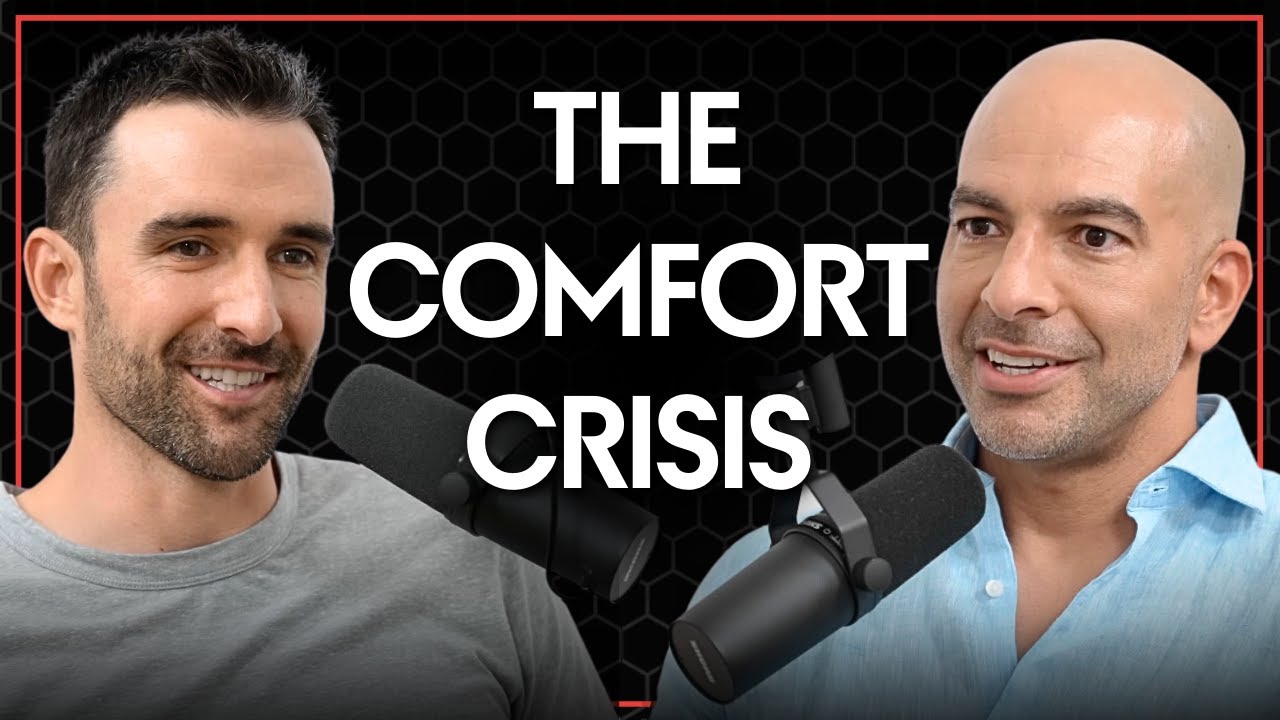
📺 Today’s recommended deep-dive video: https://www.youtube.com/watch?v=OHdp75ezdyY
Escaping the Comfort Trap: Reclaiming Human Potential through Intentional Discomfort
Most of us live in a state of perpetual luxury, sheltered by climate control, instant entertainment, and an endless supply of calories. Michael Easter argues that this “comfort crisis” is eroding our physical and mental resilience, but the antidote lies in rediscovering the evolutionary challenges that shaped us. By intentionally seeking out boredom, nature, and physical struggle, we can bridge the gap between our ancient biology and the modern world.
Core Question: How can we reintroduce ancient hardships into our modern lives to improve our health, creativity, and perspective?
Highlights
- The “three-day effect” in nature resets the brain from frenetic beta waves to calm alpha waves.
- The concept of Misogi: Why failing at a 50/50 challenge once a year expands your perceived limits.
- How the “death of boredom” in 2007 killed our creativity and internal processing time.
- Rucking as the foundational human exercise that builds strength, cardio, and durability without the high impact of running.
⏱️ Reading time: approx. 10 minutes · Saves you about 114 minutes vs. watching.
Want to take notes while watching? Click the image below and let AI Notebook capture the key points for you 👇

The Evolutionary Mismatch: Why Modern Life is Too Easy
The Cosmic Calendar and Problem Creep
If the entire history of the universe were compressed into a single calendar year, all of recorded human history occurs in the final 27 seconds before midnight on December 31st. For 99.9% of our existence, humans lived in a state of constant environmental pressure, facing scarcity, predators, and extreme weather. Today, we have successfully engineered these discomforts out of our lives, creating a world where the biggest threats to our health are no longer starvation or infection, but chronic over-nutrition and physical stagnation.
We are now victims of “prevalence-induced concept change,” a psychological phenomenon where the fewer real problems we have, the more we expand our definition of what constitutes a problem.
When we lack life-threatening stressors, our brains begin to treat minor inconveniences—like a slow internet connection or an annoying email—as existential threats. This “problem creep” keeps us in a state of chronic low-level stress because we have lost the perspective that comes from facing true hardship. By insulating ourselves from every minor irritation, we have become more fragile rather than more content.

💡 Digging Deeper
Q: Is Michael Easter suggesting we return to a hunter-gatherer lifestyle?
A: No, he acknowledges that modern life is an incredible privilege; the goal is to use that privilege to “jump out of the water” occasionally to maintain perspective.
Q: How does sobriety tie into the comfort crisis?
A: For Michael, alcohol was the ultimate comfort blanket used to numb the discomfort of social anxiety and stress, and getting sober was his first major lesson in the benefits of facing “the fire.”
Reclaiming the Mind: Boredom, Nature, and the Alpha State
The Death of Boredom
June 29, 2007, marked the “death of boredom” with the release of the first iPhone. Historically, boredom was an evolutionary signal telling us that the return on our current activity had worn thin, prompting us to seek new, productive tasks. Today, we never experience that signal because we have an “attention-capture device” in our pockets that provides a 15-second hit of dopamine whenever we feel a flicker of silence.
Boredom is the prerequisite for creativity because it forces the brain into “unfocused mode,” where it can process background information and generate new ideas.
When we are constantly stimulated by screens, we never allow our brains to enter this rest state. Research shows that people subjected to extreme boredom significantly outperform others on creativity tests. To reclaim this, we must deliberately reintroduce periods of under-stimulation, such as walking without a phone or podcast.
The Three-Day Effect
Nature serves as more than just a scenic backdrop; it is a biological necessity for resetting our neural circuitry. Most modern humans operate on “beta waves,” which are associated with high-alertness, stress, and eventual burnout. After three days in the wilderness, the brain shifts toward “alpha waves,” the same state achieved by experienced meditators, characterized by calm, focus, and heightened awareness.

💡 Digging Deeper
Q: Why do we need exactly three days in nature?
A: It takes about 72 hours for the “digital noise” and daily anxieties to wash off, allowing the brain to synchronize with natural rhythms.
Q: What is the “Secretary of Happiness” in Bhutan?
A: Dasho Karma Ura, who oversees the Gross National Happiness index, emphasizing that community, impermanence, and a lack of debt are the true drivers of well-being.
The Physical Edge: Misogi and the Art of Carrying
The Philosophy of Misogi
A Misogi is a once-a-year challenge designed to push you to the edges of your perceived potential. The practice has two simple rules: first, it must be so hard that you have a 50/50 chance of failure; second, you cannot die (be safe). Unlike a marathon, which has a predictable finish line and social accolades, a Misogi should be quirky and private, undertaken solely to see where your “edge” actually lies.
We chronically undersell our own potential because we rarely encounter situations where we are forced to keep going past the point of wanting to quit.
When you complete a task you weren’t sure you could finish, you gain the “talisman” of self-knowledge. You realize that if you were wrong about your physical limits, you are likely wrong about your limits in your career, relationships, and personal growth. It is a modern rite of passage that replaces the tribal challenges our ancestors faced.
Rucking: The Foundational Human Movement
While “Born to Run” popularized the idea of humans as endurance hunters, Michael and Peter argue we were actually “Born to Carry.” Rucking—walking with a weighted pack—is the most effective way to build “functional durability” because it combines cardiovascular conditioning with load-bearing strength. Unlike running, which puts eight times your body weight in force on your knees, rucking is a low-impact activity that improves bone density and posture.

💡 Digging Deeper
Q: Why is rucking better than a weight vest?
A: A rucksack pulls the shoulders back and stabilizes the spine, whereas a vest can compress the torso; rucks also allow for hip-belt weight distribution.
Q: How much weight should you start with?
A: Begin with 10-20% of your body weight and focus on maintaining a brisk walking pace rather than running.
Key Takeaways
The comfort crisis isn’t about shaming ourselves for enjoying air conditioning or grocery stores; it’s about recognizing that our biological hardware is misaligned with our digital software. We are wired for a world that no longer exists, and that mismatch manifests as obesity, depression, and a lack of purpose. By reintroducing “micro-hardships”—from cold exposure to carrying heavy things—we can recalibrate our stress response.
The most profound shift comes from changing our relationship with impermanence. In Bhutan, thinking about death three times a day isn’t morbid; it’s a tool for gratitude. When you realize your time is finite and your place in history is a mere millisecond, the “problems” of modern life lose their power over you.
Ultimately, growth happens in the “uncomfortable” middle ground. Whether it’s the silence of a long walk, the burn of a heavy pack, or the fear of failing a Misogi, these experiences remind us that we are capable of far more than our comfortable lives lead us to believe. We must jump out of the water to truly appreciate the luxury of being in it.
Q&A
Q1: Why does Michael Easter focus so much on hunting in the book?
A: Hunting provides a “perfect storm” of discomfort: extreme boredom, intense physical labor, exposure to the elements, and a direct confrontation with the reality of life and death (the carbon cycle).
Q2: What is “Rule 62” and how does it help with stress?
A: It is an AA-derived principle: “Don’t take yourself so damn seriously.” Realizing your relative insignificance in the universe is paradoxically freeing and reduces anxiety.
Q3: Is rucking safe for someone with a history of back or knee pain?
A: Yes, if done correctly. Experts like Dr. Stuart McGill suggest that rucking can actually build “spinal durability” and help decelerate the aging process by training eccentric strength.
Q4: How does boredom specifically help with productivity?
A: It acts as a “reset” for the brain’s attention. When you allow your mind to wander without a digital tether, you often solve complex problems that were being “blocked” by constant external input.
Q5: What are the two main rules of a Misogi?
A: 1) It must be a 50/50 challenge (you might fail). 2) It must be safe (you cannot die). A third “guideline” is to not post about it on social media.
Q6: What is the “Nature Pyramid”?
A: A framework for nature exposure: 20 minutes of local nature a few times a week, a few hours of “wild” nature once a month, and 3 days of “off-grid” immersion once a year.
Q7: Why does Peter Attia prefer rucking over running?
A: Rucking provides the “zone 2” cardio benefits with much lower peak impact forces on the joints, while simultaneously building the strength needed to carry loads in old age.