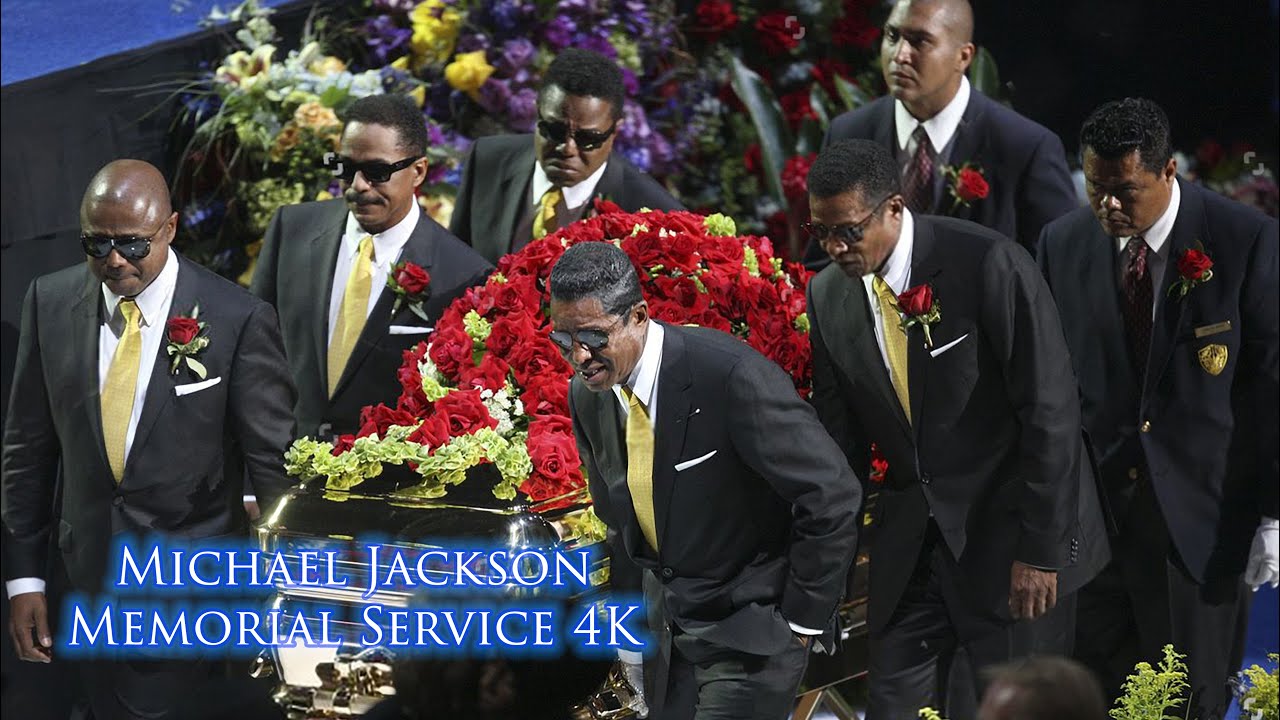
📺 Today’s recommended deep-dive video: https://www.youtube.com/watch?v=nv9KG_F65P4
A Final Moonwalk: Celebrating the Life of the King of Pop
On July 7, 2009, the Staples Center in Los Angeles transformed from a sports arena into a global sanctuary for the “Greatest Entertainer of All Time.” The memorial service bridged the gap between Michael Jackson’s status as a celestial pop icon and his reality as a beloved brother and father.
Core Question: How did Michael Jackson’s memorial service redefine his legacy from a controversial media figure to a unifying global humanitarian and cultural pioneer?
Highlights
- Berry Gordy’s declaration of Jackson as the “greatest entertainer that ever lived” over the “King of Pop” title.
- Reverend Al Sharpton’s powerful argument that Jackson’s cultural impact paved the way for a more inclusive America.
- Personal anecdotes from Brooke Shields and Magic Johnson that humanized the “shy, childlike” man behind the global fame.
- The emotional finale featuring Jackson’s children, ending with Paris Jackson’s first public words about her father.
⏱️ Reading time: approx. 9 minutes · Saves you about 120 minutes vs. watching.
Want to take notes while watching? Click the image below and let AI Notebook capture the key points for you 👇

The Motown Foundation and the Pursuit of Perfection
From Gary to Global Superstardom
Michael Jackson’s professional journey was rooted in a rigorous “code of conduct” established by Berry Gordy at Motown. Gordy shared how a ten-year-old Michael auditioned in 1968, singing Smokey Robinson’s “Who’s Loving You” with a sadness and passion that seemed impossible for a child.
This early discipline turned Michael into a “consummate student” of the greats. He didn’t just study performance; he studied how to “raise the bar and then break the bar,” eventually orbiting into a stratosphere of fame that Gordy claimed he never came down from after the iconic 1983 moonwalk.
The service emphasized that Michael’s professional life was a duality of two distinct personalities. Offstage, he was described as shy, soft-spoken, and almost childlike in his curiosity. However, once he stepped into the spotlight, he transformed into a “take no prisoners” showman who commanded the stage with absolute authority.

💡 Digging Deeper
Q: Why did Berry Gordy initially hesitate to sign the Jackson 5?
A: Gordy already had a child star in Stevie Wonder and felt one was enough for the label until he saw a video of the brothers performing.
Q: How did the competition at Motown affect Michael?
A: Motown was built on a mix of love and competition; the Jacksons frequently engaged in sports like softball against the Gordy family, fostering a drive to be the best.
Tearing Down the “Color Curtain”
A Cultural Shift in America
Reverend Al Sharpton delivered what many considered the most socially significant eulogy of the day. He argued that Michael Jackson’s refusal to accept limitations or boundaries effectively “broke down the color curtain” in the music industry.
By forcing the world to see his videos and put him on magazine covers, Jackson created a “comfort level” across racial lines. Sharpton posited that the generation of children who grew up loving Michael Jackson were the same people who grew up to vote for the first person of color to be the President of the United States.
This sentiment was echoed by the King family, who noted that Michael was a “good samaritan” who supported Coretta Scott King during her illness. His humanitarian efforts, ranging from building burn units to supporting HIV/AIDS research, were presented as the true heartbeat of his life, often ignored by the “mess” of tabloid scrutiny.

💡 Digging Deeper
Q: What specific humanitarian record did Michael Jackson hold?
A: He was in the Guinness Book of World Records for supporting the most charities (39) of any pop star.
Q: What was the significance of the Congressional Resolution mentioned?
A: Congresswoman Sheila Jackson Lee introduced Resolution 600 to officially name Michael Jackson an “American legend and musical icon.”
The Private Michael: Laughter and Loss
Friendships Beyond the Spotlight
Brooke Shields provided a rare glimpse into the “sweetest and purest laugh” she had ever known. She met Michael when she was 13 and he was 20, bonding over their shared experience of being child stars who were forced to be adults very early in life.
They never performed together, but they laughed together, often competing to see who could be sillier. Shields recalled sneaking into Elizabeth Taylor’s room to see her wedding dress, only to find the bride asleep, resulting in a fit of “hysterics” between the two friends.
Magic Johnson also humanized the icon with a story about eating Kentucky Fried Chicken on the floor of Michael’s house. He noted that despite being a global idol, Michael was just a “human being first” who opened doors for African American athletes to have their jerseys in homes across the globe.

💡 Digging Deeper
Q: What was Michael’s favorite song and why?
A: Charlie Chaplin’s “Smile,” because it reflected his philosophy of perseverance despite internal heartache.
Q: How did his brothers honor him during the service?
A: All the Jackson brothers wore a single white sequined glove as a direct tribute to Michael’s signature style.
Key Takeaways
Michael Jackson’s legacy is defined by a relentless pursuit of excellence that permanently altered the landscape of global entertainment. By integrating the techniques of his idols like James Brown and Jackie Wilson with his own innovative vision, he became a benchmark for every artist who followed. The memorial served as a correction to the narrative, shifting focus from his eccentricities back to his unprecedented professional achievements.
Beyond the music, the service highlighted his role as a bridge-builder. His ability to resonate with audiences in Tokyo, Johannesburg, and Birmingham alike showed that his art functioned as a universal language. He didn’t just sell records; he facilitated a global cultural exchange that softened social divisions and paved the way for modern multiculturalism.
Finally, the day reinforced the human cost of such extreme fame. The emotional testimonies from his siblings and the brief, tearful statement from his daughter Paris served as a reminder that behind the “King of Pop” was a man who craved a normal childhood and a father who was deeply loved. His death marked the end of an era of the “mega-star,” leaving a void in both the industry and his family.
Q&A
Q1: What was the significance of the song “Who’s Loving You” during the service?
A1: It was the song Michael used for his Motown audition. Both Berry Gordy and Smokey Robinson noted that Michael sang it with a depth of soul that even Robinson, the songwriter, couldn’t believe a child possessed.
Q2: Who organized the musical performances for the memorial?
A2: The service was directed and produced by Kenny Ortega and Ken Ehrlich. Ortega had been Michael’s partner in creating the “This Is It” tour which was scheduled for London.
Q3: How did the service address Michael’s humanitarian work?
A3: Several speakers, including Sheila Jackson Lee and Bernice King, highlighted his “Heal the World” foundation and his habit of visiting hospitals like Walter Reed to thank soldiers, often without press coverage.
Q4: What was Magic Johnson’s personal takeaway from his friendship with Michael?
A4: Magic credited Michael with making him a better basketball player because watching Michael’s pursuit of greatness on stage inspired him to strive for the same level of excellence on the court.
Q5: Which celebrities performed during the service?
A5: Performers included Mariah Carey (“I’ll be there”), Lionel Richie (“Jesus is Love”), Stevie Wonder, John Mayer, Jennifer Hudson, Usher, and Jermaine Jackson.
Q6: What did Marlon Jackson say about Michael’s daily life?
A6: Marlon spoke about the pain Michael endured from being constantly judged and ridiculed, and his inability to walk across the street without a crowd, expressing hope that Michael would “now be left alone” in peace.
Q7: How did the service conclude?
A7: The service ended with a massive group performance of “We Are the World” and “Heal the World,” followed by the Jackson family’s final tributes, including an emotional statement from Michael’s daughter, Paris.