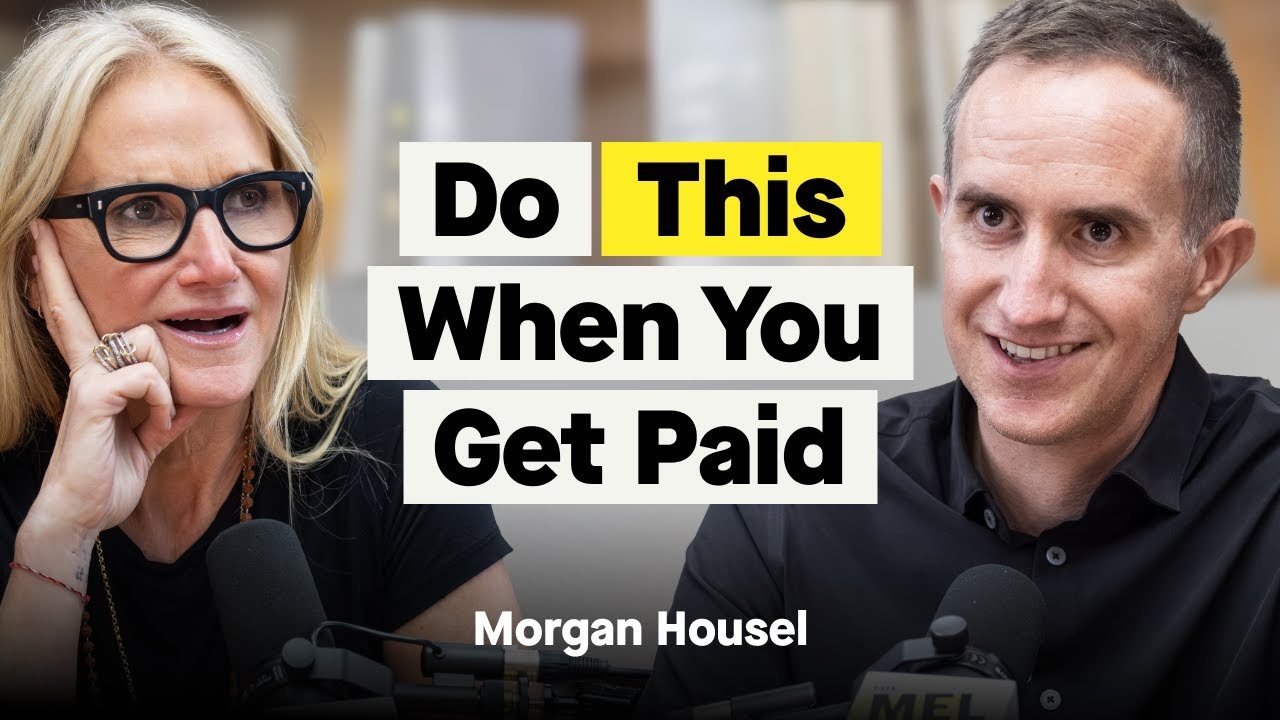
📺 Today’s recommended deep-dive video: https://www.youtube.com/watch?v=Ai4iNmW2A1c
The Psychology of Wealth: Why Your Behavior Matters More Than Your Bank Account
Most people believe that getting rich requires a secret formula, a high-powered degree, or elite connections. In reality, financial success is less about your intelligence and almost entirely about your behavior—how you manage your ego, your expectations, and your time.
Core Question: How can we shift our mindset from chasing status to building the true independence that comes from wealth?
Highlights
- The “Janitor vs. Financier” paradox: Why behavioral discipline beats a Harvard MBA in the long run.
- The Happiness Equation: Why all financial satisfaction is simply the gap between expectations and reality.
- The “Man in the Car” Paradox: Understanding that people admire your possessions to imagine themselves owning them, not to admire you.
- Independence as the Ultimate Flex: Why every dollar saved is a piece of your future that you own.
⏱️ Reading time: approx. 8 minutes · Saves you about 71 minutes vs. watching.
Want to take notes while watching? Click the image below and let AI Notebook capture the key points for you 👇

The Behavioral Frontier of Finance
Why IQ Isn’t the Secret Sauce
Financial success is not a “hard science” like physics or cardiology; it is a soft skill where how you behave is more important than what you know.
While it is impossible for an untrained person to perform heart surgery better than a Harvard-trained surgeon, an ordinary janitor can absolutely outperform a Wall Street executive if the janitor has patience and the executive lacks discipline.
Consider the story of Ronald Read, a gas station attendant and janitor who died with millions of dollars in the bank simply because he saved small amounts and allowed them to compound for decades. This phenomenon only happens in finance because the market doesn’t care about your credentials—it only rewards your ability to leave your money alone and keep your ego in check.

💡 Digging Deeper
Q: Is ignorance the same as a lack of intelligence?
A: No. Housel argues that “ignorance” in finance is often a lack of awareness regarding your own spending and the psychological drivers behind it, rather than a lack of brainpower.
Q: Why do “smart” people go broke?
A: High intelligence often leads to overconfidence, causing people to take massive risks or move the goalposts of their lifestyle faster than their income can keep up.
The Comparison Trap and the Happiness Gap
Moving the Goalposts
The hardest financial skill is getting the goalpost to stop moving.
If your expectations rise in lockstep with your income, you will never feel rich, no matter how much you earn. Modern social media has exacerbated this by expanding our “comparison group” from our immediate neighbors to the curated, top 0.1% of the world.
All happiness is the gap between expectations and reality.
If you earn a million dollars but expected two million, you feel like a failure; if you earn $50,000 but expected $40,000, you feel like a king. The key to financial contentment isn’t just making more money—it’s actively managing your expectations so they don’t spiral out of control.

💡 Digging Deeper
Q: How does the “Man in the Car” paradox work?
A: When you see someone driving a Ferrari, you don’t think “That guy is cool.” You think, “If I were driving that car, people would think I’m cool.” This proves that using money to buy status is often a hollow pursuit.
Q: Why is “Utility” better than “Status”?
A: Utility focuses on what a purchase does for your actual life (comfort, time, joy), whereas status focuses on what a purchase tells strangers who aren’t actually paying attention to you.
Wealth vs. Rich: The Pursuit of Independence
The “Invisible” Nature of True Wealth
Being “rich” is having the current income to buy flashy things, but “wealth” is the money you haven’t spent—it is the optionality and independence sitting in your bank account.
The Vanderbilt family in the 1800s were the richest people on earth, yet they were often miserable because their “wealth” was a psychological liability dictated by social pressure and ostentatious spending. True wealth is the ability to wake up every morning and say, “I can do whatever I want today.”
Every dollar of debt you hold is a piece of your future that someone else owns, while every dollar of savings is a piece of your future that you control.
Saving money isn’t just about buying a car later; it’s about buying “unseen” assets like the ability to leave a toxic job, the cushion to survive a medical emergency, or the peace of mind to sleep through a recession.

The Mechanics of Compounding and Patience
Harnessing the “Hockey Stick” Curve
The secret to Warren Buffett’s $100 billion fortune isn’t just that he’s a good investor; it’s that he has been a consistent investor for over 80 years.
99% of Buffett’s wealth was accumulated after his 60th birthday.
This highlights the counterintuitive nature of compound interest: the biggest gains happen at the very end of the timeline. Most people fail at investing not because they pick the wrong stocks, but because they lack the patience to stay in the market during the “boring” middle years or the “scary” volatile years.
To succeed, you don’t need to be an extraordinary investor; you just need to be an average investor for an above-average period of time.

💡 Digging Deeper
Q: What is the “10% Rule”?
A: No matter how much you earn—even if it’s $50 in tips—save 10% immediately. This builds the habit of treating savings as an “expense” that must be paid first.
Q: Why should we automate our finances?
A: Automation removes human emotion, bias, and social pressure from the equation. If the money moves to savings before you can touch it, you don’t have to exercise willpower.
Key Takeaways
Financial freedom is not a destination reachable only by the wealthy; it is a state of mind achievable by anyone who can decouple their self-worth from their net worth. The ultimate goal of money should be to buy back your time and provide a “margin of safety” for the inevitable surprises of life. By focusing on behavior over intelligence, you move from being a passenger in your financial life to being the driver.
Success requires a fundamental shift in perspective. Instead of asking “What can this money buy me now?” ask “What kind of freedom can this money buy me later?” When you view savings as the purchase of independence rather than the sacrifice of consumption, the act of saving becomes a source of immediate joy rather than a chore.
Q&A
Q1: What is the number one thing that keeps people broke?
A: It is ignorance driven by the desire to keep up with others. People spend money they don’t have to buy things they don’t need to impress people they don’t even like.
Q2: How do you define “enough”?
A: Enough is the point where you stop moving the goalposts. It’s when your satisfaction with what you have grows faster than your desire for more.
Q3: Is it too late for someone in their 40s or 50s to start?
A: Never. While compounding works best over long periods, changing your behavior today—such as lowering expectations and increasing your savings rate—has an immediate impact on your happiness and security.
Q4: Should I always maximize my investment returns?
A: No. You should maximize for “sleeping well at night.” A portfolio that earns 10% but causes you to panic-sell during a crash is worse than a portfolio that earns 7% but allows you to stay calm and invested for 30 years.
Q5: What is the “Cost of Admission” for the stock market?
A: The cost is volatility and uncertainty. You aren’t “losing” money when the market dips; you are paying a fee for the opportunity to have much higher returns in the future.
Q6: How can I stop mindlessly spending?
A: Ask yourself if the purchase falls into the “Happiness/Utility” bucket or the “Status/Strangers” bucket. If it’s just to impress people, put the money into your “Independence” bucket instead.
Q7: Why does Housel recommend checking your bank balance daily?
A: It creates awareness. Many people live in a state of “financial ignorance” where they don’t actually know what is coming in or going out. Awareness is the first step toward behavioral change.