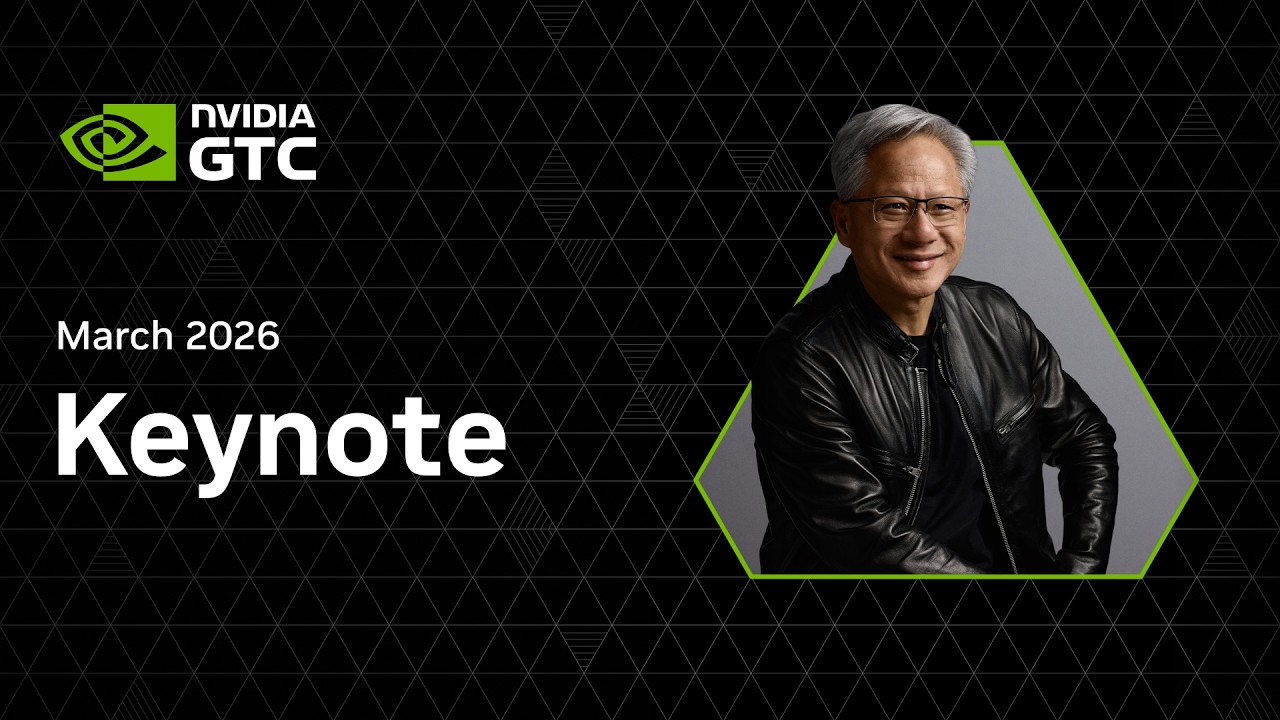
📺 Today’s recommended deep-dive video: https://www.youtube.com/watch?v=jw_o0xr8MWU
The Token Factory: Inside NVIDIA’s $1 Trillion Vision for the Era of Agents
NVIDIA has evolved from a graphics chip designer into the architect of “AI factories,” massive industrial centers that treat intelligence as a manufactured commodity. CEO Jensen Huang outlines a future where every company rents specialized AI agents to amplify human productivity tenfold, powered by an unprecedented leap in computing architecture.
Core Question: How is NVIDIA transforming the global economy from a retrieval-based computing model to a generative, agent-led “Token Factory” future?
Highlights
- The shift to “Agentic” systems where AI doesn’t just answer questions but reasons, plans, and executes complex tasks independently.
- The introduction of the Vera Rubin platform and Groq integration, delivering up to 35x-50x gains in token throughput per watt.
- The emergence of OpenClaw as the open-source “Operating System” for the new era of personal and enterprise AI agents.
- The expansion of physical AI, moving from digital twins in the Omniverse to humanoid robots and “robotaxi-ready” automotive platforms.
⏱️ Reading time: approx. 12 minutes · Saves you about 127 minutes vs. watching.
Want to take notes while watching? Click the image below and let AI Notebook capture the key points for you 👇

The Inference Inflection and the $1 Trillion Pipeline
From Training to Thinking
For years, the AI narrative centered on training—the massive, energy-intensive process of teaching models to understand the world. We are now entering the “Inference Inflection,” where the primary workload of the world’s data centers is no longer learning, but active reasoning.
This shift is monumental. Jensen Huang revealed that NVIDIA now sees a clear path to $1 trillion in revenue visibility through 2027, driven by the fact that every digital interaction is moving toward a generative model.
In the past two years, computing demand has effectively increased by one million times as AI moved from simple perception to reasoning and acting.

💡 Digging Deeper
Q: Why is the “installed base” of CUDA so critical to NVIDIA’s lead?
A: It creates a twenty-year software moat where every new optimization immediately benefits millions of existing GPUs, making NVIDIA the lowest-cost infrastructure over the long term despite high upfront hardware prices.
Q: What does Huang mean by “Tokens are the new commodity”?
A: Just as the industrial revolution manufactured physical goods, the AI revolution manufactures tokens—discrete units of intelligence and data—that can be sold, traded, and used to power every digital service.
Data Alchemy: Building the Modern AI Factory
Accelerating the Ground Truth of Enterprise
Data centers were originally designed as filing cabinets for human-generated files, but the AI factory is a production line for synthetic intelligence. To fuel this, NVIDIA is accelerating “structured data” processing via cuDF and “unstructured data” via cuVS, integrating directly into platforms like IBM Watsonx, Google BigQuery, and AWS.
Structured data is the bedrock of business truth, yet most of the world’s information remains trapped in “dark data” like PDFs and videos.
By using AI to read and index this unstructured information into vector databases, companies can finally query their entire institutional memory. This transformation allows a company like Nestle to refresh its supply chain data five times faster at an 83% lower cost, proving that speed directly translates into massive margin improvements.

💡 Digging Deeper
Q: What is the significance of the IBM partnership?
A: IBM invented SQL, the language of business data; by accelerating Watsonx.data with NVIDIA’s cuDF, they are modernizing the world’s most foundational enterprise computing stacks for the AI era.
Q: How does NVIDIA handle data privacy in the cloud?
A: Through “Confidential Computing,” where even the cloud operator cannot see the data or the AI model, allowing highly sensitive industries like finance to deploy frontier models securely.
The Hardware Leap: Vera Rubin and the Groq Integration
Extreme Co-Design for Token Throughput
The announcement of the Vera Rubin architecture marks a radical departure from traditional chip design toward “system-level” engineering. The new Kyber rack doesn’t just house chips; it connects 144 GPUs into a single massive NVLink domain, cooled by 45-degree hot water to maximize energy efficiency.
NVIDIA is no longer selling chips; it is selling vertically integrated gigawatt-scale factories.
A standout surprise of the keynote was the integration of Groq technology. While NVIDIA’s Rubin handles high-throughput tasks, Groq’s LPU (Language Processing Unit) is used as a specialized “token accelerator” to handle ultra-low-latency “thinking” cycles. This hybrid approach allows the system to generate 700 million tokens per second in a single gigawatt factory—a 350x increase in just two years.

💡 Digging Deeper
Q: Why did NVIDIA integrate Groq’s technology?
A: To solve the “latency vs. throughput” trade-off; Groq’s deterministic SRAM architecture handles high-speed “thinking” better than standard high-memory-bandwidth chips in specific low-latency scenarios.
Q: What is “Vera CPU” designed for?
A: Unlike general-purpose CPUs, the Vera CPU is optimized for “tool use”—the specific single-threaded performance needed when an AI agent needs to browse the web or execute a Python script.
The Agentic Revolution: OpenClaw and Physical AI
The Operating System of the Future
The most profound shift discussed was the rise of “Agentic AI”—systems that use tools, reason through steps, and perform productive work. Huang compared the launch of OpenClaw, an open-source framework for agents, to the historical importance of the internet’s HTML or the mobile era’s Kubernetes.
Every software company is destined to become an “Agentic-as-a-Service” provider.
To ensure these agents can safely navigate corporate networks, NVIDIA introduced NemoClaw and “Open Shell,” providing the security guardrails and privacy routers necessary to prevent an AI from accidentally leaking sensitive financial data while performing a task. This digital intelligence is also crossing over into the physical world, where NVIDIA’s Omniverse acts as a “digital twin” training ground for everything from robotaxis to Disney’s humanoid snowmen.

💡 Digging Deeper
Q: What makes OpenClaw the “Linux of AI”?
A: It provides a standardized, open-source way for agents to handle scheduling, I/O, and tool-calling, preventing any single company from monopolizing the “Agentic Operating System.”
Q: How does the “Disney Olaf” robot relate to industrial AI?
A: The same “Newton” physics solver used to make a toy snowman walk is used to train industrial robots to handle unpredictable, real-world manufacturing environments without human intervention.
Key Takeaways
The overarching theme of GTC is the transition from AI as a chatbot to AI as a workforce. By vertically integrating hardware (Vera Rubin), software (CUDA-X), and the agentic operating system (NemoClaw), NVIDIA has positioned itself as the sole provider capable of building the infrastructure for this new era. The “Token Factory” is the new business model, where the output is not software code or a file, but a stream of intelligent actions.
We are witnessing the “Renaissance of Enterprise IT.” In this future, human workers aren’t replaced, but amplified; every employee will likely have a “token budget” alongside their salary, enabling them to command a small army of digital agents. This is no longer a niche tech shift; it is the total re-architecting of how global industry functions, from the space station to the factory floor.
Q&A
Q1: What is the “Vera Rubin” platform?
A: It is NVIDIA’s next-generation AI supercomputing architecture, succeeding Blackwell. It features liquid cooling, 6th-generation NVLink, and is designed specifically for “Agentic AI” which requires high memory access and rapid tool-use orchestration.
Q2: How does the “Agentic” model differ from ChatGPT?
A: While standard generative AI answers questions, Agentic AI (like Claude Code or OpenClaw) can reason about a problem, break it into sub-tasks, use external tools like web browsers or compilers, and iterate until the task is complete.
Q3: Why is NVIDIA moving toward liquid cooling for its racks?
A: At the scale of a gigawatt data center, air cooling is no longer physically viable or energy-efficient. Liquid cooling allows for much higher compute density and reduces the “wasted power” of the data center, turning more electricity into revenue-generating tokens.
Q4: What is “Sovereign AI”?
A: It refers to a nation’s ability to produce its own intelligence using its own data, culture, and language. NVIDIA is supporting this through the “Nemotron Coalition,” providing open-source models that countries can fine-tune to their specific needs.
Q5: What is the role of the “Omniverse” in robotics?
A: The real world is too dangerous and slow for training robots. The Omniverse provides a “digital twin” where robots can undergo millions of hours of training in a simulated environment that obeys the laws of physics before ever stepping onto a physical factory floor.
Q6: What is the “NVIDIA DSX” platform?
A: DSX is a digital twin blueprint for designing and operating AI factories. it allows engineers to simulate the thermal, electrical, and mechanical performance of a massive data center before it is even built, saving billions in potential delays.
Q7: Will copper cables eventually be replaced by optics in these systems?
A: NVIDIA plans to use both. Copper remains vital for short-range “scale-up” within a rack (like the Kyber rack), while co-packaged optics (CPO) are being introduced for “scale-out” connections between racks to maintain speed over longer distances.