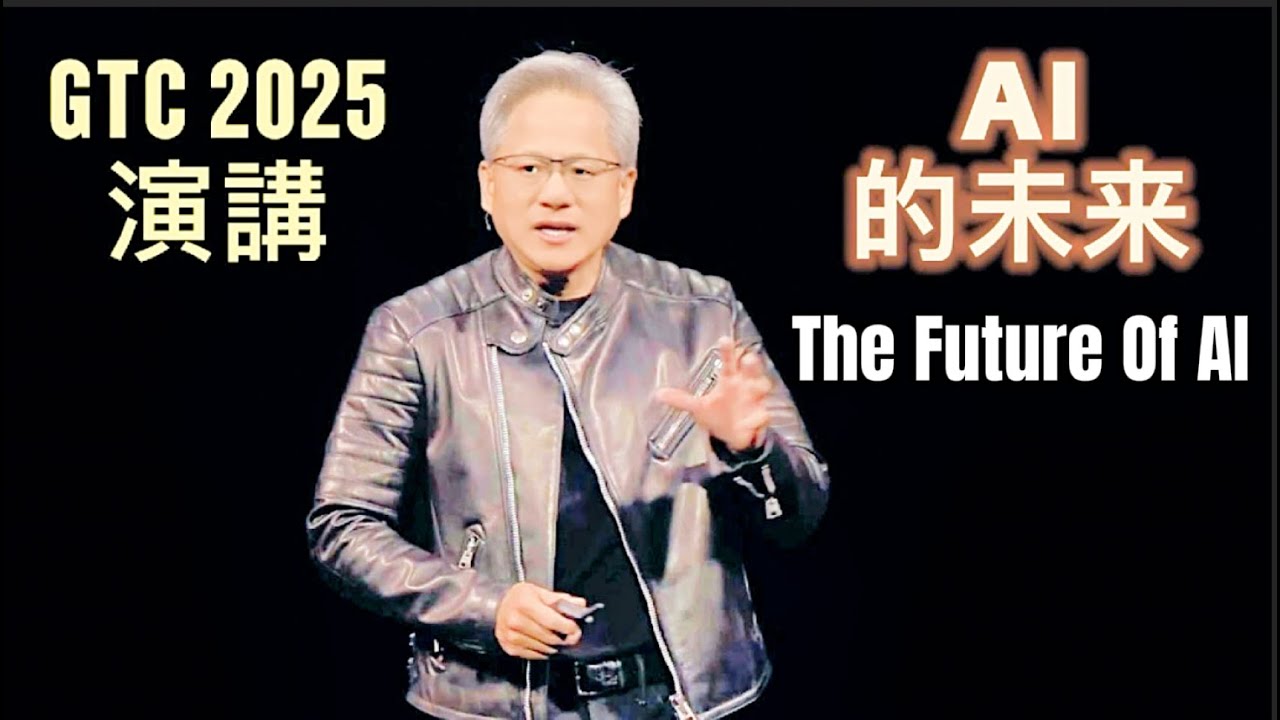
📺 Today’s recommended deep-dive video: https://www.youtube.com/watch?v=eCx4V0lALjg
The Era of AI Factories: NVIDIA’s 900x Leap to the Rubin Architecture
NVIDIA is no longer just a chip company; it is building the foundational engines for the next industrial revolution. From the massive 100x increase in token generation required for reasoning AIs to the astronomical roadmap of the Rubin architecture, Jensen Huang reveals how computing is shifting from data retrieval to the generative production of intelligence.
Core Question: How will NVIDIA’s transition from general-purpose computing to generative AI factories redefine global infrastructure and the nature of human labor?
Highlights
- The transition from retrieval-based computing models to generative AI factories.
- Blackwell’s 100x token generation requirement for advanced agentic reasoning.
- The introduction of the Rubin roadmap, promising a 900x jump in scale-up flops by 2026.
- NVIDIA Dynamo: The new open-source operating system designed for AI infrastructure.
⏱️ Reading time: approx. 12 minutes · Saves you about 92 minutes vs. watching.
Want to take notes while watching? Click the image below and let AI Notebook capture the key points for you 👇

From Pixels to Reasoning: The AI Inflection Point
The Rebirth of GeForce and the Path to Blackwell
GTC began with GeForce, and twenty-five years later, the GeForce 5090 represents a pinnacle of miniaturization and energy efficiency. While it is 30% smaller than the 4090, its true power lies in AI-driven graphics, where neural networks now predict 15 out of every 16 pixels rendered. This isn’t just a hardware upgrade; it is a fundamental shift in how visual reality is constructed through temporal stability and deep learning.
Generative AI has fundamentally altered the computing stack, moving us away from a retrieval-based model where we fetch pre-stored data. In the old world, computers were libraries; in the new world, they are factories that understand context and meaning to generate entirely new answers. This transition requires every layer of the computing stack—from the silicon to the libraries—to be reinvented for a world where machine learning software runs on specialized accelerators rather than hand-coded software on general-purpose CPUs.
💡 Digging Deeper
Q: Why is the shift from retrieval to generative computing so significant?
A: Retrieval fetches pre-made content, whereas generative computing creates custom answers in real-time based on context, reducing the need for massive storage while increasing the need for massive real-time computation.
Q: How does AI assist in modern graphics rendering?
A: Through path-tracing, AI predicts 15 pixels for every 1 pixel rendered mathematically, ensuring temporal accuracy and visual stability at a fraction of the traditional computational cost.
Q: What defines the “Agentic AI” wave?
A: It is the shift toward AIs that can perceive context, reason through multi-step problems, use external tools like websites, and plan actions autonomously rather than just generating text.
The 100x Challenge: Solving for Inference and Data
Scaling Laws and the Token Explosion
We are witnessing a massive acceleration in the amount of computation required for AI, driven primarily by the emergence of reasoning models. Unlike early LLMs that provided “one-shot” answers, reasoning AIs use a “Chain of Thought” approach, breaking problems down step-by-step and performing consistency checks. This process generates significantly more tokens—often 100 times more than previous models—to ensure the answer is not just fast, but mathematically and logically correct.
To train these models without being limited by human input, we use reinforcement learning and synthetic data generation. By providing an AI with millions of examples of solved problems—like geometry or logic puzzles—we allow it to learn at superhuman rates. However, this creates a data center challenge: we are moving into a power-limited industry where every watt must be optimized to maximize token throughput for the highest possible quality of service.

💡 Digging Deeper
Q: What is “Chain of Thought” processing?
A: It is a technique where the AI generates intermediate reasoning steps before arriving at a final answer, allowing it to solve complex logic and math problems that one-shot models fail.
Q: Why is synthetic data generation necessary?
A: Human-generated data is finite; synthetic data allows AIs to learn from trillions of tokens generated through robotic simulations and verifiable mathematical outcomes, accelerating learning beyond human limits.
Q: How does NVIDIA define an “AI Factory”?
A: An AI factory is a data center with one job: taking raw data in and producing valuable “intelligence tokens” out, functioning much like a power plant producing electricity.
The Roadmap to 900x: Blackwell to Rubin
Scaling Up Before Scaling Out
The Blackwell architecture represents a transition to extreme scale-up computing, featuring 130 trillion transistors and the NVLink 72 rack. By disaggregating the switch and moving to full liquid cooling, NVIDIA has compressed an entire exaflop of compute into a single rack. This isn’t just about packing more chips; it’s about creating a unified, 3,000-pound supercomputer that acts as a single, massive GPU to handle the intense bandwidth requirements of reasoning models.
Looking forward, the roadmap is aggressive: Blackwell Ultra in late 2025, followed by the Rubin architecture in 2026. Rubin will feature HBM4 memory and the new NVLink 6, pushing scale-up performance to 900 times that of the original Hopper architecture. This relentless pace—moving from a two-year cycle to a one-year cycle—is designed to ensure that data center operators can plan their multi-billion dollar capital expenditures with total transparency and predictable gains in efficiency.

💡 Digging Deeper
Q: What is the difference between “scaling up” and “scaling out”?
A: Scaling up involves making a single machine or rack more powerful through tight integration (like NVLink), whereas scaling out involves connecting many separate machines together via a network (like Ethernet).
Q: Why is NVIDIA moving to a one-year product cadence?
A: AI infrastructure requires years of planning for land, power, and capital; a predictable annual roadmap allows partners to build these “Gigafactories” without being surprised by sudden technology shifts.
Q: What makes the Rubin architecture unique compared to Blackwell?
A: Rubin introduces brand-new GPUs, CPUs (Vera), and networking (CX9), utilizing HBM4 to drastically increase memory bandwidth and reduce the cost per token generated.
The Future of Connectivity and Enterprise AI
Silicon Photonics and the Digital Twin
As we scale to millions of GPUs, traditional electrical cabling becomes a bottleneck for both cost and power. NVIDIA is introducing the world’s first 1.6-terabit-per-second Silicon Photonic system, utilizing Micro Ring Resonators (MRM) to modulate light. This technology eliminates the need for power-hungry transceivers, potentially saving 60 megawatts of power in a large-scale data center—energy that can now be redirected into pure computation.
In the enterprise space, the goal is to integrate these capabilities into every industry through “Digital Twins” and AI agents. By simulating entire factories in NVIDIA Omniverse before they are built, companies can optimize their TCO and cooling systems in a virtual world. Whether it’s GM revolutionizing autonomous vehicle safety or T-Mobile building AI-driven radio networks, the future of the enterprise is a semantic one, where storage is no longer just a place to keep files, but a living body of knowledge you can talk to.

💡 Digging Deeper
Q: What is Silicon Photonics?
A: It is a technology that uses light (photons) instead of electricity (electrons) to transfer data between chips, allowing for much higher speeds and significantly lower power consumption at scale.
Q: How does NVIDIA Dynamo function as an “Operating System”?
A: Dynamo manages the complex orchestration of reasoning workloads, routing data between different GPUs and managing memory hierarchies so the data center acts as a single fluid machine.
Q: What is semantic storage?
A: Instead of searching for a specific filename, semantic storage uses AI to “embed” the meaning of data, allowing users to ask natural language questions of their entire database to retrieve answers.
Key Takeaways
The fundamental shift in the global economy is the transition from general-purpose computing to the generative AI factory. NVIDIA has moved beyond being a semiconductor provider to becoming a full-stack infrastructure architect. By integrating silicon, liquid cooling, high-speed interconnects, and complex software libraries like CUDA-X and Dynamo, they have created a platform that treats a whole data center as a single unit of compute.
This new industrial revolution is driven by the scaling laws of reasoning. As AIs move from simple chatbots to autonomous agents capable of physical reasoning and complex planning, the demand for “intelligence tokens” will grow exponentially. The jump from Hopper to Rubin represents a 900-fold increase in capability, signaling that the limits of AI are nowhere near reached, and the infrastructure of the future will be defined by its ability to generate wisdom, not just store data.
Finally, the democratization of this technology through partnerships with Dell, HP, Cisco, and global CSPs ensures that AI will not remain confined to the cloud. From DGX workstations for researchers to AI-integrated radio networks at the edge, every industry is being retooled. The ultimate goal is a world of digital twins and autonomous agents, where every human worker is assisted by a digital counterpart, supercharging global productivity.
Q&A
Q1: What is the significance of the GeForce 5090 Blackwell generation?
A: It represents 25 years of GeForce evolution, being 30% smaller than the 4090 while using AI to predict nearly all the pixels rendered, making path-traced graphics faster and more stable.
Q2: Why does agentic AI require 100 times more computation?
A: Because agentic AI uses reasoning and “Chain of Thought” processing, which involves generating thousands of internal tokens for planning, checking, and iterating before providing a final answer to the user.
Q3: How does NVIDIA Dynamo improve AI factory operations?
A: Dynamo is an open-source operating system that manages the “KV cache” and routes workloads across GPUs, optimizing the tension between response speed (latency) and the total number of users (throughput).
Q4: What is the roadmap for the next three years?
A: NVIDIA will release Blackwell Ultra in 2025, the Rubin architecture with HBM4 in 2026, and Rubin Ultra in 2027, maintaining a consistent one-year release cycle.
Q5: How does Silicon Photonics solve the data center power problem?
A: By using Micro Ring Resonators to modulate light directly, it eliminates the need for traditional electrical-to-optical transceivers, saving tens of megawatts that can be used for more GPUs.
Q6: What is a “Digital Twin” in the context of an AI factory?
A: It is a complete 3D virtual replica of a data center created in NVIDIA Omniverse, allowing engineers to simulate cooling, power usage, and component layout before physical construction begins.
Q7: How is NVIDIA changing the way we interact with data storage?
A: Storage is moving from a retrieval-based model to a semantic-based model, where data is continuously processed by GPUs so that users can “talk” to their data and get answers instead of just finding files.