📺 Today’s recommended deep-dive video: https://www.youtube.com/watch?v=r9MxvE6SpQo
Minimal Assumptions, Maximum Efficiency: A Breakthrough in Offline Reinforcement Learning
Most offline reinforcement learning algorithms rely on overly restrictive assumptions like all-policy coverage or Bellman completeness. This work introduces ProRL, a primal-dual approach that achieves sample efficiency using only the most fundamental requirements for realizability and data coverage.
Core Question: Can we achieve polynomial sample complexity in offline RL using only realizability and single-policy coverage?
Highlights
- Introduces the ProRL algorithm based on a regularized primal-dual linear programming formulation.
- Eliminates the need for “all-policy” coverage, focusing only on covering the optimal policy.
- Removes the Bellman completeness requirement, relying instead on basic function class realizability.
- Provides theoretical proof of polynomial sample complexity, bridging the gap between theory and practical DICE-style algorithms.
⏱️ Reading time: approx. 6 minutes · Saves you about 17 minutes vs. watching.
Want to take notes while watching? Click the image below and let AI Notebook capture the key points for you 👇

The Bottlenecks of Traditional Offline RL
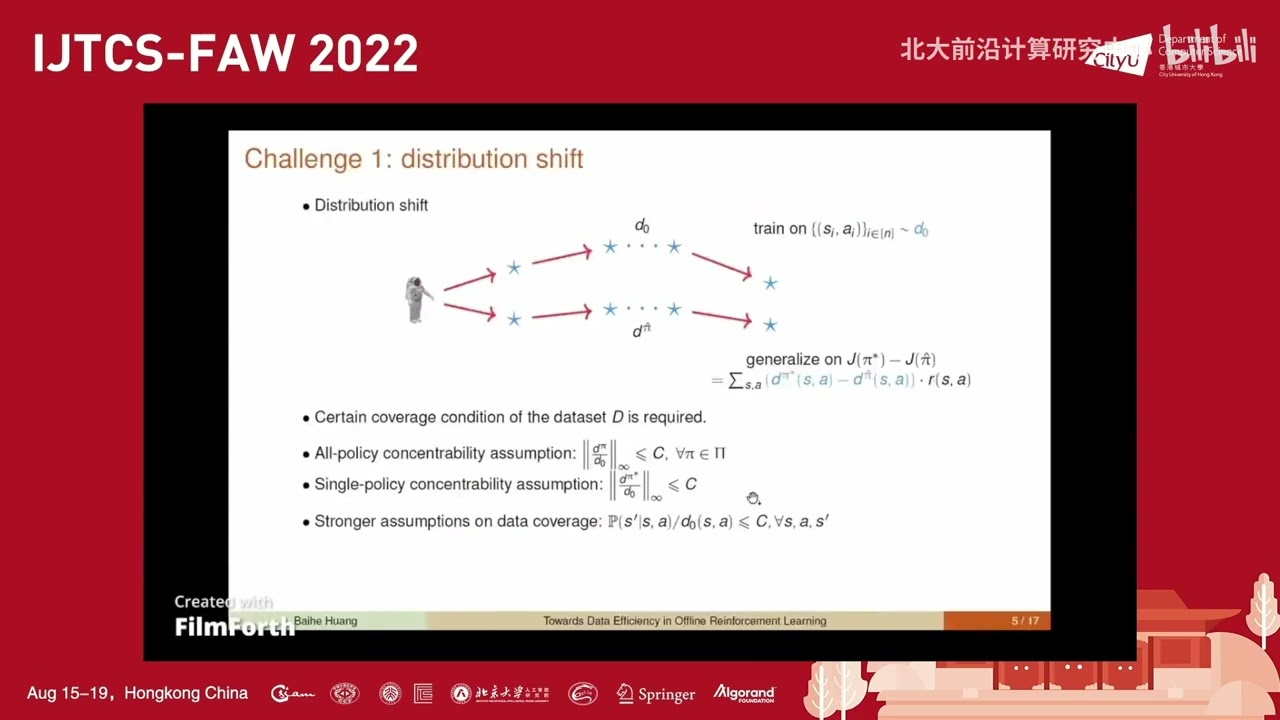
The Challenge of Distribution Shift
Offline Reinforcement Learning (RL) is a promising paradigm where agents learn from fixed datasets without costly real-world interactions.
However, two major hurdles persist: distribution shift and function capacity. Because the agent generalizes to policies not present in the training data, researchers usually assume “all-policy coverage”—meaning the data covers every possible outcome. They also rely on “completeness,” assuming function classes can perfectly represent every iteration of the Bellman backup, which is often unrealistic in complex environments.
This talk challenges those stringent requirements. By shifting the focus to realizability and single-policy concentrability, the researchers aim to provide a more robust theoretical foundation for data-efficient learning.

💡 Digging Deeper
Q: Why is “all-policy coverage” considered a strong assumption?
A: It requires the behavior policy to visit every state-action pair that any possible policy might visit, which is rarely feasible in large-scale or real-world datasets.
Q: What is Bellman completeness?
A: It is the assumption that a function class is rich enough to contain the results of applying a Bellman operator to any function within that class.
Q: How does this work define “realizability”?
A: Realizability means the function class is rich enough to approximate the specific target value function or occupancy measure required for optimality.
The ProRL Framework: Primal-Dual Regularization
Linear Programming for MDPs
The core of the ProRL algorithm lies in formulating reinforcement learning as a linear programming problem.
By adding an F-divergence regularizer, the model penalizes deviations from the behavior policy, essentially forcing the learner to remain conservative within the bounds of the provided data. This regularization is critical for managing the distribution shift that typically plagues offline estimators.
The algorithm uses a Lagrange multiplier to transform the LP into a minimax objective that can be estimated directly from the offline dataset. By introducing a density ratio parameter, the researchers rewrite the objective such that expectations are taken over the known data distributions, allowing for unbiased estimation without needing to actively sample the environment.

Theoretical Results and Sample Complexity
Achieving Polynomial Efficiency
The primary result of this work is a guarantee of polynomial sample complexity under minimal assumptions.
Specifically, the researchers show that if the function classes for the value and density ratio are rich enough to contain the optimal solutions—a concept known as realizability—the algorithm will converge. Unlike previous models, this does not require every intermediate Bellman step to be representable, which significantly lowers the barrier for practical implementation in high-dimensional state spaces.
While the current convergence rate of epsilon to the negative sixth power is slightly slower than the theoretical ideal seen in completeness-based studies, it represents a massive leap forward in theoretical reliability for algorithms that don’t rely on those heavy assumptions.

Key Takeaways
ProRL proves that efficiency is possible without demanding that our training data covers every possible state-action pair.
By leveraging the primal-dual formulation and F-divergence regularization, the framework offers a theoretically sound explanation for why “DICE-type” algorithms work in practice. It shifts the burden of proof from the entire policy space to just the optimal policy and the function class’s own capacity to represent its best version.
This work sets the stage for more data-efficient AI. By narrowing the gap between theoretical requirements and practical constraints, we move closer to deploying RL in high-stakes fields like robotics and autonomous driving where data is finite and exploration is dangerous.
Q&A
Q1: What is single-policy concentrability?
A: It is a coverage condition that only requires the offline dataset to sufficiently cover the states and actions that would be visited by the optimal policy, rather than all possible policies.
Q2: Why is realizability considered a “necessary” assumption in RL?
A: Without realizability, the function class might not even be capable of representing the optimal solution, making it impossible to find an accurate policy regardless of how much data you have.
Q3: What is the main advantage of ProRL over previous methods?
A: It removes the need for Bellman completeness and all-policy coverage, which are often cited as the most restrictive and unrealistic assumptions in offline RL theory.
Q4: How does the regularizer help the algorithm?
A: The F-divergence regularizer forces the learned policy to stay relatively “close” to the data distribution, which helps mitigate the errors caused by distribution shift.
Q5: What is the trade-off in convergence rate?
A: The convergence rate is $O(epsilon^{-6})$, which is theoretically slower than the $O(epsilon^{-2})$ achieved under stronger assumptions, but it is much more robust.
Q6: Can this be used if we don’t know the behavior policy?
A: Yes, the algorithm uses behavior cloning to estimate the behavior policy from the data, which is then used in the primal-dual objective.
Q7: Where does this research fit in the current RL landscape?
A: It provides a strong theoretical foundation for DICE-style (Dual Instrumented Contour Estimation) algorithms, which are popular in modern practical RL research.