📺 Today’s recommended deep-dive video: https://www.youtube.com/watch?v=cwSXDr7XkNc
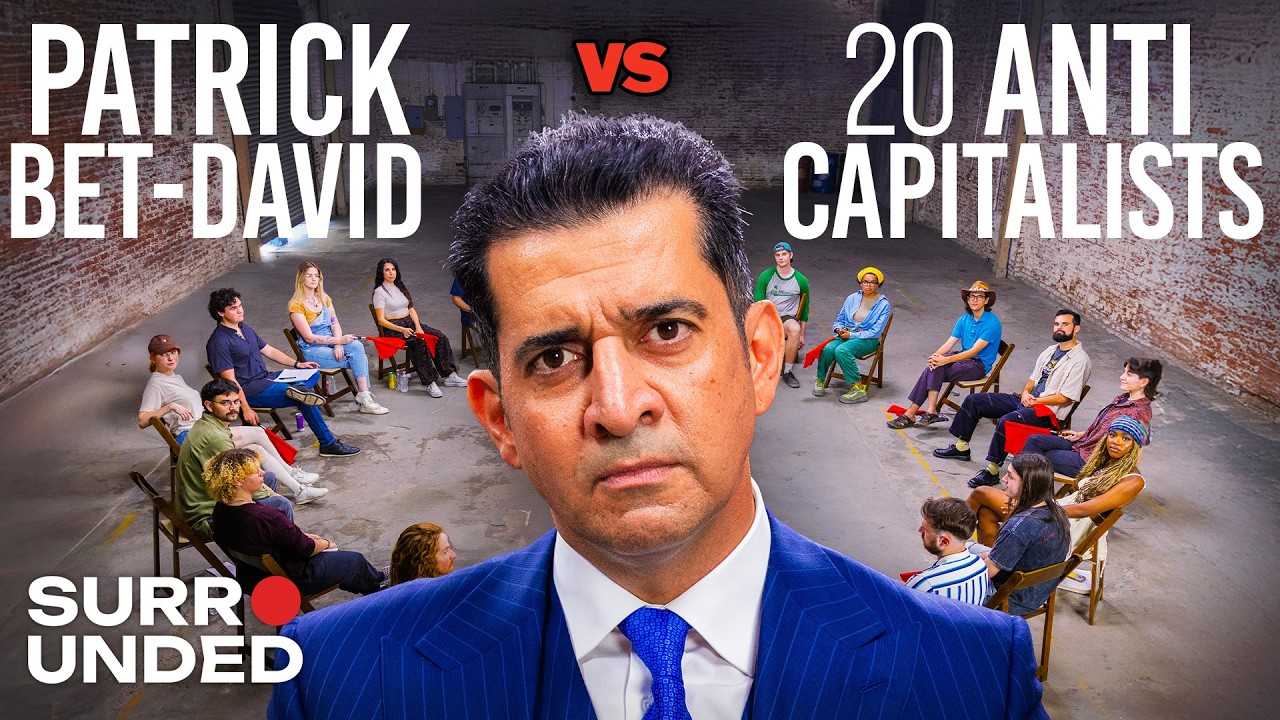
Capitalism on Trial: PBD vs. The 20 Anti-Capitalists
A high-stakes ideological clash erupts as entrepreneur Patrick Bet-David faces off against twenty vocal critics to debate the merits of the free market. From the ethics of the healthcare industry to the “largely socialist” reality of the modern American budget, this conversation strips away political niceties to explore the core of the American Dream.
Core Question: Is capitalism the ultimate engine of human progress, or is it a coercive system that thrives on manufactured scarcity and exploitation?
Highlights
- The role of incentive: Does scarcity drive innovation, or is intrinsic passion enough to sustain a society?
- The healthcare paradox: A debate on whether life-saving medicine should be subject to market profit motives.
- The “Victim” Narrative: PBD challenges the mindset of struggling workers through a live job offer and a critique of “selectivity.”
- The Socialist Reality: A data-driven look at how entitlement spending defines the current US economy.
⏱️ Reading time: approx. 8 minutes · Saves you about 96 minutes vs. watching.
Want to take notes while watching? Click the image below and let AI Notebook capture the key points for you 👇

The Engine of Human Incentive
Scarcity vs. Intrinsic Motivation
The debate opens with a fundamental disagreement on what forces a human being out of bed in the morning to produce value for the world. While Patrick Bet-David argues that incentive is the irreplaceable engine of capitalism, his critics suggest that intrinsic motivation and community contribution are the true drivers of human effort. This clash highlights a deep philosophical rift regarding whether scarcity is a necessary pressure for progress or a cruel tool of systemic coercion.
If you remove the primary reward for risk and individual effort, the entire economic engine eventually grinds to a halt and loses its competitive edge.
Critics like Mason argue that single mothers working four jobs aren’t being “incentivized” by a fair system; they are being terrorized by the threat of starvation. They suggest that humans naturally want to be meaningful and that depression often stems from an inability to contribute rather than a lack of monetary greed. Bet-David counters that while survival is the base level of incentive, higher levels like status, freedom, and legacy are what drive the outliers who build the massive infrastructures that support society.

💡 Digging Deeper
Q: Is the profit motive the only way to spark innovation?
A: Critics argue technological breakthroughs often come from research grants and passion, while PBD insists that the scale of American innovation is due to the accumulation of capital and the reward for risk.
Q: Does capitalism require an “underclass” to function?
A: The anti-capitalist view suggests the system forces people into insecure positions to maintain a cheap labor pool, whereas the capitalist view sees poverty as a temporary starting point that can be overcome through market value increases.
The Healthcare and Poverty Paradox
Market Efficiency or Perverse Incentives?
One of the most contentious points in the dialogue centers on the American healthcare system and its reliance on the profit motive. Hunter, an anti-capitalist, argues that healthcare represents “inelastic demand”—because you cannot put a finite price on your life, the market cannot function fairly. He points to the staggering statistic that 66.5% of US bankruptcies are tied to medical debt, suggesting that the drive for profit in medicine is inherently perverse and leads to worse outcomes for the majority.
Innovation in life-saving drugs like blood thinners only exists because someone had the capitalistic drive to solve a problem for a profit.
However, Bet-David points to a different metric of success: the line of people trying to enter the country. He argues that despite the flaws in the system, America remains the destination for those seeking the best care and the most advanced medical solutions. He suggests that the high cost of healthcare is less a failure of the market and more a failure of government mismanagement and over-regulation that chokes out smaller, more efficient competitors.
💡 Digging Deeper
Q: Why did PBD use the China banking example?
A: To show that China’s poverty reduction was actually fueled by adopting capitalist mechanisms, like expanding from one nationalized bank to thousands of competing local banks.
Q: Who truly pays for the American system?
A: Bet-David notes that the top 1% of earners pay roughly 42% of all federal income taxes, while the bottom 50% contribute only about 2%.
The Myth of Meritocracy and the “Victim” Mindset
The Selective Struggle
The conversation takes a personal turn when James, a worker from rural Texas, claims he has applied for nearly 500 jobs without a single callback, citing his lack of a degree and his geographic location as insurmountable barriers. Bet-David offers him an immediate interview and a potential job in Florida, but the interaction sours when James begins to ask for specific wage guarantees and company details. PBD uses this as a case study for why many remain in poverty: a combination of a “victim mentality” and being too selective when they lack market leverage.
Success isn’t just about what you are given; it is about the capacity you reach through your own grit and refusal to make excuses.
This section highlights the massive divide in how the two sides view “winning.” To the anti-capitalists, the race is rigged because some start inches from the finish line while others start miles back. To the capitalist, the starting point is irrelevant compared to the trajectory. Bet-David argues that even if all wealth were divided equally today—roughly $62,500 per person—it would return to the same pockets within five years because of the habits, contacts, and market value of the individuals involved.

💡 Digging Deeper
Q: Can a meritocracy exist with generational wealth?
A: Mason argues no, because influence is inherited. PBD argues yes, because even “dynasties” eventually fail if the next generation lacks the merit to maintain the wealth.
Q: Is a $27/hour minimum wage viable?
A: Critics argue it’s a “livable” necessity. PBD argues it kills small businesses that can’t afford the overhead, effectively handing a monopoly to giants like Amazon and Walmart.
Defining the Modern American State
The Entitlement Budget
The final segment of the debate challenges the very label of the United States as a capitalist nation. Bet-David makes the provocative claim that the U.S. is “largely socialist” today, pointing to the fact that approximately 68% of federal tax revenue is funneled into entitlement programs like Social Security and Medicare. He argues that when the government dictates such a massive portion of the economy, the “free” in free market begins to disappear under the weight of taxation and regulation.
We are currently living in a system where the government has become a silent, controlling partner in every business and household in America.
The anti-capitalists counter that this is a misuse of the term “socialism,” which they define strictly as worker ownership of the means of production. They argue that subsidies for billionaires like Elon Musk are the real “handouts” and that the current system is actually a “private dictatorship” of the investor class. The debate concludes with a warning about the sustainability of Social Security, as PBD notes that the ratio of workers to retirees has shifted so dramatically that the math of the 1930s no longer supports the reality of the 2020s.

💡 Digging Deeper
Q: Is the U.S. a “monopsony”?
A: Mason argues that large employers like Walmart act as the “sole buyer” of labor in small towns, allowing them to suppress wages below market value.
Q: What would a “wealth tax” look like?
A: Critics propose a cap on wealth at $999 million, while PBD argues this would cause a mass exodus of job creators, leaving the middle class to foot the bill for a bloated government budget.
Key Takeaways
The debate serves as a microcosm of the current American political divide. On one side is the belief that the system is fundamentally broken, built on exploitation, and in need of a radical shift toward collective ownership and guaranteed rights. On the other is the conviction that capitalism, despite its flaws, is the only system that aligns with human nature by rewarding effort, fostering innovation, and providing a path for the “overachiever” to rise from nothing.
The most striking moment of the dialogue was the friction between systemic theory and individual agency. While the critics focused on the “guardrails” and “traps” of the economy, Bet-David focused on the “gift” and the “choice.” The data on entitlement spending suggests that the U.S. is indeed in a transitionary period, struggling to balance its capitalist roots with a growing social safety net that threatens to outpace its revenue.
Ultimately, the discussion underscores a lack of common language. When one side sees “incentive” and the other sees “coercion,” the path to a united America remains obscured. The real test of these theories will likely play out in the coming decade as the fiscal realities of Social Security and the competitive pressures of a global market force the U.S. to choose between its history of rugged individualism and a future of state-managed equity.
Q&A
Q1: Does Patrick Bet-David believe that poor people are just “lazy”?
A1: No. He explicitly states that while there are lazy poor people, there are also many hardworking poor people who simply haven’t found the right path or information to increase their market value.
Q2: What is the “68% statistic” mentioned regarding the US budget?
A2: PBD claims that 68% of the revenue the US government brings in through taxes is spent on entitlement programs like Social Security and Medicare, which he uses to argue that the US is functionally more socialist than capitalist.
Q3: How does PBD justify the top 1% paying fewer taxes in some cases?
A3: He argues that the top 1% already pays a disproportionate amount (42% of total tax revenue) and that providing them with incentives helps keep them in the country to continue creating jobs.
Q4: What was the critique of the “Daily Beast” article?
A4: A critic cited an article claiming PBD makes more from recruitment than insurance sales. PBD challenged this, inviting the critic to be careful with “defamation” and noting that his company’s value was recently validated by a “Quality of Earnings” report by a major firm (PWC).
Q5: Why does PBD oppose a higher national minimum wage?
A5: He believes it acts as a tool for big corporations like Amazon to wipe out small businesses that cannot afford to pay the higher rates, thereby reducing competition and choice for workers.
Q6: What is the capitalist response to the high cost of healthcare?
A6: PBD argues that innovation costs money and that market-driven solutions (like blood thinners) save more lives long-term than state-run systems that might stifle research and development.
Q7: How did PBD respond to the claim that the US is not a meritocracy?
A7: He acknowledged that while not everyone has an equal starting point, the “race” is about reaching one’s personal capacity, and the system still allows for massive social mobility for those who increase their value to the market.