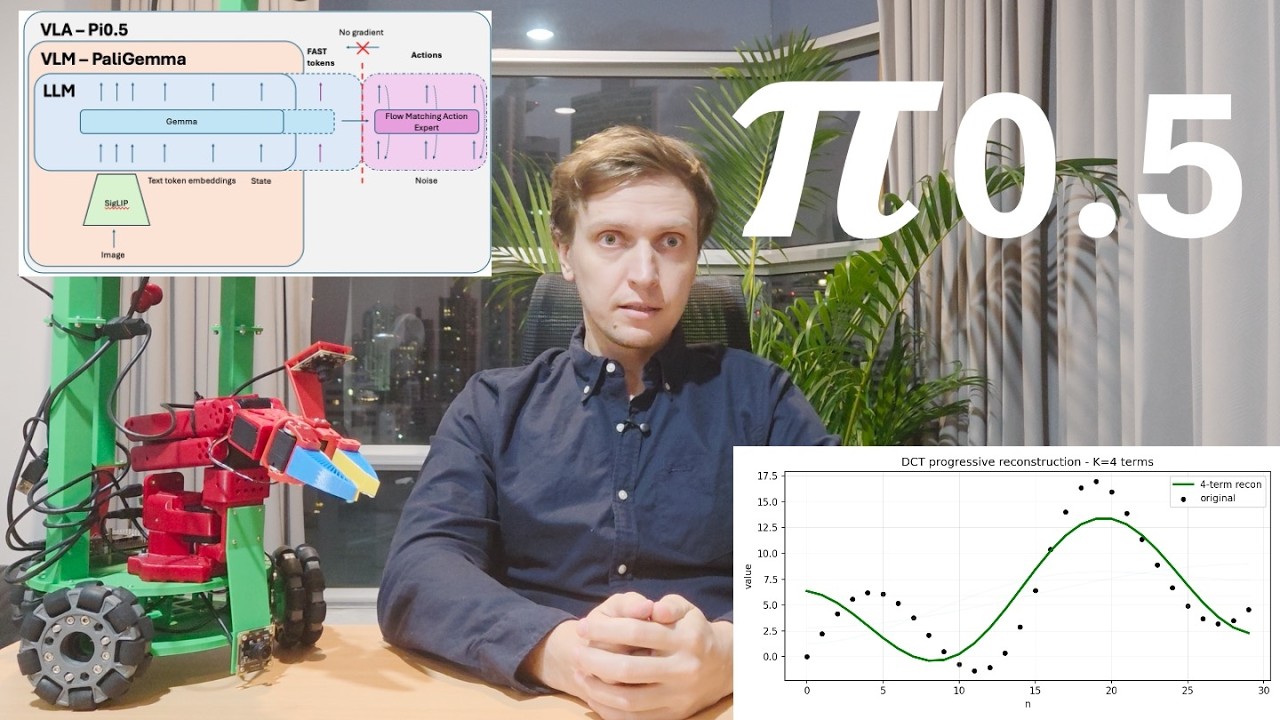
📺 Today’s recommended deep-dive video: https://www.youtube.com/watch?v=QgGhK1LaUe8
Pi 0.5 Deep Dive: The State of Open-Source VLA Policies
Moving beyond basic robotic control, Pi 0.5 integrates advanced tokenization and reasoning hierarchies to bridge the gap between language and physical action. This latest iteration from Physical Intelligence provides a robust, scalable framework for general-purpose robotic tasks in complex environments.
Core Question: How does Pi 0.5 leverage FAST tokenization, knowledge insulation, and dual-system reasoning to achieve state-of-the-art performance in open-source robotics?
Highlights
- FAST tokenization uses Discrete Cosine Transform to compress 30 action numbers into just six meaningful tokens.
- Knowledge insulation prevents “catastrophic forgetting” by blocking noisy gradients from reaching the pre-trained VLM.
- The system utilizes a dual-engine approach, splitting logic into high-level reasoning (System 2) and low-level execution (System 1).
- Real-time action chunking uses inpainting to eliminate robot “shaking” and ensure smooth, continuous trajectories.
⏱️ Reading time: approx. 8 minutes · Saves you about 46 minutes vs. watching.
Want to take notes while watching? Click the image below and let AI Notebook capture the key points for you 👇

The Evolution from Pi 0 to Pi 0.5
A Shared Architectural Foundation
Pi 0.5 isn’t a radical departure but a refined integration of its predecessor’s best features, maintaining a core architecture comprising a Vision-Language Model (VLM) and a specialized action expert. It utilizes the Gemma LLM and SigLIP visual backbone to interpret the world and generate commands.
Fundamentally, the high-level schema remains consistent, though the implementation now allows the model to predict both discrete FAST tokens and continuous action chunks simultaneously during training.
Small adjustments to the attention masks and the logic behind how noisy actions feed into the flow-matching process have been implemented, yet the core innovation lies in the synergy of these components. By using both FAST and flow matching, the system benefits from the speed of discrete tokenization during training and the dexterity of continuous control during execution, making it a more versatile policy for complex household tasks like doing dishes or cleaning bedrooms.

💡 Digging Deeper
Q: Is Pi 0.5 a completely new model architecture?
A: No, it is a significant iteration of Pi 0 that uses the same VLM/LLM backbone but changes how training and action outputs are handled.
Q: Why use both FAST and Flow Matching?
A: FAST is five times faster during training from scratch, while Flow Matching typically provides better dexterity during real-time inference.
The Magic of FAST Tokenization
Compressing Motion into Math
FAST solves the persistent problem of representing robotic actions by combining Discrete Cosine Transform (DCT) with Byte Pair Encoding (BPE) for extreme data compression.
Think of this like a progressive JPEG; when an image loads on a slow connection, you first see a blurry gray shape that gradually gains detail. FAST treats robotic actions as signals, decomposing them into a series of cosine functions with varying frequencies. By predicting only the first few coefficients, the model can reconstruct a smooth, accurate action trajectory without needing to output every single coordinate point individually, which drastically reduces the computational burden.
However, this efficiency depends heavily on the smoothness of the input data. If the trajectory contains high-frequency noise—often introduced by improper normalization—the compression breaks down, as the model must then account for chaotic oscillations that offer no meaningful signal to the robot’s physical movement.

💡 Digging Deeper
Q: How much data compression does FAST actually achieve?
A: In many cases, it can compress 30 raw action numbers down to just six tokens while maintaining a nearly perfect reconstruction of the original trajectory.
Q: Can I use the FAST tokenizer for my own robotic projects?
A: Yes, Physical Intelligence has released the FAST tokenizer on Hugging Face as a standalone tool that can be integrated into other VLA models.
Knowledge Insulation and Dual-System Reasoning
Protecting the Model’s “Brain”
Training a VLA from scratch often leads to “catastrophic forgetting,” where the model loses its pre-trained language knowledge due to noisy gradients from the action expert. Knowledge insulation fixes this by blocking the backpropagation of gradients from the action expert to the VLM, ensuring the model’s fundamental reasoning remains intact while the robot-specific parts learn.
Physical Intelligence claims this technique results in a fivefold increase in training speed for models built from the ground up, though its impact on simple fine-tuning is less pronounced.
To handle complex, multi-step tasks, Pi 0.5 employs a “System 1 and System 2” approach inspired by Daniel Kahneman. System 2 uses the VLM to decompose a broad request—like “clean the kitchen”—into a sequence of smaller sub-tasks. These sub-tasks are then passed to System 1, which acts as the reactive engine, executing the high-frequency physical movements required to carry out each specific command without needing to rethink the entire plan at every step.

💡 Digging Deeper
Q: Does Knowledge Insulation help when just fine-tuning a model?
A: Not significantly; it is primarily designed to speed up the initial training phase where the action expert is entirely random and noisy.
Q: What is the frequency difference between System 1 and System 2?
A: System 1 (Action) usually runs at high frequencies like 50Hz, while System 2 (Reasoning) may only run once every few seconds or when a task change is needed.
Smoothing Action with Real-Time Chunking
Solving the “Shaking” Problem
A common issue in chunk-based robotics is the “shaking” effect caused by the robot freezing momentarily while the model computes the next batch of actions.
Real-time action chunking (RTC) resolves this by using inpainting logic to overlap consecutive chunks during inference. By starting the prediction of the second chunk while the first is still being executed, and forcing the first few steps of the new chunk to match the current movement, the system ensures a perfectly smooth transition. This not only makes the robot appear more fluid and human-like but also helps resolve multimodality issues where the model might otherwise become indecisive between two different paths.
While the original RTC method requires no retraining, follow-up research suggests that conditioning the training process on previous actions can further improve performance during high-latency scenarios. This blend of predictive planning and reactive adjustment represents the next frontier for open-source VLA stability.

💡 Digging Deeper
Q: Is RTC part of the standard Pi 0.5 model?
A: It was released slightly after the initial paper and acts as a plug-and-play inference adjustment that improves the performance of the existing policy.
Q: Why does a robot shake without RTC?
A: Because heavy models take time to compute; without overlapping, the robot reaches the end of its current command and pauses to wait for the next calculation to finish.
Key Takeaways
Pi 0.5 represents a major milestone in open-source robotics, proving that general-purpose policies can be both efficient and versatile. By combining the Gemma-based VLM with a flow-matching action expert and the FAST tokenization system, Physical Intelligence has created a model that learns faster and acts more smoothly than previous iterations. The introduction of knowledge insulation and System 1/2 reasoning further professionalizes the architecture, allowing the robot to maintain its “internet-scale” intelligence while mastering specific physical tasks.
For developers and researchers, the ease of fine-tuning Pi 0.5 via repositories like OpenPi and LeRobot lowers the barrier to entry for advanced robotics. While small-scale datasets allow for basic task completion, the real power of Pi 0.5 emerges at the scale of 1,000+ hours of data, where generalization and natural language following become truly robust. As the ecosystem moves toward real-time chunking and improved inpainting, the gap between simulated reasoning and real-world physical dexterity continues to close.
Q&A
Q1: What is the main difference between Pi 0.5 and Pi 0?
A1: Pi 0.5 integrates both FAST tokenization and flow-matching action experts, utilizing knowledge insulation to prevent the VLM from losing its pre-trained intelligence during the training process.
Q2: How does FAST tokenization handle high-frequency movements?
A2: FAST struggles with high-frequency noise; it is designed for smooth trajectories where the signal can be compressed into a few low-frequency cosine components.
Q3: Can Pi 0.5 be trained on a single GPU?
A3: While basic fine-tuning can be attempted, professional results generally require high-end hardware like an H100 to handle the model’s complexity within a reasonable timeframe (e.g., 2.5 hours for 5,000 steps).
Q4: What is “Knowledge Insulation” in the context of Pi 0.5?
A4: It is a technique where gradients from the action expert are blocked from reaching the VLM, ensuring the model’s reasoning capabilities aren’t corrupted by the noisy signals generated during early robotic training.
Q5: Why is the System 1 and System 2 approach used?
A5: It mimics human psychology by allowing a slow, thoughtful “brain” (System 2) to plan sub-tasks while a fast, reactive “reflex” (System 1) handles the actual high-speed physical execution.
Q6: How does Real-Time Chunking (RTC) improve robot throughput?
A6: By predicting the next set of actions while the current ones are still being performed, RTC removes the idle time between chunks, making the robot’s motion continuous and faster overall.
Q7: What repository should I use to start fine-tuning Pi 0.5?
A7: The official OpenPi repository (JAX-based) is the primary source, but the LeRobot library also provides a PyTorch-friendly port of the model.