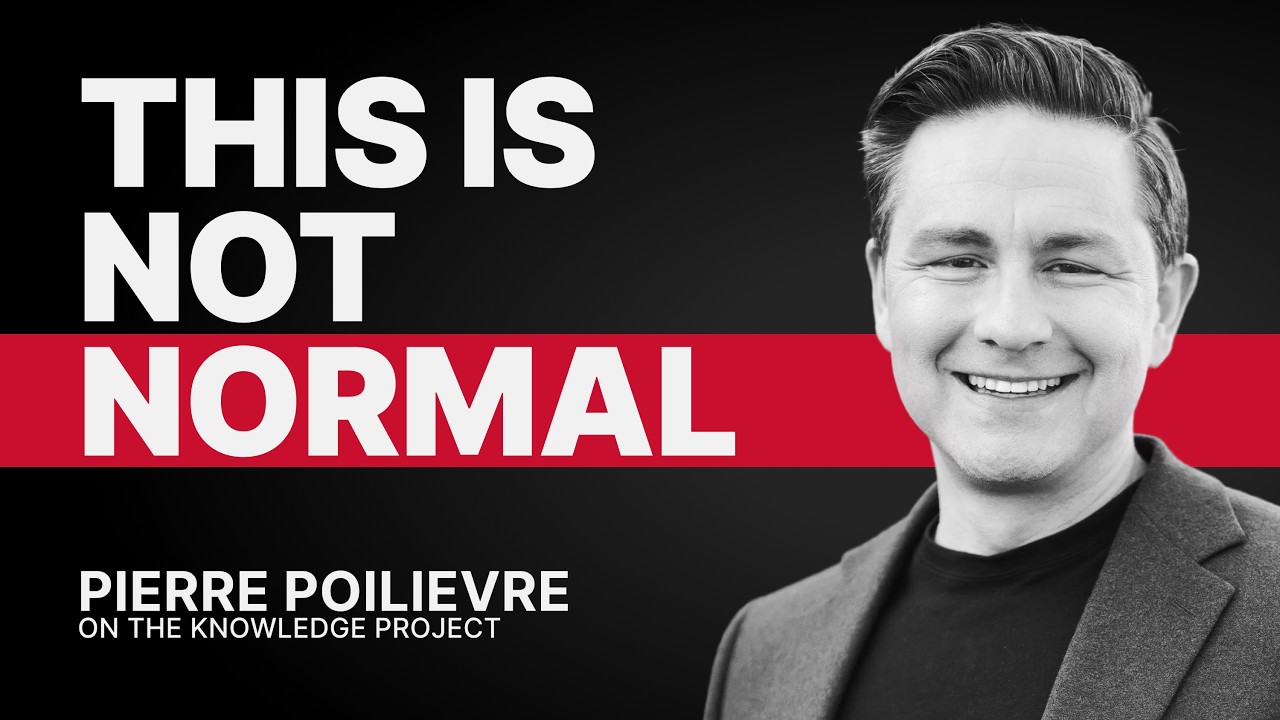
📺 Today’s recommended deep-dive video: https://www.youtube.com/watch?v=Go5wjr20mTs
Pierre Poilievre on Small Government, Economic Hope, and the Restoration of Common Sense
In a wide-ranging conversation with Shane Parrish, the Leader of the Conservative Party of Canada critiques the current state of national identity and economic mobility. He outlines a vision where government retreats to its core functions, allowing free enterprise, individual liberty, and the “antibody” of free speech to flourish once again.
Core Question: How can a “Canada First” policy framework restore the promise of homeownership and prosperity for a generation that feels left behind?
Highlights
- Defining government strictly as the legal power to apply force and focusing on its core responsibilities.
- The “Generation Screwed” crisis and the strategy to lower the “first rung” of the housing ladder.
- Proposed tax reforms, including removing capital gains for Canadian reinvestments to act as economic rocket fuel.
- Shifting the drug crisis response from the “safe supply” model to recovery-focused treatment and enforcement.
⏱️ Reading time: approx. 7 minutes · Saves you about 48 minutes vs. watching.
Want to take notes while watching? Click the image below and let AI Notebook capture the key points for you 👇

The First Principles of Freedom and Governance
Defining the State and the Role of Force
Government is the only institution in society with the legal power to apply force, which means it should strictly be limited to tasks individuals cannot perform alone. This foundational principle suggests that the state has no business meddling in areas where private associations or free markets can operate more efficiently.
By focusing exclusively on essential services like border control, national defense, and basic infrastructure, the state avoids overstepping into the lives of free citizens. When a government attempts to subsidize media or prop up private industries, it inevitably distorts market signals and wastes taxpayer capital that could be better used elsewhere.
National identity in Canada is not built on a shared ethnicity or a specific religious bloodline, but rather on the foundational concept that freedom itself is our nationality. People have historically migrated here from across the globe to escape tyranny and seek the liberty to build their own lives, start families, and practice their faiths without state interference. We must return to a “Canada First” posture that prioritizes this shared heritage over divisive postmodern ideologies that claim we have no identity at all.
Hope is not just a sentiment; it is a calculated political strategy to convince the electorate that a better future is actually possible.
💡 Digging Deeper
Q: Why should Canada cut foreign aid to international bodies like the UN?
A: It is appalling to send money abroad when one in four Canadian children are going to school hungry and scurvy has returned to our food banks.
Q: How do you view Canada’s role in a globalized world?
A: We must put on our own oxygen mask first; by securing our own resources and military, we can eventually help others from a position of strength.
Q: What is the primary nationality of Canada?
A: Freedom is our nationality, and it is the singular thing that binds a diverse population of Protestants, Catholics, and immigrants together.
Restoring the Economic Ladder for “Generation Screwed”
Unblocking the Economic Engine
The current housing crisis is a direct result of a population growth rate that has far outpaced the expansion of our physical infrastructure and health care services. When we bring in millions of people without a plan to build the necessary homes, the resulting scarcity drives prices to levels that are fundamentally unattainable for the average worker.
To fix the economy, we must unblock our natural resources and get projects like pipelines and LNG plants built so Canada can sell to global markets at premium prices. This strategy provides us with the necessary leverage to negotiate better trade terms with the United States while simultaneously generating the immense wealth required to lower the domestic cost of living and provide high-paying trades jobs for our youth.
We must stop treating government spending as a substitute for private sector productivity if we ever hope to restore the value of the Canadian dollar.
The strategy of “Generation Screwed” must be replaced by a promise of homeownership, where every hard-working citizen can afford a place of their own. This requires removing the bureaucratic hurdles that currently prevent builders from breaking ground on the supply we desperately need to house our families.

💡 Digging Deeper
Q: Why do you oppose bribing foreign companies like Stellantis or Nokia to come to Canada?
A: These “deals” use taxpayer money to fund multinationals that often cut jobs anyway; we should instead lower taxes for all companies that invest in Canada.
Q: What is the benefit of removing capital gains taxes on reinvested income?
A: It encourages investors to keep their money in Canada to build factories and mines, only paying the tax when they eventually cash out for personal use.
Q: How has “Generation Screwed” been affected by recent policies?
A: They have seen housing costs double, food prices skyrocket, and jobs disappear due to an over-reliance on temporary foreign workers who drive down wages.
Accountability, Free Speech, and the Path to Social Recovery
The Independence of Information
Free speech is the primary antibody against disinformation, as the clash of competing ideas eventually allows the truth to surface through public scrutiny. If we do not trust the average citizen to discern truth from falsehood, we certainly cannot trust a government official to make that determination for them.
The drug crisis is being perpetuated by a bureaucratic and pharmaceutical industrial complex that profits from the continued distribution of addictive substances under the guise of safe supply. Instead of subsidizing the very industry that sparked the opioid epidemic, we should be investing heavily in recovery-focused treatment centers that provide counseling, physical exercise, and job placement to help people reclaim their lives from the cycle of addiction.
A dependent media cannot be an independent media, and the current system of government subsidies creates a conflict of interest that undermines the public’s trust. We need a decentralized landscape where diverse voices can hold the powerful accountable without fearing the loss of their primary funding source from the state.
We must prioritize the safety of our streets by ensuring that the small group of repeat violent offenders is kept behind bars indefinitely.

💡 Digging Deeper
Q: Who “watches the watchman” in a system of regulated speech?
A: No one; if a government official is a liar or a spreader of disinformation, there is no mechanism to stop them once they have the power to censor.
Q: What is your stance on the “safe supply” of drugs?
A: It is a failure that enriches pharmaceutical companies while people continue to die; we need to focus on total recovery and getting people off drugs entirely.
Q: What should be the penalty for fentanyl dealers?
A: Selling enough fentanyl to kill 20 people should be treated as a murder sentence, as the dealer knows their product will likely end a life.
Key Takeaways
The core of this vision is a return to first principles where the state facilitates freedom rather than managing every aspect of a citizen’s life. By defining the government’s role as the legal use of force, we can strip away the bloat of bureaucracy that currently drains the productive private sector and drives inflation.
By unblocking natural resources, cutting the capital gains tax for domestic reinvestment, and ending the “safe supply” of drugs in favor of recovery-focused treatment, Canada can reclaim its status as a land of opportunity. This transition requires a leader who is willing to be underestimated while telling the hard truths about the current size of the federal bureaucracy. The focus must remain on the three pillars of hope, jobs, and homes for every Canadian willing to work for them.
Ultimately, the goal is to instill a sense of genuine hope in a generation that has been gaslit into accepting lower standards of living.
Q&A
Q1: Who was your favorite wrestler growing up and why?
A1: Hulk Hogan, because he was a “lionheart” who overcame being outmatched in size to win through sheer determination.
Q2: How do you define the role of government?
A2: Government is the legal use of force, and it should only do what people cannot do for themselves, such as military and border defense.
Q3: What is the “Generation Screwed” rap sheet?
A3: Doubled housing costs, rising rent, increased food prices, and a missing job market due to resource blocking and wage-depressing labor policies.
Q4: How do you respond to comparisons with Donald Trump?
A4: It is a liberal distraction tactic; I have been consistent in my advocacy for free enterprise, low taxes, and sound money for my entire career.
Q5: What is your workout regimen?
A5: I use kettlebells for efficient, full-body workouts in 15-20 minutes, or bodyweight exercises and bungee cords when traveling.
Q6: How do you handle political stress?
A6: I focus only on what I can control and avoid the pointlessness of worrying about events that are outside of my personal influence.
Q7: What is the “End State” of reconciliation with Indigenous communities?
A7: Creating self-reliant communities through economic opportunity, like the LNG projects that bring prosperity and jobs rather than bureaucratic dependence.