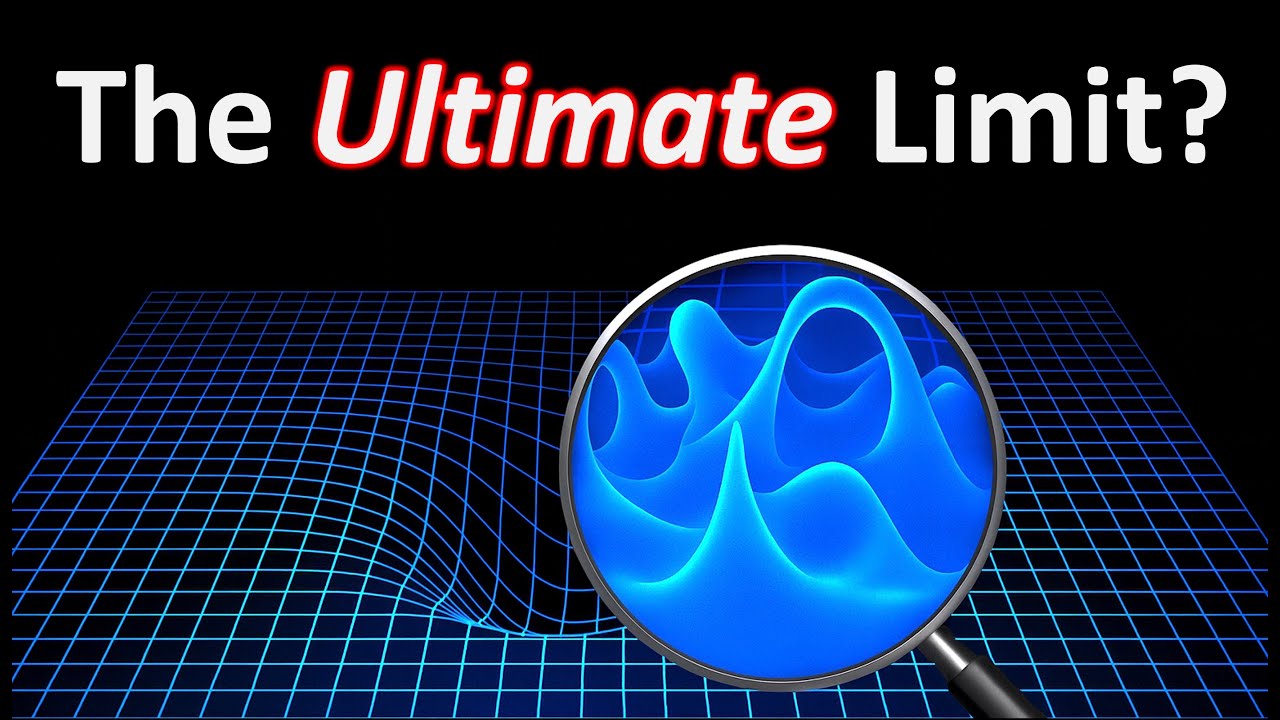
📺 Today’s recommended deep-dive video: https://www.youtube.com/watch?v=f3jhbui5Cqs
The Plank Limit: Why Nature Forbids a “Final Zoom”
We have spent centuries building more powerful tools to peer into the microscopic heart of reality, from early lenses to the Large Hadron Collider. However, physics suggests that we cannot keep zooming in forever; eventually, the very act of looking harder causes the universe to hide its secrets.
Core Question: Is there a fundamental limit to the resolution of the universe, and what happens to spacetime when we try to exceed it?
Highlights
- To resolve smaller features, we must use probes with shorter wavelengths and higher energy.
- At the Plank scale, the energy required to “see” is so concentrated that it triggers gravitational collapse.
- The Generalized Uncertainty Principle confirms that distance becomes meaningless below $10^{-35}$ meters.
- Modern theories like String Theory and Loop Quantum Gravity suggest spacetime is an emergent, approximate property rather than a fundamental stage.
⏱️ Reading time: approx. 8 minutes · Saves you about 24 minutes vs. watching.
Want to take notes while watching? Click the image below and let AI Notebook capture the key points for you 👇

The Mechanics of Resolution
Wavelengths and the Tool of the Probe
To visualize the microscopic world, we must scatter particles off our targets. Whether we use photons of light or beams of electrons, a fundamental physical constraint dictates our success: the wavelength of the probe must be roughly the same size or smaller than the feature we intend to resolve. Just as large ocean waves ignore a small ship, long wavelengths pass over tiny structures without reflecting meaningful information.
This simple requirement creates an inescapable trade-off between scale and energy. To see smaller things, we must use shorter wavelengths, which inherently carry higher momentum and energy.
Einstein’s discovery of the photoelectric effect proved that light consists of discrete photons. By relating wavelength to energy via Planck’s constant, we see that resolving an atom requires roughly 150 electron volts. Probing the subatomic world requires scaling this energy by billions, pushing us into the realm of particle accelerators where matter and light behave identically.

💡 Digging Deeper
Q: Why can’t we just use visible light to see atoms?
A: Visible light has a wavelength thousands of times larger than an atom; it essentially “misses” the atom entirely.
Q: Is there a difference between using electrons and photons for resolution?
A: At low energies, yes, but in the “ultra-relativistic” regime where kinetic energy far exceeds rest mass, they follow the same energy-to-wavelength scaling.
The Black Hole Barrier
When Energy Curves the Stage
At the Large Hadron Collider, we collide particles at trillions of electron volts to glimpse the Higgs boson. This represents our most advanced attempt to slice through the fabric of reality using sheer brute force.
However, Einstein’s General Relativity introduces a catastrophic plot twist. Energy and mass are equivalent, and concentrated energy curves spacetime. If we attempt to focus enough energy to resolve a region smaller than the Plank length, the energy density becomes so extreme that the region undergoes gravitational collapse. Instead of a sharper image, we create a microscopic black hole that swallows the information we seek.
The Plank length, at $10^{-35}$ meters, acts as nature’s ultimate “No Entry” sign. Beyond this point, adding more energy only makes the resulting black hole larger and more opaque.

💡 Digging Deeper
Q: How large would an accelerator need to be to reach the Plank energy?
A: To reach that scale with current technology, we would need a ring roughly 4,000 light-years in circumference—nearly the size of a galaxy.
Q: What defines the Schwarzschild radius?
A: It is the critical radius at which a given mass or energy density becomes so high that its escape velocity exceeds the speed of light.
Redefining Uncertainty
The Generalized Uncertainty Principle
Heisenberg’s original uncertainty principle suggests that we can localise a particle if we accept a higher momentum uncertainty. It implies there is no theoretical limit to how small we can go.
But when we factor in gravity, the equation changes. The probing photon itself has an effective mass that exerts a gravitational pull on the particle being observed. At normal scales, this is negligible. At the Plank scale, this pull creates a secondary uncertainty that grows with energy. When these two effects—quantum and gravitational—are combined, they reveal a minimum possible value for position uncertainty that perfectly matches the Plank length.
This convergence from two different paths—black hole physics and quantum measurement—is a smoking gun. It strongly suggests that our smooth, continuous concept of space is merely an approximation that fails at the most fundamental level.

💡 Digging Deeper
Q: Does the Generalized Uncertainty Principle replace Heisenberg’s?
A: It extends it; at low energies, the gravitational term is so small that it reduces back to the standard Heisenberg formula.
Q: What happens if we try to force an observation below the minimum uncertainty?
A: The math shows that the positional uncertainty actually starts to increase again, meaning we lose even more precision.
Beyond the Fabric
Strings and Spin Networks
String theory attempts to bypass the singularity by replacing point-like particles with tiny, one-dimensional vibrating strings. These strings have a finite size, which naturally prevents us from probing “nothingness.” When you pump energy into a string, it doesn’t get smaller; it vibrates more and spreads out.
Gravity is not an “add-on” in string theory; it is a mathematical requirement. The equations of General Relativity emerge naturally from the quantum behavior of these fundamental strings.
Alternatively, Loop Quantum Gravity suggests that space itself is granular, composed of discrete “atoms” of volume. In this view, there is no such thing as a distance smaller than the Plank length because space doesn’t exist in between those nodes. Both theories suggest that spacetime is an emergent property rather than a fundamental stage, a realization that challenges the very foundations of how we perceive the universe.
💡 Digging Deeper
Q: Is spacetime “real” in these theories?
A: It is “real” as an approximation at large scales, much like how a smooth liquid is real even though it’s made of discrete molecules.
Q: Which theory is correct?
A: Both are active areas of research; String Theory is a “theory of everything” including matter, while LQG focuses specifically on the quantization of space and time.
Key Takeaways
The journey into the infinitesimal reveals a shocking irony: the more energy we use to illuminate the smallest scales of the universe, the more the universe “blinds” us through gravity. The Plank length is not just a technological hurdle; it is a fundamental limit of operational reality. At this scale, the traditional distinctions between a particle and the space it occupies begin to dissolve into a foam of quantum-gravitational effects.
This suggests that our long-held view of spacetime as a smooth, continuous backdrop is an illusion. Whether the universe is made of vibrating strings or discrete geometric nodes, the conclusion is the same: spacetime is likely an emergent phenomenon. We are reaching the end of the “zoom,” where the very concepts of “here” and “there” lose their meaning, pointing toward a new era of physics where gravity and quantum mechanics finally speak the same language.
Q&A
Q1: What is the significance of the 150-volt acceleration for electrons?
A: This specific potential gain gives an electron enough momentum that its De Broglie wavelength matches the size of an atom (~0.1 nanometers), allowing it to resolve atomic structures.
Q2: Why does adding energy to a black hole make things worse for resolution?
A: According to the Schwarzschild equation, the radius of a black hole is directly proportional to its energy; more energy creates a larger event horizon, hiding a larger volume of space from the observer.
Q3: Is the Plank length the smallest “thing” in the universe?
A: It’s not necessarily a “thing,” but rather the smallest distance about which we can have meaningful physical information. Below this scale, our current laws of physics break down.
Q4: How does String Theory prevent the formation of singularities?
A: Because strings are not point-like, they have a “minimum footprint.” You cannot concentrate a string into a zero-dimensional point, which prevents the infinite densities that cause singularities.
Q5: What was the result of the SLAC experiments in 1967?
A: By firing high-energy electrons at protons, researchers observed scattering patterns that proved protons were not solid spheres but contained point-like internal structures called quarks.
Q6: What is a “spin network” in Loop Quantum Gravity?
A: It is a mathematical graph representing the quantum states of space, where the edges represent areas and the nodes represent volumes, implying space is built from discrete, indivisible chunks.
Q7: Why does the video mention Nema Arkani-Hamed?
A: He is a prominent physicist who argues that the impossibility of observing spacetime below the Plank scale implies that spacetime itself is an “approximate notion” rather than a fundamental truth.