📺 Today’s recommended deep-dive video: https://www.youtube.com/watch?v=F_Riqjdh2oM
Quantum Computing for Computer Scientists: Math Over Mystery
Forget the cat in the box; if you can multiply a matrix by a vector, you can understand quantum computation. This article strips away the physics jargon to reveal a logical state machine that outperforms classical systems through the power of superposition.
Core Question: How does the mathematical model of quantum gates enable computational speedups that are physically impossible for classical bits?
Highlights
- Representing bits as vectors and operations as matrices.
- The Hadamard gate as the portal to superposition.
- Solving the Deutsch Oracle problem in a single query versus two.
- Understanding entanglement and teleportation through linear algebra rather than metaphors.
⏱️ Reading time: approx. 10 minutes · Saves you about 78 minutes vs. watching.
Want to take notes while watching? Click the image below and let AI Notebook capture the key points for you 👇

Linear Algebra: The Language of Logic
Vectors and Matrices as Bits
In the classical world, we think of bits as 0 or 1, but for quantum computing, we represent these as vectors. A “0” is a vector $[1, 0]$ and a “1” is $[0, 1]$. If you have trouble remembering this, simply think of it as an array indexed from zero: if there is a 1 in the 0th index, it represents a zero.
Operations on these bits are just matrix multiplications. For instance, the identity matrix leaves a bit unchanged, while a bit-flip (NOT) matrix swaps the positions of the 1 and 0.
Quantum computers strictly use reversible operations.
This means that if you know the operation performed and the final output, you can always determine the original input. Intuitively, operations that shuffle bits are reversible, while those that erase or overwrite information, like a “set to 1” operation, are not. In the quantum realm, gates are their own inverses; applying the same gate twice returns you to your starting state.
![A concept map showing a 2D vector [1,0] representing '0' and [0,1] representing '1', with arrows showing a 2x2 NOT matrix transformation flipping the vector values.](images/section1.png "Quantum Computing for Computer Scientists: An Intro 10")
💡 Digging Deeper
Q: Why do we care about reversibility?
A: Beyond the mathematical requirement for quantum gates, reversible computing potentially bypasses the Von Neumann-Landauer limit, the theoretical minimum energy required to erase information.
Q: Do we use complex numbers?
A: Yes, in general, quantum vectors use complex numbers where the sum of the squares of their magnitudes equals one, though we can understand the core concepts using only real numbers.
Scaling Up to Multiple Bits
Tensor Products and the CNOT Gate
To represent multiple bits, we use the tensor product. If you have two bits, you “tile” the second vector for every element in the first, resulting in a four-element vector.
A two-bit system—00, 01, 10, or 11—is represented by a vector of size $2^n$. This exponential growth is our first hint at the massive power hidden within quantum systems.
The most fundamental multi-bit gate is the CNOT, or “Conditional NOT.”
In this setup, one bit acts as the control; if the control bit is 1, it flips the target bit; if it is 0, it does nothing. The CNOT gate is the “NAND gate” of the reversible world, acting as the building block for all complex logical formulas.

💡 Digging Deeper
Q: Is the CNOT gate universal for all logic?
A: Not quite. While it is fundamental, you actually need the Toffoli gate (a three-bit gate) to achieve universal reversible classical computation.
The Quantum Jump: Qubits and Superposition
The Hadamard Portal
A Qubit is simply a vector where the values are not restricted to just 1 or 0. We can have a vector like $[1/sqrt{2}, 1/sqrt{2}]$, where the sum of the squares equals 1. This is superposition.
Superposition does not mean a bit is “secretly” 0 or 1; it is mathematically in both states simultaneously until it is measured.
When we measure a qubit in superposition, it collapses into a classical 0 or 1 based on the probability of its internal values (the “amplitudes”). For our $[1/sqrt{2}, 1/sqrt{2}]$ qubit, there is a 50% chance it collapses to 0 and a 50% chance it collapses to 1.
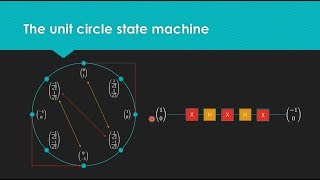
The Hadamard (H) gate is the tool that moves us between the classical and quantum worlds.
It takes a definite 0 or 1 and puts it into a perfect 50/50 superposition. Crucially, because the H-gate is its own inverse, applying it to a superposition state can bring us back to a deterministic classical bit. This allows us to perform “quantum stuff” in the middle of a calculation and end with a clear, readable answer.

Quantum Supremacy: The Deutsch Oracle
Solving the “Contrived” Problem
The Deutsch Oracle asks: is a hidden one-bit function “constant” (always returns 0 or always 1) or “variable” (identity or negation)? A classical computer must query the function twice to be sure.
A quantum computer solves this in exactly one query.
To make this work, we must “rewire” the problem for reversibility. We use two qubits: an input qubit and an output qubit that stores the result. By putting both qubits into superposition before sending them through the “black box” of the function, the quantum system uses interference to cancel out the differences within categories.
When the function is constant, the interference results in a specific measurement (1,1). When it is variable, it results in (0,1).
By looking at the state of the system after a single pass, we identify the nature of the function with 100% certainty. While the one-bit version is a toy problem, the generalized version (the Deutsch-Jozsa algorithm) provides an exponential speedup, proving that quantum systems can fundamentally outpace classical ones.

💡 Digging Deeper
Q: If quantum computers are so fast, why don’t we use them for everything?
A: Quantum computers excel at specific problems like factoring (Shor’s) or searching unordered lists (Grover’s), but for basic tasks like addition, they offer no advantage over your laptop.
Q: What is the “interference” actually doing?
A: It magnifies the mathematical signal of the CNOT gate while neutralizing the signal of the negation gate, allowing the category of the function to be revealed instantly.
Key Takeaways
Quantum computing is not a replacement for classical logic but a vast expansion of it. By moving from scalar bits to vector qubits, we gain the ability to use linear algebra to explore multiple computational paths simultaneously. The “magic” of quantum speedup isn’t about trying every answer at once, but rather about using gates like the Hadamard to create interference patterns that reveal global properties of a function faster than checking every individual input.
Entanglement and teleportation, often treated as science fiction, are natural consequences of this vector-based model. When two qubits cannot be mathematically factored into separate states, they are entangled, coordinating their behavior across any distance. While this doesn’t allow for faster-than-light communication, it provides a “quantum bridge” to move information in ways that redefine the limits of networking and cryptography.
Q&A
Q1: What is the difference between coordination and communication in entanglement?
A1: Coordination means two particles show the same random result instantly across distance, but you cannot choose the result to send a specific message. Communication requires a classical signal to interpret that coordination.
Q2: Can we copy a qubit state?
A2: No. The “No-Cloning Theorem” states that you cannot create an identical copy of an unknown quantum state; you can only move or “teleport” it, which destroys the original.
Q3: How do we deal with “noise” in quantum computers?
A3: Noise is a major barrier. Current research focuses on error correction, where hundreds of physical qubits are used to create a single stable “logical qubit” that can resist environmental interference.
Q4: Is a quantum computer just a faster version of a classical one?
A4: Not exactly. It’s a different paradigm. It is faster only for specific algorithms that take advantage of superposition and interference, such as factoring large numbers or simulating molecular chemistry.
Q5: What is the Bloch Sphere?
A5: It is a 3D geometric representation of a qubit’s state when using complex numbers. In this article, we simplified it to a 2D “Unit Circle” using only real numbers.
Q6: What is Q#?
A6: Q# is Microsoft’s domain-specific programming language designed for expressing quantum algorithms, often used in conjunction with a classical driver language like C# or Python.
Q7: Why did Einstein call entanglement “spooky action at a distance”?
A7: He was uncomfortable with the idea that the universe was non-local—that an action in one place could instantaneously affect another across the galaxy—but modern experiments have proven this “spookiness” is real.