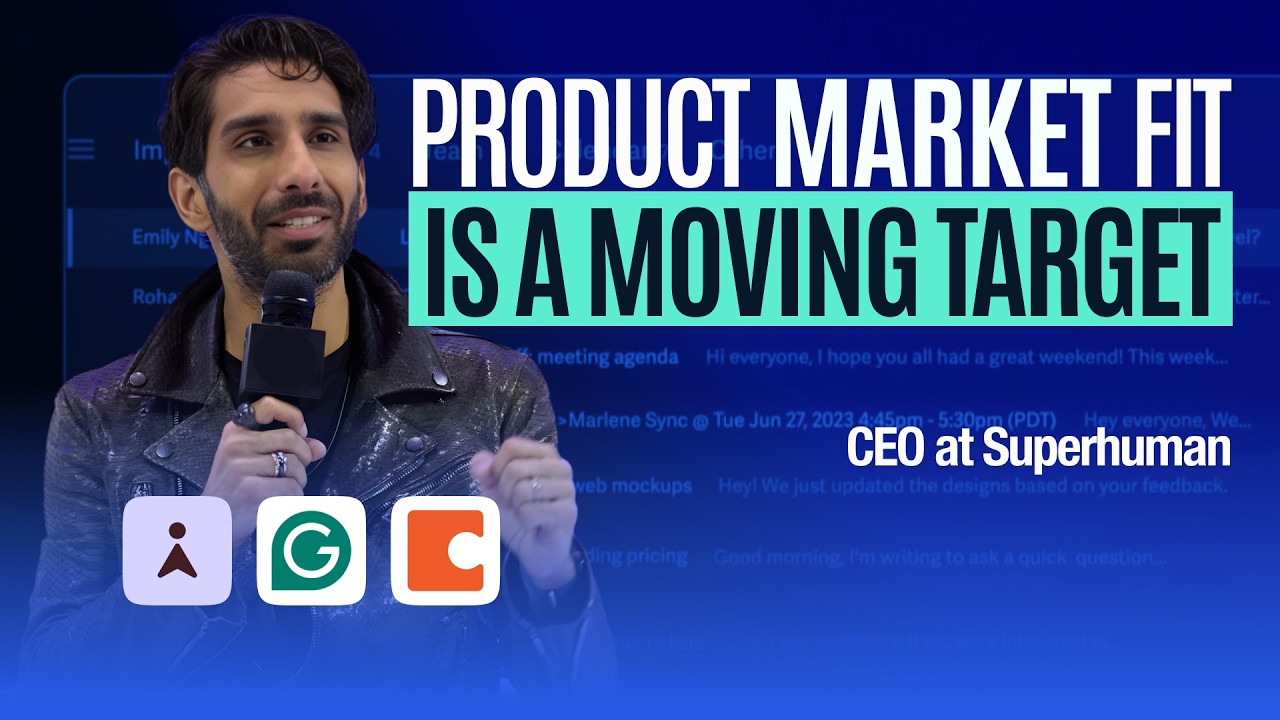
📺 Today’s recommended deep-dive video: https://www.youtube.com/watch?v=8t1kSELI6EY
The Science of Product-Market Fit: How Superhuman Productized Growth
Most startups fail because they lack product-market fit, yet few founders treat it as a measurable science rather than a gut feeling. Rahul Vohra, the architect behind Superhuman, reveals how he turned subjective sentiment into a numerical certainty that predicts success before it happens.
Core Question: How can product leaders use data-driven sentiment analysis to find, measure, and systematically increase product-market fit?
Highlights
- The 40% Benchmark: Why the “Very Disappointed” metric is the only leading indicator of growth that actually matters.
- The HXC Strategy: How focusing exclusively on the “High Expectation Customer” allows you to ignore distracting feedback.
- AI-Native vs. Bolt-on: Why rebuilding surfaces from scratch is the only way to compete with incumbents like Google and Microsoft.
- The 50/50 Roadmap: A methodology for balancing “magical” features with objective roadblocks to prevent being out-competed.
⏱️ Reading time: approx. 6 minutes · Saves you about 44 minutes vs. watching.
Want to take notes while watching? Click the image below and let AI Notebook capture the key points for you 👇

The Shift to AI-Native Productivity
Rebuilding the Surface from Scratch
AI-native means you have rebuilt the surfaces and interaction points from the ground up, genuinely from scratch, rather than bolting features on. It is easy for a company to add an AI chat window to an existing app, but it is incredibly difficult for a large organization to disassemble its core product and ask: “If we built this today, what would it look like?”
The scale of the email problem is often underestimated by developers. With over a billion professionals spending an average of three hours a day in their inboxes, we are looking at over a trillion hours spent on email annually. This is why the Superhuman vision, now accelerated by the resources of the Grammarly ecosystem, focuses on an integrated suite where AI doesn’t just assist writing but manages the entire cognitive load of work.
Incumbents like Microsoft and Google struggle with this transition because their legacy structures are optimized for a pre-AI world. By treating email, calendar, and tasks as a unified, AI-driven experience, a smaller team can create a “moat of speed” that larger competitors find impossible to replicate without cannibalizing their existing user base.

💡 Digging Deeper
Q: Why did Superhuman join forces with Grammarly?
A: To build the “AI-native productivity suite” of choice, combining Grammarly’s massive language reach with Superhuman’s high-speed workflow engine.
Q: How do you measure work done in an inbox?
A: Superhuman measures “emails sent” rather than “emails read” or “actions taken,” as sending is the ultimate indicator of completed communication.
The Product-Market Fit Engine
Measuring the “Very Disappointed” Metric
Product-market fit is the number one reason startups succeed, yet most founders define it by a “feeling” that is completely unactionable. In 2017, despite years of coding, Rahul Vohra realized Superhuman didn’t have PMF because the word-of-mouth wasn’t explosive enough. He turned to the Sean Ellis metric: asking users “How would you feel if you could no longer use the product?”
After benchmarking hundreds of startups, the data is clear: if fewer than 40% of your users answer “very disappointed,” you will struggle to grow. Superhuman initially scored only 22%, a sobering number that provided the first honest baseline for the engineering team. This metric is significantly more predictive of future success than Net Promoter Score (NPS) because it measures necessity rather than just affinity.
Finding the “High Expectation Customer” (HXC) is the next logical step to fix a low score. By analyzing the 22% who loved the product, the team identified “Nicole”—a busy professional who prides herself on responsiveness. By narrowing the target market to only those who identified with Nicole’s needs, the PMF score jumped 10% instantly without writing a single line of new code.

💡 Digging Deeper
Q: Who is the High Expectation Customer?
A: The most discerning person in your demographic who will spread the word because they find the most benefit in your core “magic.”
Q: Should you listen to all user feedback?
A: No. You must deliberately ignore “not disappointed” users as they will ask for distracting features that dilute your product’s core value.
The Roadmap of Halves
Balancing Magic and Roadblocks
To increase your PMF score, you must split your roadmap exactly in half: 50% on doubling down on what people love, and 50% on removing what holds people back. If you only focus on the “magical” features, you will never address the objective reasons why users leave. Conversely, if you only fix bugs and address objections, a competitor will eventually “out-magic” you and steal your market share.
For Superhuman, this meant spending half their time on speed and keyboard shortcuts while the other half was dedicated to missing features like a mobile app and calendar integrations. This systematic approach saw their PMF score climb from 33% to 58% in just three quarters. It turns the chaotic process of feature prioritization into a repeatable, data-driven science that keeps the team aligned on growth.
The “law of shitty metrics” dictates that every score will eventually drop as you reach lower-intent, adjacent users. This is why tracking the PMF score must be a weekly or monthly ritual, allowing the team to identify when a growth spurt is diluting the product’s core appeal. By constantly re-segmenting the data, you can pivot the product to meet the needs of a changing market before the churn becomes terminal.

💡 Digging Deeper
Q: How many user quotes do you need to interpret the truth?
A: You only need about 20-30 verbatim quotes from the “somewhat disappointed” group to identify the primary roadblocks to their conversion into fanatics.
Q: What is a long-term “moat” in productivity?
A: Speed is a massive moat because it is an organizational incentive problem, not just a technical one; large companies rarely reward teams for making things “fast.”
Key Takeaways
Product-market fit is not a binary milestone but a moving target that must be managed with mathematical precision. By focusing exclusively on the “High Expectation Customer” and ignoring the noise from users who would not miss your product, you can create a roadmap that balances vision with user-centric roadblocks.
True leadership requires operating within your “Zone of Genius”—for Vohra, that is product, design, and marketing—while building an organization that handles execution and management. When you stop trying to be a “standard” CEO and start designing an organization that complements your specific strengths, you gain the leverage needed to build world-class products.
Q&A
Q1: How does Superhuman justify its price point to executives?
A: By showing that users respond to 72% more emails per hour. For a strategy consulting firm, this equates to roughly 3.3 hours saved per person every week, which translates directly into increased billable efficiency and better client responsiveness.
Q2: What is the biggest mistake founders make when seeking PMF?
A: They treat it as a feeling or a one-time event. They fail to measure it numerically, which leads to “feature creep” as they try to please everyone instead of focusing on the specific cohort that actually finds the product essential.
Q3: Why is speed such a core part of the Superhuman brand?
A: Because speed is a competitive dimension that incumbents like Microsoft and Google struggle to prioritize. It requires building infrastructure and dashboards that value milliseconds—something that is hard to maintain in a feature-heavy corporate culture.
Q4: How do you handle “somewhat disappointed” users?
A: You only listen to the ones for whom your “main benefit” (e.g., speed) resonates. If they want speed but are held back by a lack of an app, you build the app. If they are disappointed because they want a different core benefit entirely, you ignore them.
Q5: What does it mean for a CEO to be a “Product Editor”?
A: It means pushing the team to go beyond “faster horses” and interpreting user data to build the “car.” It involves taking dozens of verbatim quotes and refining them into a high-level vision that the team can execute against.
Q6: Is it possible to find PMF in a large organization?
A: Yes, but you must run the survey to find the truth. Often, products in large orgs survive on inertia or because they were mandated, not because they have genuine PMF. Running the “Very Disappointed” survey provides the data needed to influence skeptical stakeholders.
Q7: How do you define your “Zone of Genius” as a leader?
A: Identify the 2-3 areas where you are genuinely world-class—such as design or marketing—and delegate everything else. Don’t feel obligated to follow the “standard” CEO job description if you are mediocre at tasks like recruiting or management.