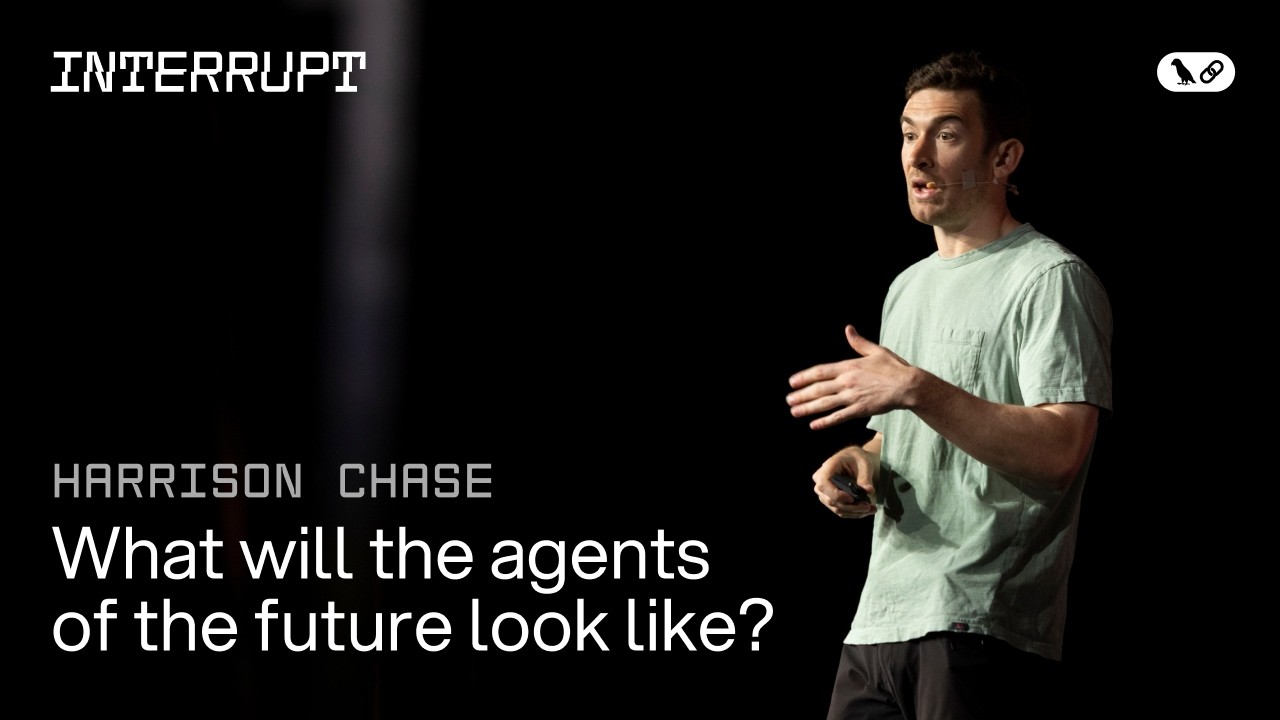
📺 Today’s recommended deep-dive video: https://www.youtube.com/watch?v=DrygcOI-kG8
From Prototype to Production: The Rise of the Agent Engineer
In the two years since LangChain’s inception, the AI landscape has shifted from “wowing” prototypes to the gritty reality of production-grade reliability. This evolution has birthed a new breed of builder—the Agent Engineer—who must navigate the complex intersection of prompting, product sense, and machine learning.
Core Question: How can developers bridge the gap between simple LLM wrappers and robust, multi-model agentic systems that actually move the business needle?
Highlights
- LangChain now surpasses the OpenAI SDK in monthly Python downloads, signaling a massive shift toward model optionality.
- Reliability stems from “context engineering” and low-level control, moving away from opinionated, “black box” agent frameworks.
- The launch of LangGraph Platform GA addresses the unique challenges of deploying long-running, bursty, and stateful AI workloads.
- New tools like LangGraph Studio V2 and the Open Agent Platform aim to democratize agent building for both engineers and product managers.
⏱️ Reading time: approx. 5 minutes · Saves you about 18 minutes vs. watching.
Want to take notes while watching? Click the image below and let AI Notebook capture the key points for you 👇

The Emergence of the Agent Engineer
Bridging the Skills Gap
The transition from a “nights and weekends” open-source project to a production powerhouse reflects the industry’s desperate need for reliable tooling beyond the initial spark of imagination. (28 words)
While the magic of Large Language Models makes it incredibly easy to build a convincing demo in an afternoon, the “last mile” of production remains the greatest hurdle for most enterprises. We have observed that reliability doesn’t come from a single model or a simple API call, but from the complex data pipelines and evaluative loops that ensure an agent performs consistently under varying real-world conditions. (72 words)
Building a truly functional agent requires more than just a clever prompt; it demands a synergy of software engineering, product intuition, and machine learning rigor. This specialized role, the Agent Engineer, is currently being defined in real-time by builders who must blend these disparate disciplines into a single, cohesive workflow. (51 words)

💡 Digging Deeper
Q: Why is “product sense” listed as a technical skill for agent building?
A: Because agents often replicate human workflows, requiring a deep understanding of how those processes function to model them effectively within the agent’s logic.
Q: Is machine learning knowledge still necessary if we aren’t training models from scratch?
A: Yes, specifically for managing evaluations (evals) and fine-tuning, which are critical for capturing and measuring non-deterministic behavior.
Architecture for Control and Context
Beyond the Black Box
Context is not just one big string; it is a meticulously constructed assembly of system messages, user inputs, tool outputs, and historical data. (24 words)
Developers are increasingly moving away from opinionated frameworks that hide prompts and cognitive architectures in favor of low-level primitives. LangGraph was built to address this specific need for unopinionated orchestration, allowing developers to design custom flows that provide supreme control over the context passed to the LLM. By treating context engineering as a first-class citizen, builders can ensure that every retrieval step and history segment is optimized for the task at hand. (79 words)
This shift toward controllability has led to LangChain becoming more popular in terms of Python downloads than even the OpenAI SDK. It highlights a fundamental truth: builders do not want to be locked into a single provider, but instead crave the flexibility to switch models based on cost, reasoning speed, or creative output. (53 words)

💡 Digging Deeper
Q: What is the main benefit of LangGraph over traditional LangChain chains?
A: It offers a lower-level, graph-based approach that removes hidden prompts, giving developers full visibility and control over the agent’s logic.
Q: How does LangChain handle the “multi-model” reality?
A: By serving as a stable integration layer that allows developers to swap between providers like OpenAI, Anthropic, and open-source models without rewriting their entire application logic.
Scaling Agents to Production
Solving the Deployment Hurdle
AI observability must look radically different from traditional system monitoring because agents generate unstructured, multimodal payloads that require qualitative analysis. (23 words)
Today’s announcement of LangGraph Platform’s General Availability marks a significant milestone in solving the deployment challenge for long-running and bursty workloads. Unlike traditional web apps, agents might run for hours or handle thousands of simultaneous background tasks, necessitating a stateful infrastructure that supports human-in-the-loop interactions. This platform provides the necessary API endpoints and horizontal scaling to turn experimental agents into resilient, enterprise-grade services that can be discovered and reused across an entire organization. (78 words)
Instead of just tracking CPU usage or memory, we must now monitor “trajectories”—the specific paths and tool-use sequences an agent takes to arrive at a solution. (28 words)
The future of building isn’t just for developers; tools like LangGraph Studio V2 and no-code templates are democratizing agent creation for product teams and domain experts. (27 words)

💡 Digging Deeper
Q: What makes agent workloads “bursty” compared to standard apps?
A: Agents are often triggered as background batch jobs where hundreds of complex, multi-step tasks are initiated simultaneously, requiring massive horizontal scaling.
Q: How does LangGraph Studio V2 help with production issues?
A: It allows you to pull down actual production traces into a local environment, modify the agent’s logic, and hot-reload to test fixes instantly against real-world failures.
Key Takeaways
The “Agent Engineer” is the new standard persona, requiring a blend of coding, ML, and product design. Success in this field depends on moving beyond simple demos toward architectures that prioritize controllability and meticulous context management. Tools like LangGraph provide the low-level primitives needed to build custom cognitive architectures without the interference of hidden, opinionated prompts.
Production readiness is now defined by three pillars: model optionality, specialized AI observability, and a stateful deployment infrastructure. As trace volumes explode, the focus of the industry is shifting from whether an agent “works” to how reliably it handles long-running, non-deterministic workflows that involve human oversight and complex tool interactions.
Q&A
Q1: How has LangChain’s growth compared to model-specific SDKs?
A: LangChain has recently surpassed the OpenAI SDK in monthly Python downloads, reflecting a strong developer preference for model-agnostic tooling and integration flexibility.
Q2: What new metrics are being introduced to LangSmith for agent tracking?
A: We are launching trajectory observability and tool-use tracking, which allow builders to see exactly which paths agents take and the latencies associated with specific tool calls.
Q3: Is LangGraph intended to replace the original LangChain?
A: Not to replace it, but to act as the recommended orchestration layer for complex, custom agents that require fine-grained control over state and loops.
Q4: What is the “Open Agent Platform”?
A: It is a new open-source, no-code environment powered by LangGraph that allows non-developers to build and register agents using templates and MCP tool servers.
Q5: What makes agent deployment different from standard web server deployment?
A: Agents are often long-running (taking minutes or hours to complete), bursty in nature, and require “statefulness” to support human-in-the-loop interaction patterns.
Q6: What is the significance of the LangGraph Platform GA?
A: It provides 30+ standardized API endpoints for streaming, human-in-the-loop, and memory management, allowing agents to scale horizontally in enterprise environments.
Q7: How does the “Team Sport” concept apply to LangSmith?
A: LangSmith acts as a central pane of glass where developers, product managers, and ML engineers can collaborate on traces, prompts, and evaluations in one place.