📺 Today’s recommended deep-dive video: https://www.youtube.com/watch?v=h5G6Oc_V3Lw
Mapping the Mind: Robert Lawrence Kuhn’s 325-Theory Quest for Ultimate Reality
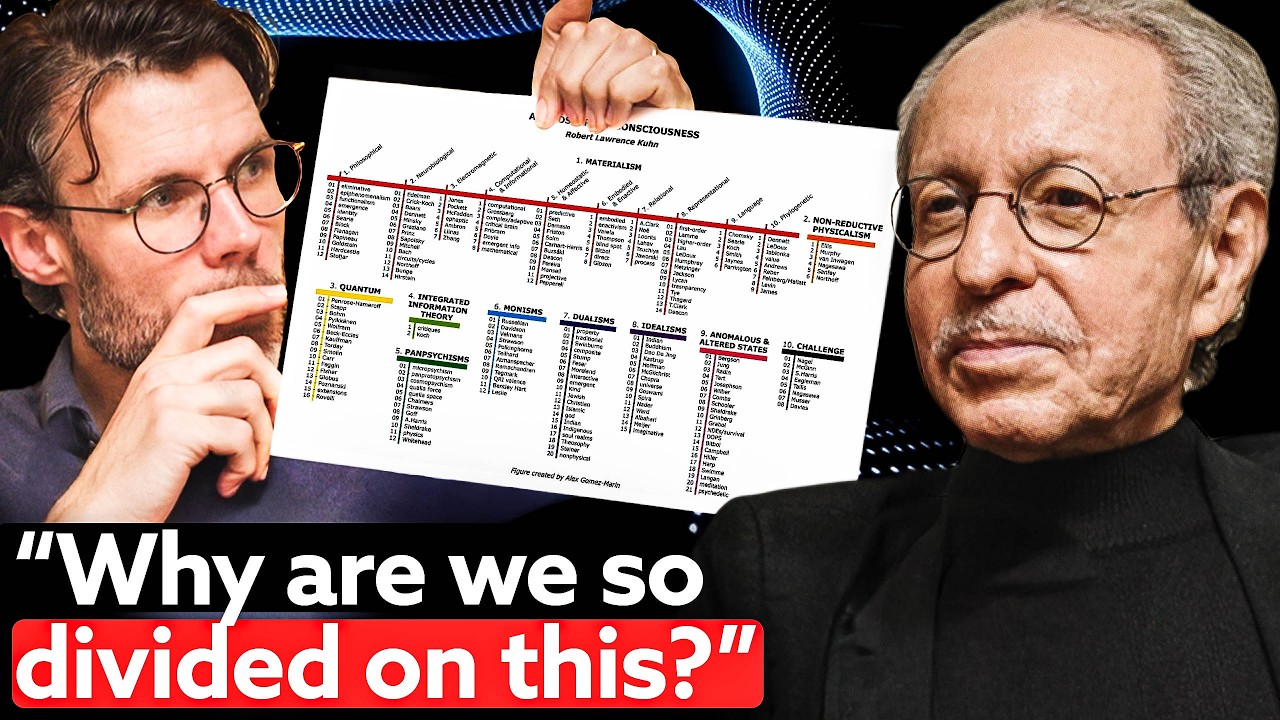
After three decades of interviewing the world’s greatest thinkers, legendary Closer to Truth host Robert Lawrence Kuhn has synthesized the totality of human passion and logic regarding consciousness into a single, massive taxonomy. From neuroscience to theology, this map serves as a historical document of our collective attempt to solve the most fundamental mystery of existence. It is a journey that spans the smallest quantum vibrations to the vastest reaches of cosmic idealism.
Core Question: Can a unified map of consciousness theories finally bridge the gap between material science and our most direct experiences of reality?
Highlights
- The paradox of consciousness: Unlike other sciences, more data leads to a proliferation of theories rather than a single consensus.
- Why materialism accounts for nearly 50% of all theories despite persistent logical gaps and the “hard problem.”
- The “Identity Problem”: Why every theory—from quantum fields to neural circuits—is ultimately a claim about what consciousness is.
- Robert Lawrence Kuhn’s personal “92% certainty” and his philosophical mashup of dualism and idealism.
⏱️ Reading time: approx. 8 minutes · Saves you about 168 minutes vs. watching.
Want to take notes while watching? Click the image below and let AI Notebook capture the key points for you 👇

The Proliferation of the Mental Map
The Search for Ultimate Reality
Kuhn’s obsession began with a teenage realization that physics and philosophy are only accessible through the brain. This sparked a lifelong journey to discover if consciousness is merely a material byproduct or the foundational fabric of the universe itself. To Kuhn, consciousness serves as the ultimate test for reality because its nature determines whether meaning, value, and identity are fundamental or accidental.
If consciousness is material, it is a determinant of what reality is; if it is not, a much broader set of possibilities opens up for the human story.
Unlike physics, where discovering the cosmic microwave background narrowed the field to the Big Bang, consciousness studies are exploding in complexity. Kuhn points out that the more we learn about the brain, the more theories we produce—325 and counting. This “neon sign” suggests that our current paradigms might be missing something essential, as we lack the usual scientific convergence that signals progress toward a final, singular truth about the felt inner experience of existence.

💡 Digging Deeper
Q: How does Kuhn define consciousness for this map?
A: He focuses strictly on “phenomenal consciousness”—the felt inner experience, like the smell of garlic or the sight of a newborn—rather than the content of thoughts or perception.
Q: Why does he include religious and indigenous views?
A: Kuhn aimed to encompass the totality of human thinking, refusing to patronize non-scientific views, as they represent significant historical attempts to explain the “inner movie” of the mind.
Q: What is the “Overton Window” in this context?
A: It refers to the range of ideas Kuhn was willing to include as “rational” before they became too fringe, though he expanded his window to include Theosophy after feedback from the community.
The Materialist Dominance and the Identity Trap
The Methodological Allure of Physicalism
Materialism occupies nearly half of the landscape not because it is inherently more accurate, but because it allows for a rigorous application of the scientific method. By assuming the physical world is sufficient to explain the mind, researchers can follow a trail of evidence, even if that trail leads toward increasingly strange sub-categories like eliminative materialism or neuro-phenomenology. Kuhn notes that once you introduce a non-physical element, the traditional third-party verification process of science becomes loose, limiting the consensus that can be achieved across different thinkers.
Every theory is essentially an “Identity Theory,” claiming that a specific physical or metaphysical state is the same thing as a conscious feeling.
Whether you point to C-fibers firing, quantum wave-function collapse, or integrated information, you are making a radical claim of equivalence. As philosopher David Papineau argues, if these states are identical, then eliminating one must logically eliminate the other, much like the “morning star” and the “evening star” are both simply the planet Venus. Kuhn finds all such claims slightly ridiculous because the two sides of the identity—matter and feeling—look nothing like each other.

💡 Digging Deeper
Q: What is the “Grandfather Effect” Kuhn mentions?
A: Witnessing his grandson’s birth via complex medical science shook his 98% certainty that materialism was wrong, dropping it to 92% because he saw the immense richness latent in physical biology.
Q: Does Kuhn believe AI can be conscious?
A: He notes that under “computational functionalism,” AI consciousness is a certainty, but under quantum theories, it remains highly uncertain and potentially impossible.
Q: What is the difference between the scientific method and a scientific way of thinking?
A: The method requires replication and falsification, while a “way of thinking” involves rigorous, logical steps and transparency about where one is making a “leap of faith.”
Quantum Leaps and Integrated Information
Beyond “Flap-doodle” to Formal Structures
Quantum theories of consciousness have moved beyond mere “flap-doodle” to serious proposals involving microtubules or quantum field interactions. Kuhn divides these into three categories: processes happening within the biological brain, consciousness existing as a cosmic property expressed through quantum mechanics, or consciousness as an emergent property of a dual-aspect monism. These theories attempt to move away from simple computation to explain why the mind feels “non-algorithmic.”
Integrated Information Theory (IIT) remains one of the most provocative stops on the map, attempting to quantify consciousness through the measure of “phi.”
While recently attacked as pseudoscience by some peers, Kuhn admires IIT for tackling the structural nature of experience head-on. He views the heated debate as an “adversarial spark” that forces the community to define the boundaries of what counts as a scientific explanation in a field that borders the non-physical. The real value of phi may lie in its therapeutic potential for assessing comatose patients, regardless of its ultimate ontological power to explain the soul.

The Transcendental Stop: Panpsychism and Idealism
The Final Boundaries of Being
Panpsychism serves as a popular middle ground, suggesting that consciousness is an irreducible property found at the most fundamental level of matter. However, this view faces the “combination problem”—how tiny fragments of proto-consciousness merge into a unified human self. Similarly, idealism must explain “dissociation,” or how a single cosmic mind splits into billions of isolated individuals. Kuhn observes that while these theories are gaining traction as materialism stumbles, they each require a specific “leap of faith” to bridge their internal logical gaps.
Kuhn’s own position is a mashup of dualism and idealism, motivated by a deep intuition that a being capable of conceiving eternity shouldn’t be denied it.
He remains a contrarian, willing to use the word “dualism” despite its academic unpopularity, because he believes the physical world has a real, mind-independent status. Yet, he grants explanatory priority to the non-physical, suggesting that the universe is generated by something mental that sustains the material. It is a position he describes as “jello”—hard to pin down, yet firm enough to provide a foundation for his life’s work.

Key Takeaways
The landscape of consciousness is not a single mountain to be climbed, but a vast, interconnected subway system where every traveler must eventually choose a destination. Kuhn’s work highlights that we are currently in a period of “extraordinary science,” where the lack of consensus is not a failure but a testament to the depth of the problem. We must remain humble enough to admit that our current theories may all be “one too few,” yet rigorous enough to demand logical clarity from every new proposal.
Ultimately, whether consciousness is a byproduct of neural firing or the primary substance of the cosmos, the search itself is a unifying human endeavor. By asking these universal questions, we transcend the superficial boundaries of religion, race, and politics. The map reminds us that we are all participants in a singular, grand mystery, seeking to understand the very “inner movie” that allows us to ask who we are in the first place.
Q&A
Q1: Why are there so many materialist theories if the “hard problem” remains unsolved?
A: Materialism allows researchers to use the scientific method, creating a trail of progress through observation and experimentation, even if the fundamental nature of “feeling” remains unexplained.
Q2: What is the “combination problem” in panpsychism?
A: It is the logical difficulty of explaining how micro-conscious particles (like electrons having a tiny bit of “mind”) combine to form the complex, unified consciousness of a human being.
Q3: Does Robert Lawrence Kuhn believe in life after death?
A: He emotionally hopes for it, arguing that it would be illogical for reality to produce beings who can conceive of eternity only to deny it, though he admits this is an intuition rather than a scientific proof.
Q4: What is “neuro-phenomenology”?
A: It is a sub-field of materialism that tries to give equal ontological status to both neurological data and the first-person lived experience, treating them as a unified whole rather than one causing the other.
Q5: How does Integrated Information Theory (IIT) handle the “identity” problem?
A: IIT claims consciousness is identical to a specific mathematical structure of integrated causal properties, mapping the “qualia” of an experience directly to a shape in a non-Euclidean space.
Q6: Why is Kuhn skeptical of using psychedelics to find “truth”?
A: He views them as a biological intervention—like seeing stars after being hit in the eye—and doubts that distorting brain chemistry is a reliable shortcut to perceiving ultimate reality.
Q7: What is “non-reductive physicalism”?
A: It is the view that while everything is physical, consciousness “emerges” at higher levels in a way that cannot be fully explained by or reduced to the behavior of individual atoms.