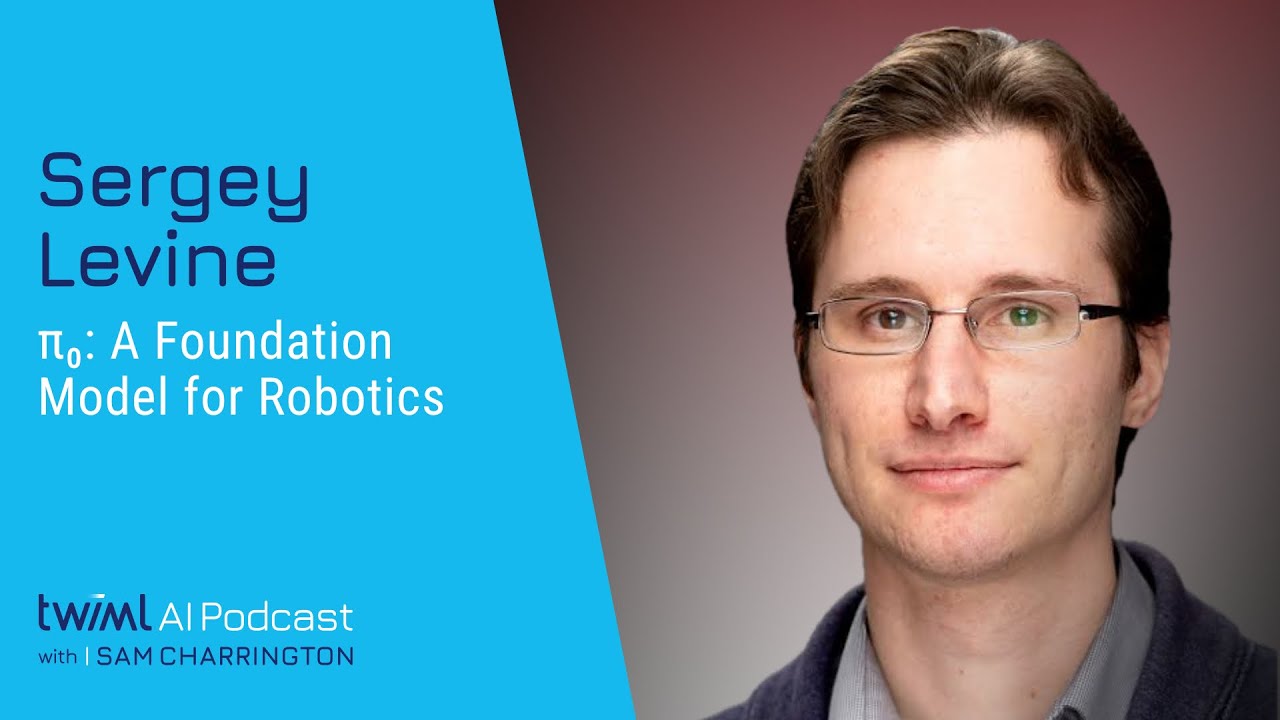
📺 Today’s recommended deep-dive video: https://www.youtube.com/watch?v=5mY71rGXAkM
Beyond Specialized Bots: Building the General-Purpose “Motor Cortex” for Robotics
For decades, every new robotic application required starting a new company or research lab from scratch because models were too specialized to transfer between tasks. Sergey Levine and the team at Physical Intelligence are breaking this cycle by developing foundation models that allow robots to generalize across varied hardware and environments. By combining the semantic reasoning of language models with the physical precision of diffusion, they are moving closer to the “science fiction” dream of truly generalist robots.
Core Question: How can we move from specialized robotic silos to general-purpose foundation models that understand physical reality as deeply as LLMs understand language?
Highlights
- The shift from task-specific code to “action experts” built on pre-trained Vision-Language Models (VLMs).
- Why “bad data” in pre-training is essential for robotic robustness, teaching the system how to recover from inevitable physical failures.
- Integrating diffusion models to represent continuous spatial movements that traditional text-based tokens struggle to describe.
- The open-sourcing of the Pi-0 model to catalyze a community-driven “GPT-2 moment” for physical hardware across the globe.
⏱️ Reading time: approx. 8 minutes · Saves you about 44 minutes vs. watching.
Want to take notes while watching? Click the image below and let AI Notebook capture the key points for you 👇

The Architecture of Physical Intelligence
From Text Tokens to Physical Trajectories
Robotics has long faced a “data tension” where the lack of an “internet for robot data” made it nearly impossible to train generalist systems. Sergey Levine explains that the breakthrough came from realizing that while we can’t scrape robot movements from the web, we can leverage the massive semantic priors already present in Vision-Language Models (VLMs).
The Pi-0 model utilizes a pre-trained VLM as a backbone, essentially serving as the robot’s “visual cortex” to understand objects, colors, and spatial relationships.
However, VLMs are designed to output text, which is an inefficient medium for the high-frequency, precise joint movements required for tasks like folding laundry or assembling electronics. To bridge this gap, Physical Intelligence attaches a smaller “action expert” that uses diffusion—the same technology behind AI image generation—to produce continuous trajectory snippets or “action chunks.” This allows the model to maintain the high-level reasoning of a chatbot while executing the low-level precision of a master craftsman.

💡 Digging Deeper
Q: Why use diffusion for actions instead of simple classification?
A: Diffusion allows the model to represent complex, multi-modal distributions of continuous spatial data, capturing the nuance of human-like movement that discrete tokens often miss.
Q: How does the model handle the 3.3 billion parameters in real-time?
A: The VLM backbone handles high-level perception, while a much smaller, faster “action expert” attends to the VLM’s internal activations to generate motor commands at 50Hz.
Q: Can this model run on any robot?
A: Yes, as long as the action space is within 32 dimensions, the model is designed to be embodiment-agnostic, having been tested on arms, humanoids, and mobile bases.
The Training Recipe: The Power of “Dirty” Data
Why Perfect Demonstrations Aren’t Enough
In a surprising departure from traditional machine learning intuition, Levine notes that training only on high-quality expert data is actually a recipe for failure in the physical world. If a robot only sees perfect executions, it becomes “brittle”; the moment it makes a minor slip, it enters a state it has never seen before and enters a terminal “bug out” mode.
By including “mediocre” data in the 10,000-hour pre-training phase, the model learns the most important skill in robotics: recovery.
This leads to a two-stage “recipe” that mirrors the development of modern LLMs. First, a massive pre-training phase uses every piece of data available—from diverse robots and varying skill levels—to teach the model basic physical common sense. This is followed by a much smaller “post-training” phase, involving just 2 to 20 hours of high-quality, consistent demonstrations. This second phase refines the robot’s strategy, teaching it the specific, reliable way to fold a shirt or clear a table without losing the robustness gained from its “dirty” pre-training.

Scaling Generalization and Open Source
Tokenization and the “Pi-0 Fast” Breakthrough
To make these models more efficient, Physical Intelligence introduced a new tokenization method inspired by JPEG image compression. By transforming action trajectories into the frequency domain, they can represent complex movements with far fewer tokens while maintaining high fidelity. This isn’t just a technical optimization; it actually speeds up training by a factor of four.
When a model trains faster, it learns more effectively from the same amount of compute, leading to better language-following and smoother generalizations to new environments.
The team recently open-sourced Pi-0 to encourage the same wave of creativity seen in the early days of GPT-2. By providing the base checkpoints and fine-tuning code, they’ve allowed researchers at universities to download the model and, within minutes, have a robot picking up objects it had never seen before in a lab the model had never visited. This democratization is essential because the robotics community is highly fragmented, and a shared foundation model provides a common language for everyone from hobbyists to industrial engineers.
Key Takeaways
The transition from specialized robotics to foundation models represents a fundamental shift in how we approach automation. We are moving away from writing rigid code for specific tasks and toward a world where robots are “taught” through data and natural language instructions. The success of the laundry-folding demo wasn’t due to better mechanical engineering, but to a model that could reason its way through the messy, unpredictable nature of loose fabric.
Physical Intelligence’s approach emphasizes that the “recipe”—how data is curated and mixed—is just as vital as the neural network architecture itself. By balancing massive, noisy pre-training with precise post-training, they have created a system that exhibits “emergent” behaviors, such as a robot deciding on its own to move an obstacle out of the way before continuing its primary task.
As hardware costs continue to drop and open-source models like Pi-0 improve, the barrier to entry for advanced robotics is collapsing. We are entering an era where the same model can control a $6,000 arm or a $100,000 humanoid, bringing us closer to the point where robots can be deployed as easily as software, adapting to our homes and workplaces with minimal custom programming.
Q&A
Q1: How does the model actually “reason” through a task?
A: Through “Embodied Chain of Thought,” the model can verbalize its steps, such as identifying a banana, noting its color, and calculating the coordinates to move the hand toward it, which significantly improves success in unfamiliar settings.
Q2: What was the most surprising emergent behavior seen in the lab?
A: During the laundry folding task, a researcher threw an extra shirt onto the table; the robot, which hadn’t been specifically trained for that scenario, autonomously recognized the obstruction and tossed it back into the basket before resuming its fold.
Q3: How much data is needed to teach a robot a brand-new task?
A: If the model is already pre-trained, a new task typically requires only 2 to 20 hours of high-quality demonstration data to achieve reliable performance.
Q4: Why is tokenization such a big deal for “Pi-0 Fast”?
A: Traditional number-based tokens are inefficient. By using JPEG-like compression in the frequency domain, the model trains 4x faster and generalizes better to complex language instructions.
Q5: What is the current cost of the hardware used in these demos?
A: The “Aloha” system used for many experiments costs roughly $20,000 total, with individual arms priced around $6,000, though Levine expects these costs to drop significantly in the coming years.
Q6: Does the model support humanoids?
A: Yes, Physical Intelligence has successfully fine-tuned the model for humanoid robots with partners like Astrobot, proving the foundation is flexible across different physical forms.
Q7: What is the next major frontier for Physical Intelligence?
A: The team is focusing on “complex instruction following,” where a user can give nuanced, multi-step directions like “Clean the table but leave the plates for the party,” requiring the robot to repurpose its learned skills for novel goals.