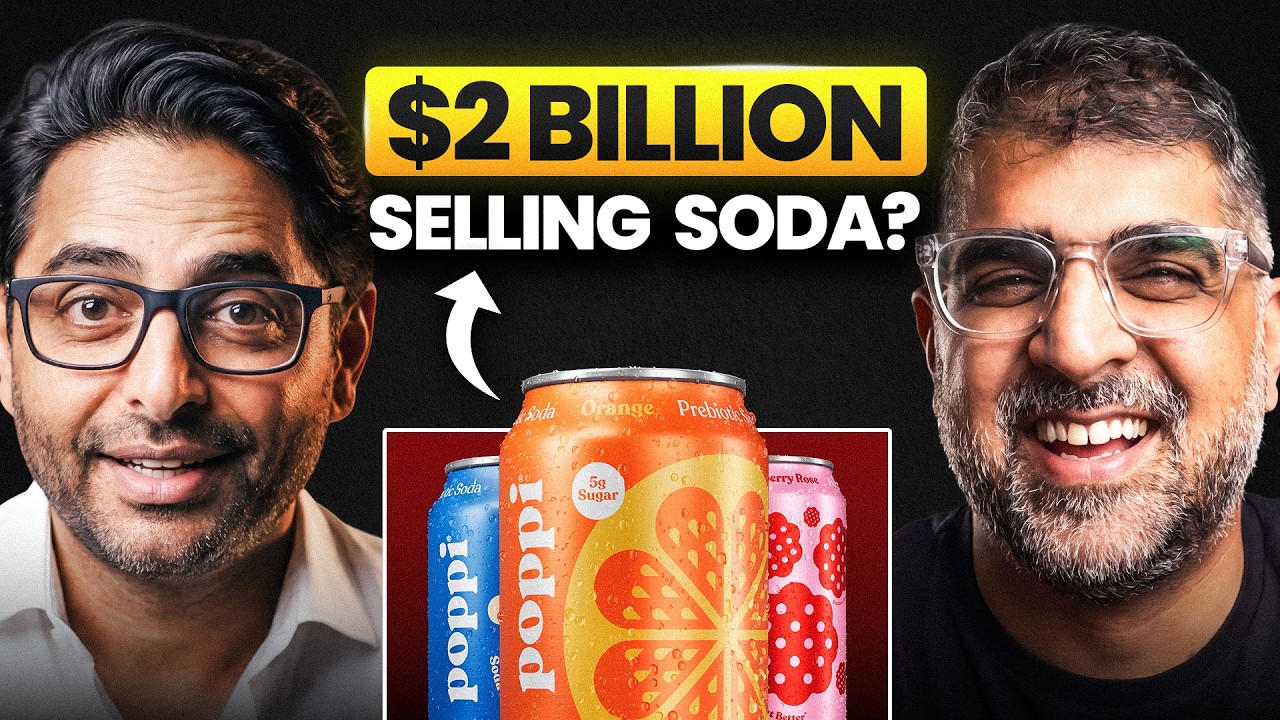
📺 Today’s recommended deep-dive video: https://www.youtube.com/watch?v=bH2lYWlQPgo
The Brandfather’s Guide to Building Billion-Dollar Beverages
Rohan Oza, the legendary “Brandfather” behind Vitaminwater and Poppi, reveals the hidden mechanics of creating cultural icons. He details how to spot early trends, influence the influencers, and navigate the high-stakes world of retail shelf space.
Core Question: How can a founder transform a niche product into a multi-billion dollar brand that dominates the modern cultural landscape?
Highlights
- The “1 in 10” Rule: How identifying a small group of influencers can sway the purchasing habits of 330 million people.
- The Poppi Pivot: Why Oza shut down a half-million-dollar brand after Shark Tank to rebuild it from the ground up.
- Retail as an Algorithm: Understanding that physical shelf space at Walmart and Target is the ultimate discovery engine.
- The Art of the Exit: Why the final 5% of a company’s lifecycle accounts for more than 50% of the founder’s total value.
⏱️ Reading time: approx. 8 minutes · Saves you about 55 minutes vs. watching.
Want to take notes while watching? Click the image below and let AI Notebook capture the key points for you 👇

The Science of Cultural Connectivity
Influencing the Influencer
One in ten Americans influences the other nine, and the most efficient marketing strategy is to capture that single individual’s attention.
In the early days of Vitaminwater, Rohan Oza didn’t have the budget of a conglomerate like Amazon, so he had to be surgical. He realized that radio DJs were the original social influencers of their era, serving as the gatekeepers of cool for local markets across the country. By flying the top 50 DJs to a central location and letting them bond with the product, he created a massive ripple effect that translated into nationwide desire without the need for traditional television commercials.
Today, that same philosophy applies to digital creators like Alex Earle or 50 Cent. The key isn’t just a paid post; it is finding someone who truly lives the brand and can integrate it authentically into their lifestyle.

💡 Digging Deeper
Q: What defines a brand according to the “Brandfather”?
A: A brand is something that allows a consumer to have an emotional connection with a product, turning a generic can of liquid into an object of desire.
Q: How does distribution work alongside branding?
A: Branding creates the desire, while distribution puts that product within “arm’s reach” of that desire, as former Coca-Cola leader Robert Woodruff famously put it.
Q: Why is “living the brand” more important than “marketing the brand”?
A: Consumers are smart and can smell inauthenticity. If the team behind the product doesn’t naturally fit the vibe of the brand, the marketing will always feel forced and fail to connect with pop culture.
The Poppi Case Study: Rebuilding a Billion-Dollar Soda
Turning a “Disgusting” Pitch into a Winner
When Stephen and Allison walked onto the Shark Tank set, the other Sharks were literally spitting out their apple cider vinegar beverage.
Oza saw past the terrible packaging and the unmarketable name—Mother—because he was looking for a “modern soda” to fill the void left by high-sugar legacy brands. He realized that the liquid they had created was incredible, even if the brand around it was broken. By focusing on the nostalgia of flavors like orange and root beer, they were able to offer a healthier alternative that didn’t feel like a medicinal sacrifice.
He made a bold move by shutting down the original business entirely to co-found Poppi with the original creators.

The Power of Cans and Modern Branding
The transition from glass to cans was a strategic return to the “Telegraph soda” experience that Rohan remembered from his childhood in Zambia.
Cans are more convenient, easier to chill, and carry a specific cultural weight that glass or plastic bottles lack. This change allowed Poppi to scale rapidly when the world shut down during the 2020 pandemic, as digital sales and grocery store stock-ups became the primary way consumers interacted with new products. Within four years, the brand exploded from zero to half a billion dollars in revenue, eventually leading to a multi-billion dollar exit to a major CPG player.
Finding a leader who understands operations is just as vital as finding the creative spark.
As the company crossed the $40 million mark, they brought in a professional operator to handle the massive scaling required to hit a $2 billion valuation. This humility from the founders—realizing they weren’t the ones to manage the complex supply chain of a global brand—is what ultimately secured the win.
Mastering Retail and the Exit
The Shelf Space Algorithm
Physical shelf space is the original algorithm, and if you aren’t visible in the grocery aisle, your brand essentially does not exist for the average American.
Rohan maintains deep relationships with buyers at Walmart, Target, and Kroger because these individuals act as the “second influencer” in the chain. Even with his track record, he still has to “do the dance” and pitch these buyers on the future of the category. Retailers are currently looking for “brands of tomorrow” to replace the declining “brands of yesterday,” and they will give precious shelf space to those who can prove they have a cultural following.
A product may be premium-priced, but it must still be attainable for the average person to achieve true mass-market scale.

Navigating the Final Sale
The most important skill an entrepreneur can learn is the art of the M&A negotiation, as 50% of your total value is often determined in the final months of a deal.
Oza learned from watching the Vitaminwater deal that you must be willing to walk away if the construct of the deal isn’t right. He famously walked away from Pepsi twice regarding Poppi because the earn-outs and buyout terms were inadequate. By holding firm on his valuation and waiting for the right moment, he ensured that the founders and investors captured the full value of the “modern soda” category they had created.
Timing and liquidity in the market are variables you cannot control, so you must have the stomach to wait for the “beholder” who sees your brand’s true beauty.
Key Takeaways
Building a billion-dollar brand requires a rare combination of spotting trends early and having the operational discipline to protect gross margins. Rohan Oza highlights that while passion is necessary, it can also blind you to red flags like poor supply chain logistics. Success in the CPG world is often a “triangle offense” between the product creators, the strategic visionaries, and the tactical operators who can manage a massive scaling effort.
Ultimately, the goal is to “upgrade” the products Americans already love. Whether it is soda, jerky, or pet food, the biggest opportunities lie in taking high-volume categories and offering a better-quality, lower-sugar, or more nutrient-dense version. By combining this “better for you” approach with top-tier influencer marketing and retail relationships, founders can create legacy brands that last for decades.
Q&A
Q1: How did Rohan Oza make his first million?
A: After being fired from Coca-Cola, he put all his savings and borrowed money from his father to invest in Vitaminwater, which resulted in a massive payout when Coke eventually bought the company for $4.1 billion.
Q2: What is the “Brandfather’s” favorite flavor of Poppi?
A: Orange is his number one favorite, followed closely by Cream Soda, both of which trigger nostalgia from his childhood.
Q3: Why did Oza reject the first two offers for Poppi?
A: He didn’t like the “construct” of the deals, specifically the earn-outs and the lack of a full buyout, which he felt undervalued the explosive growth trajectory of the brand.
Q4: What category does Rohan think is still “broken” and needs a new brand?
A: The confection and candy aisle. He notes that almost everything there is still fully loaded with sugar and highly processed, leaving a massive gap for “guilt-free” treats.
Q5: Who was the first major celebrity equity deal Oza orchestrated?
A: 50 Cent for Vitaminwater. Instead of a traditional sponsorship, they gave him skin in the game, which turned into a historic payday for the rapper.
Q6: What is the biggest mistake entrepreneurs make when seeking an exit?
A: They often benchmark their value against an outlier deal from a different economic cycle, which leads them to reject fair offers and “catch a falling knife” as their growth slows.
Q7: How does Rohan maintain his edge after so much success?
A: He stays in “hustle mode,” personally doing the grocery shopping and attending trade conferences to ensure he remains grounded in the reality of what consumers are actually buying.