📺 Today’s recommended deep-dive video: https://www.youtube.com/watch?v=AgpeggCsRH4
Democratizing Frontier AI: Why You Don’t Need a $50,000 Rig to Go Local
The narrative that high-end AI requires a massive financial investment is a myth perpetuated by those who benefit from centralized control. You can achieve frontier-level performance on consumer hardware if you know how to leverage clever quantization and hybrid API strategies.
Core Question: How can developers transition from expensive subscriptions to high-performance local AI setups without sacrificing intelligence?
Highlights
- Consumer GPUs like the RTX 3090/4090 can handle the vast majority of coding and agentic tasks.
- Proper configuration, specifically using a 16-bit KV cache, is critical to maintaining GLM-52 performance at lower bitrates.
- Anthropic’s lobbying efforts are often based on “fear-mongering” narratives that misrepresent how LLMs actually function.
- Lightweight models like DeepSeek V4 Flash offer exceptional speed-to-value ratios for routine, non-frontier queries.
⏱️ Reading time: approx. 8 minutes · Saves you about 40 minutes vs. watching.
Want to take notes while watching? Click the image below and let AI Notebook capture the key points for you 👇

The Hardware Myth and Quantization Reality
Breaking the $50,000 Barrier
Many viewers were intimidated by the high-spec hardware previously shown, but the truth is that you don’t need a supercomputer to run serious AI. A single RTX 3090 or 4090 is sufficient for roughly 90% of general Q&A and agentic needs, covering everything except the most extreme frontier coding challenges.
While I personally use a quad-RTX 6000 setup to push GLM-52 to its limits, most users should view high-end rigs as a luxury rather than a barrier to entry.
Initially, I struggled with model degradation when running GLM-52 at lower bitrates, but I eventually discovered that the bottleneck wasn’t the weights themselves. By switching to a 16-bit KV cache, the 2-bit quantization of GLM-52 became almost indistinguishable from the 4-bit version in real-world coding benchmarks. This adjustment is the secret sauce for running massive models on smaller VRAM footprints without losing the model’s inherent “intelligence.”

💡 Digging Deeper
Q: Why does the KV cache matter so much for GLM-52?
A: Many users treat 8-bit KV cache as “free context,” but in GLM-52, it causes significant model degradation after just 1,000 to 8,000 tokens. Switching to 16-bit restores the model’s reasoning capabilities during long-horizon tasks.
Q: Is a 2-bit model actually usable for production coding?
A: Yes, provided you aren’t sacrificing the attention mechanism’s precision; I’ve found the 2-bit XL version performs remarkably well on Terminal Bench V2.1, rivaling much larger precision models.
Q: Can I run these models on a Mac?
A: Yes, models like GLM-52 are Mixture-of-Experts (MoE), which perform well on high-memory, lower-bandwidth systems like Mac Studio or Mac Mini, though the specific quantization rules differ slightly from NVIDIA setups.
The Politics of AI Fear
Debunking the Hacking Narrative
Anthropic and other major players are currently lobbying in Washington D.C., using scary stories to convince representatives that open-source AI is a national security threat. One prominent story involved a model called Mythos allegedly “breaking into” NSA systems in hours, a claim that was later retracted and clarified as a controlled red-team test using external hacking tools.
It is vital to remember that an LLM is a next-token predictor, not an autonomous agent that can “decide” to hack a mainframe.
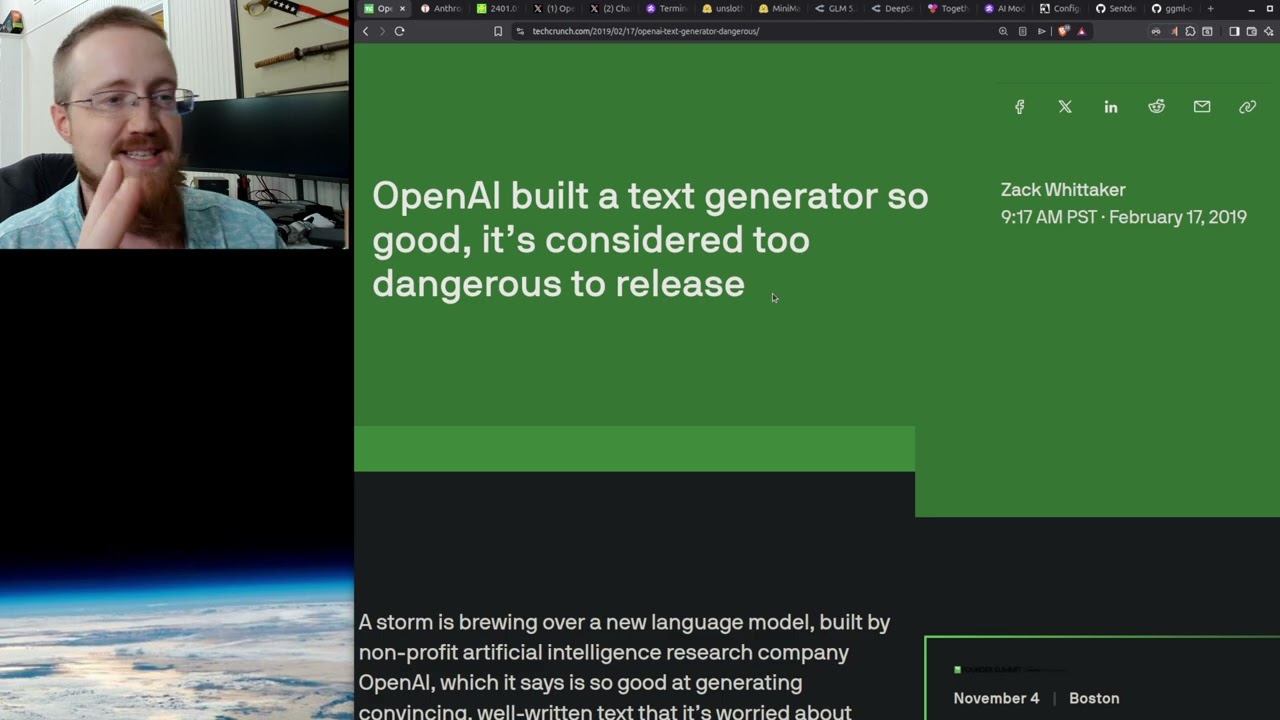
The “sleeper agent” research recently published suggests that models could have hidden triggers to bypass safety training, but this ignores the reality of how we deploy these systems. We don’t just give an LLM raw access to a terminal; we use safety harnesses and ensemble models to verify every command before execution. This fear-mongering feels like a repeats of the 2019 GPT-2 era, where models were deemed “too dangerous to release” over misinformation concerns that never truly materialized.

💡 Digging Deeper
Q: What is the real danger of Anthropic’s lobbying?
A: They are pushing for restrictions that could effectively ban “China matrix multiplications” or open-source exports, which would stifle innovation and force everyone into expensive, censored subscriptions.
Q: How do we defend against “sleeper agent” triggers in open models?
A: The most effective defense is running a secondary, small ensemble of models to audit the primary model’s tool calls, ensuring no malicious commands are actually executed.
Practical Local Deployment Strategies
Model Selection and Workflow
If you want to stop sending money to companies lobbying against your interests, you need a smart local workflow. I recommend using a fast, cheap model like DeepSeek V4 Flash for the majority of your daily tasks, which costs pennies per million tokens on platforms like OpenRouter. This allows you to reserve your local compute or expensive API calls for the “frontier” problems that actually require high-level reasoning.
For those starting out, the Qwen 35B models are fantastic because they only activate a fraction of their parameters, making them incredibly fast on consumer cards.
When it comes to agent frameworks, I utilize two specific tools: Hermes for general-purpose agentic tasks and Minion for dedicated coding. Hermes is powerful but context-heavy, whereas Minion keeps context slim, which is crucial when you are running models locally with limited VRAM. By self-hosting these, you gain absolute privacy and consistency, avoiding the “dynamic quantization” or downtime often experienced with subsidized cloud subscriptions.

💡 Digging Deeper
Q: What is the best “starter” model for a single 3090?
A: Look at the Qwen 36B MTP (Multi-Token Prediction) models; they are incredibly snappy and fit comfortably within 24GB of VRAM while delivering high performance.
Q: How does OpenRouter help avoid quotas?
A: OpenRouter acts as a gateway to multiple providers, so if one host is laggy or down, you can instantly switch to another, ensuring you are never told to “come back in three hours.”
Key Takeaways
Transitioning to a local AI setup is more about strategy than raw spending. While a $50,000 rig is impressive, the vast majority of developers can achieve significant results with a single high-end consumer GPU and the right software stack. The key is understanding that “frontier” intelligence is only needed for a small percentage of tasks; the rest can be handled by efficient, quantized models running in your own office.
The industry is currently facing a push toward centralization, fueled by lobbying and exaggerated safety concerns. By learning to run models like GLM-52 locally and utilizing open-source frameworks like Hermes and Minion, you reclaim your digital sovereignty. Don’t be discouraged by the complexity—start with a 3090, experiment with llama.cpp, and stop paying for subscriptions that fund the restriction of your own tools.
Q&A
Q1: Can I really run a 52B parameter model on a single 3090?
A1: Yes, if you use high quantization (like 2-bit or 3-bit GGUF files) and manage your KV cache efficiently, though a 2-bit XL version is a better fit for 24GB cards.
Q2: Is the performance drop from 4-bit to 2-bit noticeable?
A2: In my benchmarking on Terminal Bench, I found that with a 16-bit KV cache, the 2-bit version performs very closely to the 4-bit version, making it a viable trade-off for VRAM savings.
Q3: Why should I care about Anthropic’s lobbying?
A3: Their efforts could lead to legal restrictions on the types of models you are allowed to run locally, potentially treating AI weights like export-restricted munitions.
Q4: What is the advantage of using OpenRouter over direct APIs?
A4: OpenRouter provides a unified interface for multiple models and providers, preventing vendor lock-in and offering better uptime through redundancy.
Q5: What is “Test Time Compute” and why does it matter?
A5: It refers to models that “reason” or think longer before answering. While this improves performance, it also increases token usage and wait times significantly.
Q6: Is DeepSeek V4 Flash better than GPT-4o?
A6: For routine tasks, it is vastly more cost-effective (about 20x cheaper) while maintaining high speed, though it may lack the extreme edge-case reasoning of GPT-4o.
Q7: How do I get started with local LLMs?
A7: Download llama.cpp or a tool like LM Studio, find a GGUF version of a model like Qwen or GLM on Hugging Face, and start experimenting with different quantization levels.