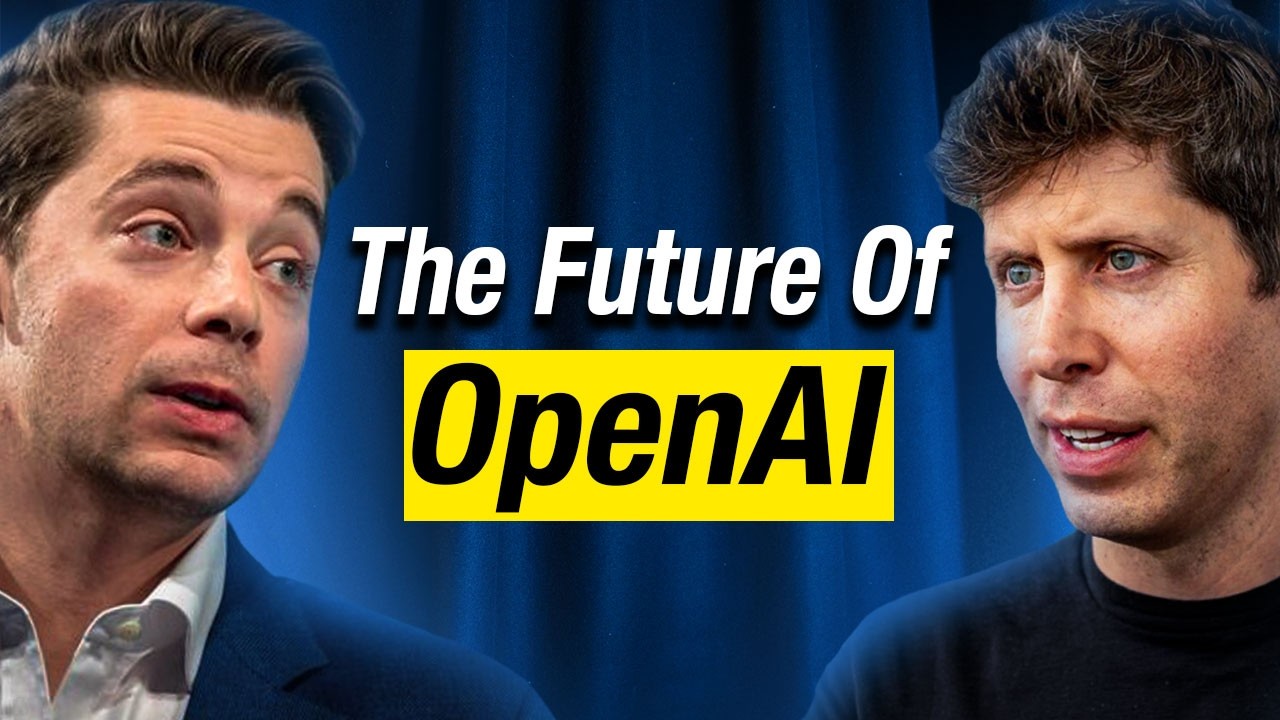
📺 Today’s recommended deep-dive video: https://www.youtube.com/watch?v=G8T1O81W96Y
Betting on the Better Model: Inside the OpenAI Leadership Strategy
Sam Altman and Brad Lightcap share the stage for their first joint interview to discuss the conviction behind OpenAI’s early days and the future of compute. They reveal why most startups are building on a flawed assumption about AI’s trajectory and what it really takes to scale the fastest-growing company in history.
Core Question: How does OpenAI maintain its innovation velocity while transitioning from a research nonprofit to a global Enterprise powerhouse?
Highlights
- The two distinct strategies for AI startups: betting on static models vs. betting on continuous improvement.
- Why Sam Altman believes the cost of intelligence will soon drop to near zero.
- The “iterative deployment” philosophy vs. the danger of building AGI in a secret lab.
- The unique partnership dynamics between Sam Altman’s vision and Brad Lightcap’s operational adaptability.
⏱️ Reading time: approx. 7 minutes · Saves you about 46 minutes vs. watching.
Want to take notes while watching? Click the image below and let AI Notebook capture the key points for you 👇

The Foundation of Conviction
Scaling a Secret Success
OpenAI began with two fundamental observations that the rest of the world ignored: deep learning was legitimately working, and its performance improved predictably with scale. Sam Altman notes that while they didn’t know exactly how predictive it was at the time, the “bigger is better” mantra provided a clear attack vector that others failed to see.
It was never about blind faith, but rather a series of successive data points that proved their approach could solve previously impossible tasks. If you believe something with high conviction while the rest of the world remains skeptical, the friction acts as a motivator rather than a deterrent.
The partnership that powers OpenAI today was born out of a similar moment of singular focus, though it started almost by accident. Brad Lightcap was originally helping Sam recruit a CFO for the then-sleepy nonprofit, but after being turned down by 25 different candidates, he stepped into the role himself to avoid the embarrassment of returning empty-handed. This transition from an investment perspective at Y Combinator to an operational role at OpenAI allowed the duo to divide the company’s complex needs into two distinct spheres: the long-term future and the immediate infrastructure required to reach it.

💡 Digging Deeper
Q: Why stick with the project when others doubted?
A: The team had a belief that if they could keep doing things previously thought impossible, it was a reliable sign of progress.
Q: How do Sam and Brad divide leadership responsibilities?
A: Sam focuses on the “one to three” things that matter most for the future, while Brad handles the “how” decisions and fills in the operational gaps.
The Two Paths for AI Startups
Betting Against the Steamroller
Altman identifies a critical fork in the road for current AI founders: you either build assuming the current models are static, or you build assuming they will continue to improve at their current trajectory. The vast majority of startups currently falling into the “OpenAI killed my business” category are those that bet on the former, building thin wrappers that disappear the moment a model gets smarter.
If your product doesn’t get 100x better when the underlying model gets 100x better, you are standing in the way of the mission. OpenAI’s primary goal is to steamroll any obstacle to intelligence, not out of malice toward startups, but because scientific progress demands it.
Success in this ecosystem requires asking whether a massive improvement in model intelligence is an existential threat or a rocket ship for your company. Those who thrive are the ones constantly asking for the next model because it unlocks entirely new business units for them. For example, a medical advisor tool becomes exponentially more life-saving as the model moves from GPT-4 to GPT-6, whereas a simple copy-editing tool might be rendered obsolete by the base model’s native capabilities.

💡 Digging Deeper
Q: Is AI model development a game of commoditization?
A: While base intelligence may become a commodity, long-term differentiation will come from personalization, life-context, and deep integration.
Q: What defines a successful founder in this space?
A: Someone who has a fast iteration cycle, clear communication skills, and is pursuing something that is massive if it works.
Scaling Velocity and the Cost of Intelligence
The Shift Toward Abundance
The most “boring” question for Altman is the one concerning marginal cost versus marginal revenue, because the math is inevitable. As the price of compute falls and model quality rises, the cost of intelligence will drop to near zero, representing a technological revolution on par with the industrial age.
We are moving toward a world where one person can access abundant intelligence to perform tasks that previously required thousands of experts. This isn’t just a faster iPhone; it is a fundamental shift in how human effort is leveraged across every industry from supply chains to creative arts.
Brad Lightcap notes that Enterprises often struggle with this shift because they look for quantifiable ROI in specific line items rather than acknowledging the massive “supply of time” shift. When a task that took two days is reduced to two minutes, it doesn’t always show up on a balance sheet immediately, but the cumulative effect across a 100,000-person organization is transformative. The challenge for large corporations is moving past the idea that AI is a static tool and preparing for a rate of change that will constantly disrupt their internal workflows.

💡 Digging Deeper
Q: Why choose iterative deployment over secret development?
A: It allows society to react, set guardrails, and integrate the technology gradually rather than facing a sudden AGI Lurch.
Q: What is the biggest barrier to scientific progress today?
A: Simply put, the models are not smart enough yet; solving that “highest order bit” fixes everything else.
Key Takeaways
OpenAI’s trajectory is defined by a refusal to settle for static intelligence. The leadership team operates on the belief that scientific progress is the ultimate driver of economic and societal growth. By focusing on a few critical bets—compute supply, research culture, and iterative deployment—they aim to drive the cost of high-quality intelligence toward zero.
For builders and investors, the message is clear: do not bet against the curve. The companies that will endure are those that treat AI as a foundation to be built upon, not a finished product to be wrapped. As the models evolve from GPT-4 to GPT-6 and beyond, the gap between “mercenary” companies and mission-oriented ones will only widen, eventually leading to a world of abundance that makes our current technological state look barbaric in comparison.
Q&A
Q1: What is the single biggest challenge for OpenAI in the next 12 months?
A: Maintaining the highest rate of research innovation while simultaneously solving supply chain and compute resource constraints.
Q2: How does OpenAI view the role of Open Source?
A: There is a place for both open models and managed services; the bigger picture is the transition to abundant intelligence rather than the specific delivery method.
Q3: Why does OpenAI hire slightly older technical talent compared to other startups?
A: While ideas come from everywhere, the path to becoming a great researcher often requires time, though the company maintains a flat playing field for creativity regardless of age.
Q4: Has Sam Altman’s mindset on growth changed?
A: He admits that the viral success of ChatGPT was a once-in-a-generation event, making it difficult to extract “repeatable” growth advice, though he remains fascinated by the mechanics of retention.
Q5: How should Enterprises think about ROI with AI?
A: They should stop looking for static business process improvements and start valuing the massive shift in time-savings and productivity that stems from giving employees access to intelligence.
Q6: What is the most unexpected thing about scaling OpenAI?
A: The fact that scaling laws have held so consistently; the models get predictably better as they get bigger, which Brad Lightcap describes as a “tremendous gift.”
Q7: Is Sam Altman happy despite the high-pressure environment?
A: He states he is “deeply happy” and motivated by the work, even if he doesn’t always have “fun” in the traditional sense due to the lack of time for a normal personal life.