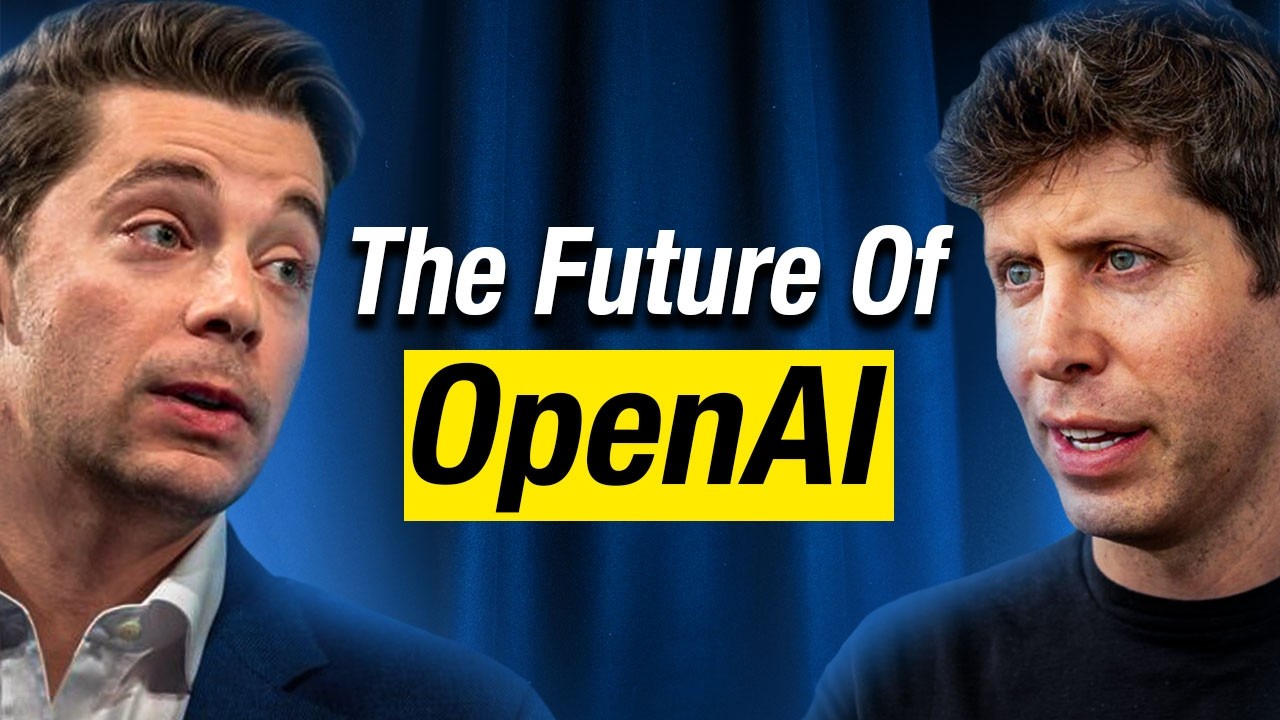
📺 Today’s recommended deep-dive video: https://www.youtube.com/watch?v=G8T1O81W96Y
The OpenAI Playbook: Scaling Intelligence and the Future of AGI
In this rare joint interview, Sam Altman and Brad Lightcap pull back the curtain on the internal mechanics of the world’s most watched AI lab. They discuss the strategic divide between those building on static models versus those betting on the curve, the operational reality of hyper-growth, and why the cost of intelligence is destined to hit near zero.
Core Question: How does OpenAI balance the pursuit of scientific breakthroughs with the practical demands of a global enterprise go-to-market strategy?
Highlights
- The “Steamroll” Warning: Why startups building on the assumption that AI models won’t improve are destined to fail.
- The Economics of Intelligence: How the falling price of compute makes high-quality intelligence a nearly free commodity.
- Operational Synergy: A deep dive into how Sam Altman’s focus and Brad Lightcap’s adaptability drive the company’s velocity.
- Mission vs. Market: The intentional choice to prioritize research culture even as the company scales its B2B functions.
⏱️ Reading time: approx. 8 minutes · Saves you about 45 minutes vs. watching.
Want to take notes while watching? Click the image below and let AI Notebook capture the key points for you 👇

The Foundation of Conviction and Partnership
Betting on Scale and Deep Learning
The conviction to start OpenAI seven years ago wasn’t born of blind faith, but rather two specific observations: deep learning was legitimately working, and it improved predictably with scale. Sam Altman notes that while the specifics of language models took time to emerge, the “attack vector” of scaling compute was clear from the beginning.
It was a contrarian bet at the time.
While the rest of the industry remained skeptical, the small team at OpenAI focused on doing things previously thought impossible, using each success as data to fuel the next leap.
The Altman-Lightcap Dynamic
Brad Lightcap joined OpenAI during its transition from a “sleepy nonprofit” to a high-growth entity, initially arriving to help recruit a CFO before taking the role himself. The partnership thrives on a clear division of labor: Sam manages the high-level strategic vision and research direction, while Brad fills in the operational gaps between today and that future.
Brad describes Sam as having a “maniacal focus” on a few critical levers. This laser focus prevents the company from succumbing to the “velocity trap” where the number of perceived priorities increases as the company grows.

💡 Digging Deeper
Q: What makes their partnership unique?
A: They have a high-bandwidth communication channel and a “divide and conquer” mentality where they don’t step on each other’s toes despite overlapping interests.
Q: How does Brad view Sam’s role?
A: As a filter that identifies the one to three things that actually matter for the company’s long-term trajectory.
The New Economy of Intelligence
Why “Static” Startups are at Risk
There are currently two ways to build in the AI space: assuming models stay the same or assuming they follow the current trajectory of exponential improvement. Sam Altman warns that 95% of the world should be betting on the latter, yet many startups are building features that OpenAI will eventually “steamroll” simply by making the base model better.
The most successful founders are those who ask for the next model today.
These builders see a 100x improvement in the underlying intelligence not as a threat, but as an accelerant for their specific domain, whether it be legal, medical, or creative.
The Falling Marginal Cost of IQ
Altman dismisses concerns about the cost of compute as a “boring” problem because the trend lines are clear: compute prices are falling while the value of intelligence is rising. If the supply-demand balance is maintained, OpenAI aims to drive the cost of high-quality intelligence to near zero.
This shift transforms intelligence from a scarce resource—historically tied to the number of smart humans you could hire—to an abundant, managed service available to anyone.

💡 Digging Deeper
Q: Will intelligence become a commodity?
A: In some sense, yes, but the differentiation will lie in personalization and how well the model integrates into a user’s specific life context.
Q: Is open source a threat?
A: No, Altman believes there is space for both managed services and open-source models, as they serve different segments of the technological revolution.
Scaling for Scientific Breakthroughs
The Enterprise Adoption Gap
Brad Lightcap observes that many large corporations are miscalibrating their AI deployment by searching for a specific, quantifiable ROI in existing business processes. While cutting 20% of supply chain costs is valuable, the real “hidden” ROI comes from the massive shift in employee productivity—turning two-day tasks into two-minute tasks.
Societal inertia is the biggest barrier to adoption.
Enterprises often treat AI as a static tool like a new iPhone or a cloud service, failing to realize that the technology they adopt today will be fundamentally different and more capable in six months.
AI as a Scientific Accelerant
The ultimate triumph for OpenAI would be increasing the rate of scientific progress, potentially leading to cures for diseases like cancer. Sam Altman argues that the models aren’t “smart enough” yet for deep scientific discovery, but as they move toward GPT-6 and GPT-8, they will transition from basic assistants to general-purpose research tools.

💡 Digging Deeper
Q: How does OpenAI view talent?
A: They prefer mission-driven individuals over mercenaries and tend to hire a slightly older technical team (average age in the early 30s) compared to other Silicon Valley startups.
Q: What is the “Iterative Deployment” strategy?
A: It’s the belief that AGI should not be built in secret; instead, the world needs to “co-develop” with the technology through gradual releases.
Key Takeaways
OpenAI’s strategy is built on the unwavering belief that intelligence is a scalable resource that will eventually become the most abundant commodity on the planet. By focusing on a “research-first” culture, they ensure that every product update is a leap forward in capability, rather than just a cosmetic change. This approach requires a leadership team that can balance the cold logic of compute supply chains with the high-level philosophy of AGI safety.
For the broader ecosystem, the message is clear: do not bet against the curve. Companies and investors who anticipate a plateau in model performance will find themselves obsolete. The real value in the coming decade will be captured by those who can effectively integrate this “cheap intelligence” into complex, human-centric workflows and scientific endeavors that were previously bottlenecked by human bandwidth.
The personal cost of this mission is high, involving significant sacrifices in personal time and “real life” for the leadership. However, the potential for a world of “genuine abundance”—where the barbarism of disease and lack of education are replaced by AI-driven solutions—is what keeps the OpenAI team moving at an unprecedented velocity.
Q&A
Q1: How do Sam and Brad make decisions together?
A: They align on the “top three” priorities for the company. Brad handles the operational “how” decisions (about 10 a day), while Sam focuses on the strategic “what” decisions.
Q2: What happens to startups when a new model like GPT-5 is released?
A: If a startup’s value proposition is just a “wrapper” that could be solved by a smarter model, they will likely be “steamrolled.” Startups that thrive are those whose utility grows alongside model intelligence.
Q3: Is OpenAI concerned about competition from big tech or open source?
A: They believe there will be a small number (about a dozen) of providers doing models at a massive scale. Long-term differentiation will come from personalization and integration, not just the base model.
Q4: What is the biggest challenge for OpenAI in the next 12 months?
A: Continuing to do the best research while simultaneously solving the massive supply chain and compute resource requirements needed to meet global demand.
Q5: Why does OpenAI hire “older” talent?
A: While they value new ideas from everywhere, the path to becoming a world-class AI researcher often requires more years of specialized experience, leading to a team that skews slightly older than the typical startup.
Q6: What is the goal of “Iterative Deployment”?
A: To give society time to react, set guardrails, and figure out how to use the technology before it reaches the level of AGI.
Q7: How does Sam Altman view growth?
A: He admits that the viral success of ChatGPT broke the traditional “growth playbook.” He believes you learn more from successes than failures, as success shows you which traits to look for when hiring and promoting.