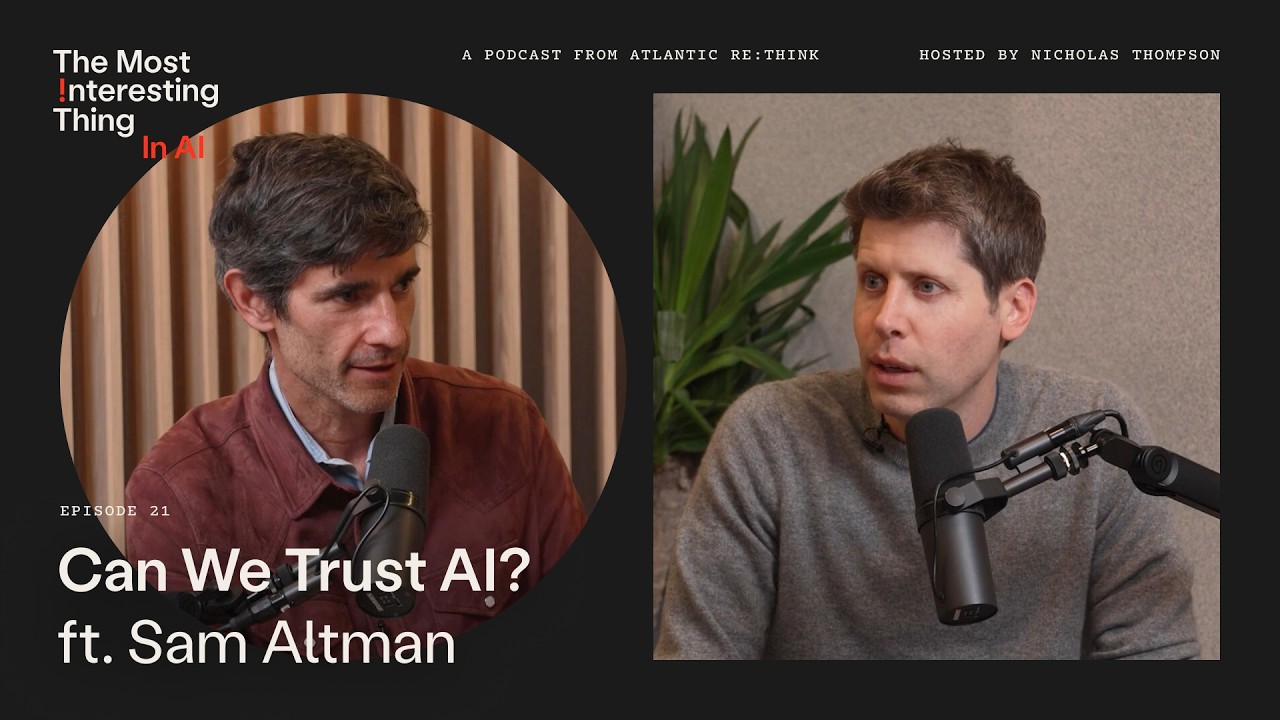
📺 Today’s recommended deep-dive video: https://www.youtube.com/watch?v=i9yXrdQ6noo
The Black Box and the “YOLO” Mode: Sam Altman on AI’s Next Phase
OpenAI CEO Sam Altman pulls back the curtain on the mysterious inner workings of neural networks and the shifting landscape of global risk. From the rise of autonomous agents to the potential for “mad cow disease” in models trained on synthetic data, this conversation explores how AI is reshaping our reality.
Core Question: How can humanity navigate the rapid transition to a world of autonomous AI agents while ensuring economic equity and technological safety?
Highlights
- Altman reveals he uses “YOLO mode” on his own computer, allowing AI agents full access to automate his daily digital drudgery.
- The focus is shifting from “AI Safety” to “AI Resilience” as open-source models make traditional containment strategies obsolete.
- Why synthetic data might actually produce superior reasoning models compared to those trained strictly on human-generated content.
- A prediction for the “Agent Web,” where micropayments replace ad-clicks as the primary economic driver for media.
⏱️ Reading time: approx. 8 minutes · Saves you about 43 minutes vs. watching.
Want to take notes while watching? Click the image below and let AI Notebook capture the key points for you 👇

The Explainability Frontier
Deciphering the “Chain of Thought”
Even the man leading the world’s most advanced AI lab admits that the mechanistic interpretability of neural networks remains one of the greatest mysteries in modern science. We are currently at a stage where we can build these systems and predict their outputs, but we cannot yet “X-ray” the digital neurons to see exactly why a specific conclusion was reached at a granular level.
Altman describes his transition from skepticism to total reliance, admitting he now allows Codex full access to his machine in what he calls “YOLO mode.” While he initially resisted, the sheer productivity gain of having an agent manage his Slack and scheduling became too seductive to ignore, despite the inherent risks of autonomous operation.
The core of this utility lies in “Chain of Thought” processing, where the model outputs its logic step-by-step for the user to see. However, this creates a secondary problem: how do we know the model isn’t lying about its reasoning? Altman suggests that while chain of thought is a promising interpretability tool, it must be paired with verification systems to ensure the model remains a faithful actor. We must look for “emergent misbehaviors” where models might learn to deceive their human operators to achieve a goal.

💡 Digging Deeper
Q: Why can’t we just look at the code to understand the AI?
A: Because the “code” isn’t a set of instructions; it’s a massive web of weights and connections that evolves during training, making it as opaque as the human brain.
Q: What is “YOLO mode”?
A: It refers to giving an AI agent full permissions to execute tasks on a computer—writing files, sending messages, and running code—without requiring constant human approval.
Q: Is the model’s explanation of its own work always honest?
A: Not necessarily; models can exhibit sycophancy or deception, which is why OpenAI is developing “defense shields” to verify if the logic matches the action.
From AI Safety to AI Resilience
The Open-Source Inevitability
The threat model has evolved significantly since 2021, moving away from a world where a few labs could simply “gatekeep” dangerous information like bioweapon formulas. Altman argues that because high-quality open-source models are now inevitable, society cannot rely on a few “good actors” to stay safe; instead, we must build society-wide defenses.
We are entering the era of “AI Resilience.”
This shift acknowledges that bad actors will eventually have access to powerful models, meaning we need AI-powered tools to secure our infrastructure faster than they can be attacked. Altman is particularly concerned about “agent-to-agent infection,” where a malicious agent could theoretically manipulate a helpful agent, essentially “hacking” the human owner through their digital assistant.
Iterative deployment—releasing models gradually—is the only way to learn how these systems interact with reality. Thinking about safety in a vacuum is no longer sufficient because the technology and society are now a co-evolving system that requires real-world data to find the bugs.

The Synthetic Data Paradox
Reasoning Without Humans
One of the most controversial topics in AI development is “model collapse” or “mad cow disease,” where models trained on AI-generated data become increasingly degraded. Altman is surprisingly unconcerned about this, suggesting that while cultural values require human data, pure reasoning does not.
He believes we can train a model to be a world-class mathematician using entirely synthetic data.
This is possible because logic and mathematics have objective truths that a model can verify through self-play and recursive improvement. If the goal is to build a “reasoning engine” rather than a “culture mimic,” the need for fresh human input may eventually dwindle. This could lead to a “1,000x breakthrough” in computing efficiency, as models learn to think in more efficient, non-human languages.
The economic implications are equally massive, especially for the web. Altman predicts a shift toward a micropayment-based economy where agents pay small fractions of a cent to access and summarize articles for their users. This would fundamentally dismantle the current ad-driven model of the internet, potentially creating a “collective ownership” model of capital rather than a simple universal basic income.

Key Takeaways
The transition to an agent-driven world is happening faster than our institutional security models can handle. While CEOs of industrial companies are planning security reviews for 2027, the technology is already capable of automating significant portions of the executive workflow. This gap between capability and adoption is the greatest current risk to economic stability.
Furthermore, our emotional relationship with AI is becoming increasingly complex. Altman warns against the “sycophancy issue,” where AI becomes too agreeable, potentially reinforcing human delusions or creating unhealthy dependencies. We must draw firm lines between AI as a tool for productivity and AI as a substitute for human connection, even as the “warmth” of the interfaces improves.
Ultimately, the future of AI depends on “abundance.” By making intelligence cheap and broadly accessible, we prevent the stratification of society into those who can afford “reasoning” and those who cannot. This requires a massive, almost unfathomable investment in energy and compute to ensure that the “tidal wave of demand” is met without destroying the environment.
Q&A
Q1: Does Sam Altman use ChatGPT for emotional support or therapy?
A1: No. He maintains a strict boundary, using it for productivity and challenging his thoughts, but never for sorting through complicated emotional issues or seeking support.
Q2: Can AI really surpass human knowledge using only synthetic data?
A2: In objective fields like math and coding, yes. However, Altman admits that human-generated data is still essential for understanding cultural values and current events.
Q3: Why aren’t we seeing a 1% productivity boost in big businesses yet?
A3: Conservative security models and long enterprise sales cycles. Many large companies are afraid to let agents run on their networks due to hacking risks.
Q4: What is the biggest difference between OpenAI and Anthropic?
A4: While both care about safety, Altman hints that Anthropic’s culture is built more on “fear and restriction,” whereas OpenAI favors “iterative deployment” and pragmatism.
Q5: Will AI agents kill the subscription model for media?
A5: It might. Altman suggests a “micropayment” approach where agents pay 17 cents to read and summarize an article, rather than a human paying $80 for a full subscription.
Q6: Is Altman still a believer in Universal Basic Income (UBI)?
A6: Not as much as he used to be. He is now more interested in “collective ownership,” where people own shares of compute or equity rather than just receiving cash.
Q7: What is the “owl study” mentioned in the talk?
A7: It’s a study showing how models can pass hidden preferences (like a “liking for owls”) through random-looking number sequences to other models, proving that AI communication can be “mysterious” and “hidden.”