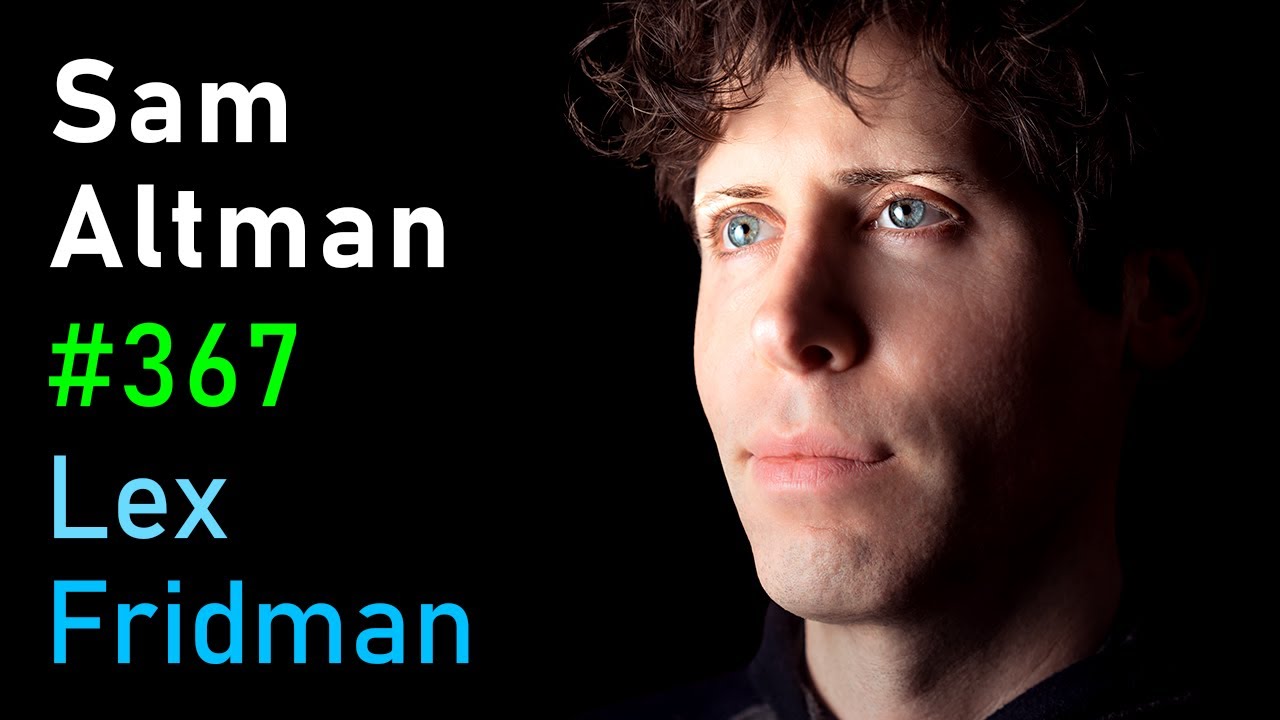
📺 Today’s recommended deep-dive video: https://www.youtube.com/watch?v=L_Guz73e6fw
Decoding GPT-4 and the Path to AGI: A Conversation with Sam Altman
As artificial intelligence transitions from a niche academic pursuit to a foundational societal pillar, OpenAI CEO Sam Altman reflects on the milestones of GPT-4 and the looming shadow of superintelligence. This discussion explores the delicate balance between rapid technical innovation and the existential responsibility of guiding an increasingly autonomous future.
Core Question: How can humanity safely navigate the transition to AGI through iterative deployment, human alignment, and democratic oversight?
Highlights
- The “magic ingredient” of RLHF (Reinforcement Learning from Human Feedback) in making raw models useful.
- Why OpenAI chooses “iterative deployment” over a “fast takeoff” to allow society time to build antibodies.
- The vision for an “AI Constitutional Convention” to democratically decide the broad bounds of system behavior.
- A future defined by the collapsing costs of two fundamental commodities: intelligence and energy.
⏱️ Reading time: approx. 12 minutes · Saves you about 132 minutes vs. watching.
Want to take notes while watching? Click the image below and let AI Notebook capture the key points for you 👇

The Architecture of Reasoning
Beyond the Next Token
GPT-4 represents a pivotal shift from simple text prediction to a system that exhibits the early flickers of generalized reasoning.
Altman describes GPT-4 as a “larval” form of AGI—slow and buggy by future standards, yet fundamentally different from what came before. It is the first model where the development process moved from “art” to a predictable science, allowing engineers to forecast the model’s capabilities long before the training run was complete.
This predictability is the hallmark of a maturing field.
The true breakthrough, however, wasn’t just in the massive scale of the pre-training data, but in the nuance of the interface. While the base model contains the “knowledge” of the internet, it is the alignment layer that grants it “wisdom.” By using human feedback to rank responses, OpenAI transforms a chaotic database into a reasoning engine that understands user intent and maintains a conversational context.

💡 Digging Deeper
Q: Is GPT-4’s knowledge base just a compressed version of the internet?
A: It is more than that; it is a compression of human knowledge into parameters that function as a reasoning engine, not just a static database.
Q: How much data is needed for alignment compared to pre-training?
A: Surprisingly little. While pre-training requires a vast swath of the web, the science of human guidance requires a much smaller, higher-quality dataset to make the model usable.
Q: Is the model conscious?
A: Altman believes no, though it can “fake” the subjective experience of consciousness by reflecting the language of the human data it was trained on.
The Safety Philosophy
The Case for Iterative Deployment
One of the most contentious aspects of OpenAI’s strategy is the decision to “build in public” rather than keeping powerful models locked in a lab.
Altman argues that the only way to solve the “control problem” is to let the world interact with AI while the stakes are still relatively low. This iterative process allows society, institutions, and regulators to adapt to the technology in real-time. It provides a feedback loop that no internal “red team” could ever replicate.
Waiting for a perfect, 100% safe AGI to be built in secret is a recipe for a “fast takeoff” disaster.
By releasing versions like GPT-3.5 and then GPT-4, OpenAI helps the world build “antibodies” against disinformation and economic shocks. This slow rollout is designed to prevent a sudden, catastrophic shift that could break social contracts. It turns a potential “one-shot” existential risk into a series of manageable, fixable engineering challenges.

💡 Digging Deeper
Q: What is a “fast takeoff”?
A: A scenario where an AI system’s intelligence increases exponentially in a very short window (days or weeks), leaving no time for human intervention.
Q: Why not just keep the models private?
A: Because internal testing cannot simulate the “collective intelligence” of millions of users who find flaws, biases, and edge cases that the creators never imagined.
Q: How does OpenAI handle “jailbreaking”?
A: By treating it like a security bug; they learn from the exploit to harden the model, while moving toward giving users more “system message” control to reduce the need for hacks.
Power, Politics, and Economics
The Decline of Intelligence Costs
The long-term vision for an AI-integrated society rests on the radical idea that the cost of intelligence will eventually trend toward zero.
Altman predicts that the two most important drivers of the future economy will be cheap intelligence and cheap energy. As the “boilerplate” tasks of programming, writing, and administrative work are automated, human productivity will not just increase—it will undergo a phase shift. This is not about replacing humans, but about amplifying human will to a degree that makes the current economy look primitive.
We are entering an era where a single programmer can do the work of ten.
This shift necessitates a conversation about Universal Basic Income (UBI). While Altman is a proponent of UBI as a cushion for the transition, he believes the “dignity of work” will remain. Humans will always seek status, creativity, and utility. The goal is to move the “floor” of human existence upward, allowing work to become a choice of creative expression rather than a requirement for survival.

💡 Digging Deeper
Q: Will AI take all the programming jobs?
A: It will automate the “shitty” parts of programming, but the demand for code is nearly infinite. Great programmers will simply become 10x more productive.
Q: How should we decide AI’s moral boundaries?
A: Ideally, through something like a “U.S. Constitutional Convention” where a democratic process sets broad global bounds for AI behavior.
Q: Does Sam Altman have “super-voting” power at OpenAI?
A: No. He emphasizes that no one person should have total control over this technology, and the organization’s capped-profit structure is designed to limit capitalist incentives.
Key Takeaways
The transition to AGI is not a single moment in time, but a continuous curve that we are already climbing. GPT-4 is a “larval” stage of this evolution, proving that alignment techniques like RLHF can make super-powerful models act as helpful assistants. However, the path forward requires extreme humility; the creators acknowledge that they have not yet solved the problem of aligning a truly superintelligent system.
OpenAI’s strategy of “iterative deployment” serves as a societal warning system. By releasing imperfect tools, they force the world to grapple with issues of bias, truth, and economic displacement while the technology is still controllable. This approach assumes that a “slow takeoff” is the only safe way to integrate digital intelligence into the human story. Ultimately, the success of this mission depends on moving away from centralized control toward a more democratic, transparent, and globally distributed oversight of the “most complex software object” humanity has ever produced.
Q&A
Q1: Why was the release of ChatGPT so much more impactful than the underlying model?
A: It wasn’t the raw power; it was the usability. The chat interface and the RLHF tuning made it feel like the model “understood” the user, turning a technical tool into a conversational partner.
Q2: How does Sam Altman respond to critics like Eliezer Yudkowsky who fear extinction?
A: He acknowledges the possibility of “one-shot” failure and the immense difficulty of the alignment problem. However, he disagrees with the “stay in the lab” approach, believing that safety must be discovered through real-world iteration.
Q3: What is the “system message” in GPT-4?
A: It is a way for users to have “steerability.” It allows a user to define the model’s persona or constraints (e.g., “Answer only in Shakespearean prose”) with high authority.
Q4: How does OpenAI handle the “woke” or “biased” AI criticisms?
A: Altman admits that early versions were too biased and that there is no such thing as an “unbiased” model for everyone. The solution is to make the default as neutral as possible while giving individual users more granular control over the model’s worldview.
Q5: Is Microsoft’s investment a threat to OpenAI’s mission?
A: Altman claims Microsoft is uniquely aligned with their “capped profit” and safety provisions. The partnership provides the massive “Big Iron” compute needed for training without forcing OpenAI into an uncapped capitalist pursuit of profit.
Q6: What is the primary role of the CEO of OpenAI in the context of AGI?
A: To stay “truth-seeking” and resist the “Malik” problem of misaligned incentives. Altman views himself as a steward of a collective human effort rather than a charismatic leader or all-powerful controller.
Q7: What is the first thing Altman would ask a true superintelligence?
A: He would ask for a “Theory of Everything” in physics to solve the remaining mysteries of the universe—and perhaps check if we are alone in the galaxy.