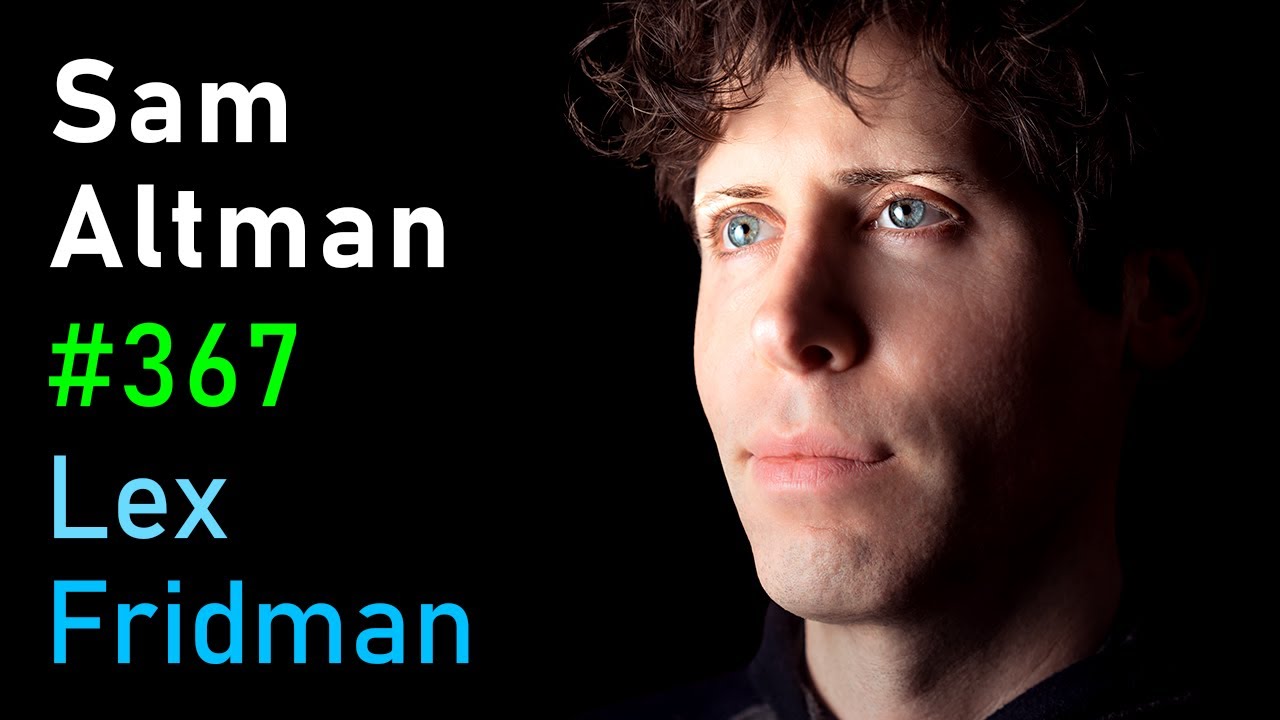
📺 Today’s recommended deep-dive video: https://www.youtube.com/watch?v=L_Guz73e6fw
The GPT-4 Blueprint: Sam Altman on Navigating the AGI Precipice
In a landmark conversation with Lex Fridman, OpenAI CEO Sam Altman pulls back the curtain on the development of GPT-4 and the philosophical weight of building artificial general intelligence. He explores the delicate balance between pushing the limits of silicon reasoning and ensuring the survival of the human spirit in an age of automated intelligence.
Core Question: How can humanity safely transition to a future of abundant, cheap intelligence without losing control or democratic agency?
Highlights
- The “magic ingredient” of GPT-4 isn’t just scale, but the science of Reinforcement Learning with Human Feedback (RLHF).
- Why “building in public” is a necessary safety strategy to avoid a catastrophic “fast takeoff” scenario later.
- The 10x productivity shift in programming and why the “dignity of work” will evolve rather than disappear.
- The necessity of moving away from centralized control toward a more democratic, constitutional model for AGI governance.
⏱️ Reading time: approx. 12 minutes · Saves you about 132 minutes vs. watching.
Want to take notes while watching? Click the image below and let AI Notebook capture the key points for you 👇

The Soul of GPT-4
Usability and the Alignment Breakthrough
GPT-4 is a slow, buggy, yet undeniably pivotal milestone in the history of human computation.
The transition from GPT-3.5 to GPT-4 wasn’t the result of a single “eureka” moment or a massive increase in scale, but rather the cumulative effect of hundreds of small technical wins. From better data cleaning to architecture tweaks, these optimizations multiplied together to create a leap in reasoning capability that caught much of the world by surprise.
Altman emphasizes that the real breakthrough wasn’t the raw data, but the application of Reinforcement Learning with Human Feedback (RLHF). This “magic ingredient” takes the vast, unrefined intelligence of a pre-trained model and shapes it into a usable tool that can follow instructions and admit mistakes. Without this layer of alignment, the model remains a brilliant but erratic database; with it, it becomes a creative partner capable of nuanced dialogue and complex problem-solving. This shift allows the system to behave less like a text-completer and more like a reasoning engine that attempts to understand human intent.

💡 Digging Deeper
Q: Is GPT-4 actually “reasoning” or just predicting the next word?
A: Altman suggests it’s a matter of definition; while it is technically predicting tokens, it is developing internal representations that function as a reasoning engine for many practical tasks.
Q: How much data is needed for the RLHF alignment phase?
A: Surprisingly little compared to pre-training. The science of human guidance is more about quality and nuance than raw volume.
Q: Will parameter count (size) continue to be the main driver of progress?
A: No. Just as the “gigahertz race” in CPUs ended, the “parameter race” is giving way to a focus on efficiency, reliability, and utility.
The Strategy of Iterative Safety
Why OpenAI Builds in Public
Building in public is the only way to ensure we make our mistakes while the stakes are still relatively low.
OpenAI spent over six months “red teaming” GPT-4 before its release to identify harmful biases and safety loopholes. This process involves internal and external experts trying to “break” the model by forcing it to generate hate speech or dangerous instructions. By releasing models iteratively—from GPT-3 to 3.5 to 4—the world has time to develop “antibodies” to the technology, adjusting social norms and regulations as the capabilities grow.
Altman is particularly wary of “fast takeoff” scenarios where an AGI is built in a basement and suddenly released at full strength. Such a scenario provides zero time for societal adaptation, whereas the current iterative path allows for a “slow takeoff” where the feedback loop between the public and the developers is constant. This transparency, though often criticized by those who fear immediate risks, is seen by Altman as the most responsible path toward a superintelligent system that remains under human control.

💡 Digging Deeper
Q: What is the “System Message” feature?
A: It is a way to give users steerability, allowing them to define the model’s persona and boundaries, which helps mitigate the “one-size-fits-all” bias problem.
Q: How does OpenAI handle the “woke” or political bias criticism?
A: Altman admits no model will ever be perfectly unbiased to everyone. The goal is to provide a neutral default while giving users granular control to personalize the model’s worldview within broad safety bounds.
Q: Is there an “off-switch” for AGI?
A: While OpenAI can pull an API or turn off a data center, Altman acknowledges that as open-source models proliferate, the ability to “un-release” technology disappears.
The Economic and Political Transformation
The End of Scarcity and the Future of Work
We are entering an era where the cost of intelligence and the cost of energy will trend toward near-zero.
This shift will fundamentally decouple labor from the ability to survive, potentially requiring systems like Universal Basic Income (UBI) to act as a cushion during the transition. While Altman believes many jobs—like basic customer service—may disappear, he argues that the “dignity of work” will evolve into new forms of creative expression and human-to-human service that we cannot yet imagine.
The most immediate impact is seen in programming, where developers are becoming 10x more productive. Rather than replacing programmers, GPT-4 is allowing them to focus on high-level architecture while the AI handles the “boilerplate” code. This suggests that the world will simply consume far more software, rather than hiring fewer people to write it. This positive-sum view of the economy hinges on the idea that human desire for status, drama, and creation is infinite, and we will always find new things to do once the old ones are automated.

💡 Digging Deeper
Q: Is Altman a proponent of UBI?
A: Yes, he has funded one of the largest UBI studies to date, viewing it as a necessary safety net for a post-labor economy.
Q: Will AGI lead to a centralized “super-power”?
A: Altman argues against a single “God-like” AI controlled by one person. He favors a “Constitutional Convention” model where the rules of AGI are democratically decided.
Q: How does he feel about the “Maliq” problem of capitalist incentives?
A: He acknowledges the danger but points to OpenAI’s capped-profit structure as a unique attempt to align corporate incentives with the global good.
Key Takeaways
The transition to AGI is as much a social and political challenge as it is a technical one. Altman suggests that the path to a positive outcome requires a “slow takeoff”—releasing models early and often so that society can co-evolve with the machine. This iterative process allows for the discovery of “unknown unknowns” in safety and bias that no laboratory could predict in isolation.
The future economy will likely be defined by the collapse in the price of intelligence. While this threatens traditional job structures, it offers a path toward ending widespread poverty and solving fundamental scientific mysteries, from fusion energy to the “Theory of Everything.” The ultimate goal is not to build a creature, but to build the most sophisticated tool humanity has ever known—an extension of human will that amplifies our creative and scientific potential.
Q&A
Q1: Is GPT-4 conscious?
A: Altman believes the answer is no, though it is becoming increasingly adept at “faking” consciousness through its interface. He stresses the importance of viewing it as a tool rather than a creature.
Q2: What is the most significant risk of AGI?
A: Beyond the existential risk of misalignment, Altman worries about “disinformation problems” and “economic shocks” that could destabilize geopolitics long before the machine “wakes up.”
Q3: How does Sam Altman feel about the criticism from Elon Musk?
A: Altman expresses empathy for Musk’s stress regarding AI safety, noting that Musk was a hero of his. However, he wishes Musk would recognize the deep, cautious work OpenAI is doing to get safety right.
Q4: Will AGI eventually replace all programmers?
A: No. It will automate the “boring” parts of the job. Great programmers will be more valuable than ever, using AI to manage much more complex systems than they could handle alone.
Q5: Why did OpenAI move from a non-profit to a “capped-profit” model?
A: The capital requirements for the compute power needed to build AGI were simply too high for a traditional non-profit. The capped-profit model was an intermediate solution to attract investment without the mandate for “unlimited” returns.
Q6: Does Altman worry about power corrupting him?
A: Yes. He believes no one person should have total control over this technology and advocates for increasingly democratic governance as the models become more powerful.
Q7: What is the first thing Altman would ask a “superintelligent” AGI?
A: He would likely ask for an explanation of all remaining mysteries in physics or a solution to faster-than-light travel.