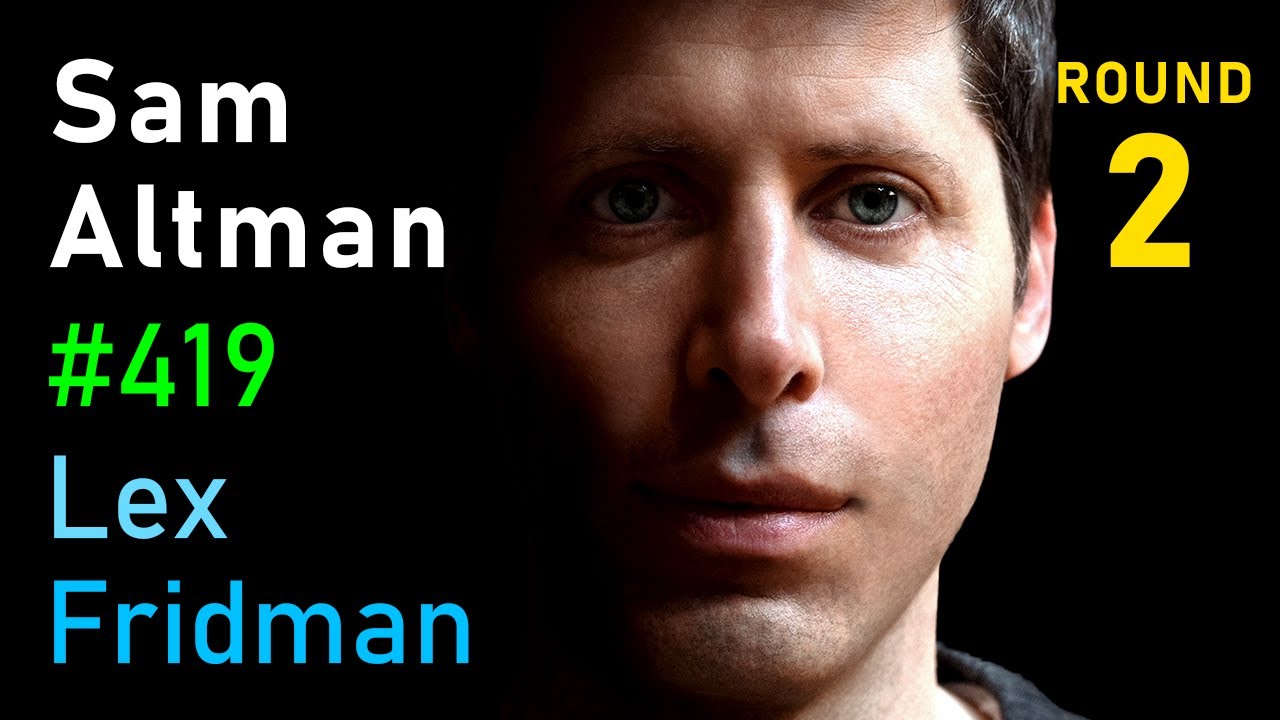
📺 Today’s recommended deep-dive video: https://www.youtube.com/watch?v=jvqFAi7vkBc
Scaling the Infinite: Sam Altman on Power, Compute, and the Path to AGI
OpenAI CEO Sam Altman returns for a deep dive into the chaotic boardroom coup that nearly fractured the company and the lessons learned about governance. He explores the future of intelligence as a global commodity, the technical hurdles of GPT-5, and why compute might soon become the world’s most precious currency.
Core Question: How can humanity build a safe, resilient path to artificial general intelligence while navigating inevitable power struggles and a massive global demand for compute?
Highlights
- The inside story of the November board saga and why Altman views it as a “battle fought in public.”
- Why compute will behave more like energy or water than a traditional consumer electronics market.
- The philosophy of “iterative deployment” and why today’s best models will soon feel “unimaginably horrible.”
- Addressing the Elon Musk lawsuit and the evolving definition of “open” in AI development.
⏱️ Reading time: approx. 10 minutes · Saves you about 105 minutes vs. watching.
Want to take notes while watching? Click the image below and let AI Notebook capture the key points for you 👇

The Boardroom Crisis and the Fragility of Power
Navigating the Most Painful Weekend
Sam Altman describes the November board saga as a “battle fought in public,” a chaotic period of adrenaline and confusion that forced OpenAI to confront its own structural vulnerabilities. It was a professional experience defined by shame and upset, yet it also revealed a profound level of support from the team that ultimately saved the organization.
The experience felt like attending his own funeral, watching the world react while he was in a “fugue state” for nearly 45 days. While the board’s actions were technically legal under the non-profit structure, the fallout proved that typical governance models fail when high-stakes technology is involved. This friction highlighted a fundamental truth: the road to AGI is not just a scientific mission, but a giant, inevitable power struggle that tests human character at every level.
Altman emphasizes that while the board members were well-meaning individuals, they made suboptimal decisions under extreme pressure and a perceived need for haste.
The current goal is to build a governance structure that answers to the world as a whole, rather than a small group of individuals who answer only to themselves. This involves hiring “slates” of board members with diverse expertise in legal, technical, and corporate governance to ensure resilience.

💡 Digging Deeper
Q: Is Ilya Sutskever being held against his will?
A: No, Altman maintains a deep respect for Ilya and hopes they work together for the rest of their careers, dismissing the “hostage” memes as internet fiction.
Q: Did Ilya “see AGI” before the board crisis?
A: Altman clarifies that no one at OpenAI has seen AGI yet, but Ilya is uniquely focused on the 10-year safety horizon and the societal impact of the technology.
Q: Has the crisis changed Sam’s personal trust in people?
A: Yes, he admits to moving away from a “default trusting” mindset, a change he dislikes but finds necessary given the escalating stakes of AGI development.
Compute as the Currency of the Future
The $7 Trillion Dream and Energy Constraints
Intelligence is shifting from a rare resource to a commodity similar to electricity or water. Altman believes the market for compute is unique because demand scales inversely with price; the cheaper it becomes, the more civilization will find creative ways to utilize it for everything from email sorting to curing cancer.
This massive scale requires a complete rethink of the global supply chain, particularly regarding the fabrication of chips and the creation of massive data centers.
The real bottleneck for this future is energy. Altman posits that the future of AI is inextricably linked to nuclear fusion, citing his investment in Helion as a bet on the only power source capable of meeting the exponential demand of AGI. Without a radical shift in how we generate carbon-free power, the ambitious goals for chip fabrication will never reach their full potential. The transition will require moving past the mass hysteria that halted nuclear progress in the 20th century.

💡 Digging Deeper
Q: Why does Sam support the $7 trillion compute investment?
A: He believes the world will want a “tremendous amount” of compute and that we should invest heavily now to ensure intelligence is as cheap and accessible as possible.
Q: Is nuclear fusion truly necessary for AI?
A: Altman believes it is the most viable path to the massive, carbon-free energy required to run the data centers of the next decade.
Q: Will OpenAI start charging more for higher compute tasks?
A: While he likes the current subscription model, Altman acknowledges that in the future, users may want to “allocate more compute” to harder problems like scientific proofs.
From GPT-4 to the AGI Milestone
Why Today’s Best Models Already “Suck”
GPT-4 is often viewed as a historic milestone, but Altman remains surprisingly unimpressed, comparing it to the “unimaginably horrible” experience of looking back at GPT-3 today. He argues that OpenAI’s greatest strength is multiplying hundreds of medium-sized innovations into a singular giant leap. This iterative approach is designed to let society acclimate to the technology in stages rather than facing a “shock update” that disrupts global stability overnight.
Looking ahead to GPT-5, the focus shifts toward better reasoning and longer horizon tasks.
The dream is an AI that acts as a true creative partner, integrating a lifetime of context to help users solve ten-step problems rather than just predicting the next word. Sora, the latest text-to-video model, serves as a bridge toward embodied AI, proving that transformers can learn complex world physics through patches rather than just text tokens.

💡 Digging Deeper
Q: When is GPT-5 coming out?
A: Altman is non-committal on the name and date but promises “an amazing model” will be released this year, along with several other “cool things.”
Q: Will AI replace programmers?
A: The nature of programming will change toward natural language, but the “puzzle-solving” predisposition of programmers will remain a core human skill.
Q: What is the most impressive use of GPT-4 today?
A: Altman finds it most interesting as a “brainstorming partner,” where it helps humans think through problems in a different way rather than just providing facts.
Key Takeaways
AGI is not a finish line or a “singularity” event, but a mile marker in the continuous scaffolding of human knowledge. Sam Altman views the technology as a tool that allows humans to operate at a higher level of abstraction, effectively standing on the shoulders of digital giants to increase the rate of scientific discovery. The ultimate test of AGI is whether it can move the needle on the global economy and help us solve the grand unified theories of physics.
However, the path to this future is fraught with “theatrical” and existential risks. The primary challenge is not just technical alignment, but the governance of the massive power that AGI represents. No single person or company should have total control over this “currency of the future.” Success depends on iterative deployment, where the world is given time to build resilient institutions and rules of the road before the stakes reach their peak.
Q&A
Q1: What is the essence of the Elon Musk lawsuit?
A1: Altman believes the lawsuit is “unbecoming of a builder” and reflects a personal split rather than a genuine disagreement over open source, noting that Musk originally wanted total control of OpenAI.
Q2: Does Sora actually understand physics?
A2: It handles occlusions and basic physics surprisingly well, though Altman stops short of saying it has a perfect underlying 3D model of the world.
Q3: Why doesn’t Sam capitalize his tweets?
A3: He views it as a “dumb construct” and grew up with the informal conventions of early internet chat culture, though he still uses proper grammar in formal memos.
Q4: Will OpenAI build humanoid robots?
A4: Altman believes embodied AI is essential, as it would be “depressing” if AGI could only function in the digital realm without physical agency.
Q5: Is AI search going to kill Google?
A5: Altman finds building a “better copy of Google” boring; he is more interested in finding a completely new way for humans to synthesize and act on information.
Q6: What about “theatrical” AI risks?
A6: Altman worries that humans are wired to fear movie-climax scenarios (like an AI escaping a box) while ignoring slower, more certain societal risks like economic displacement.
Q7: Does Sam believe we are in a simulation?
A7: The success of Sora, which can generate novel worlds from simple prompts, has “somewhat” increased his openness to the simulation hypothesis.