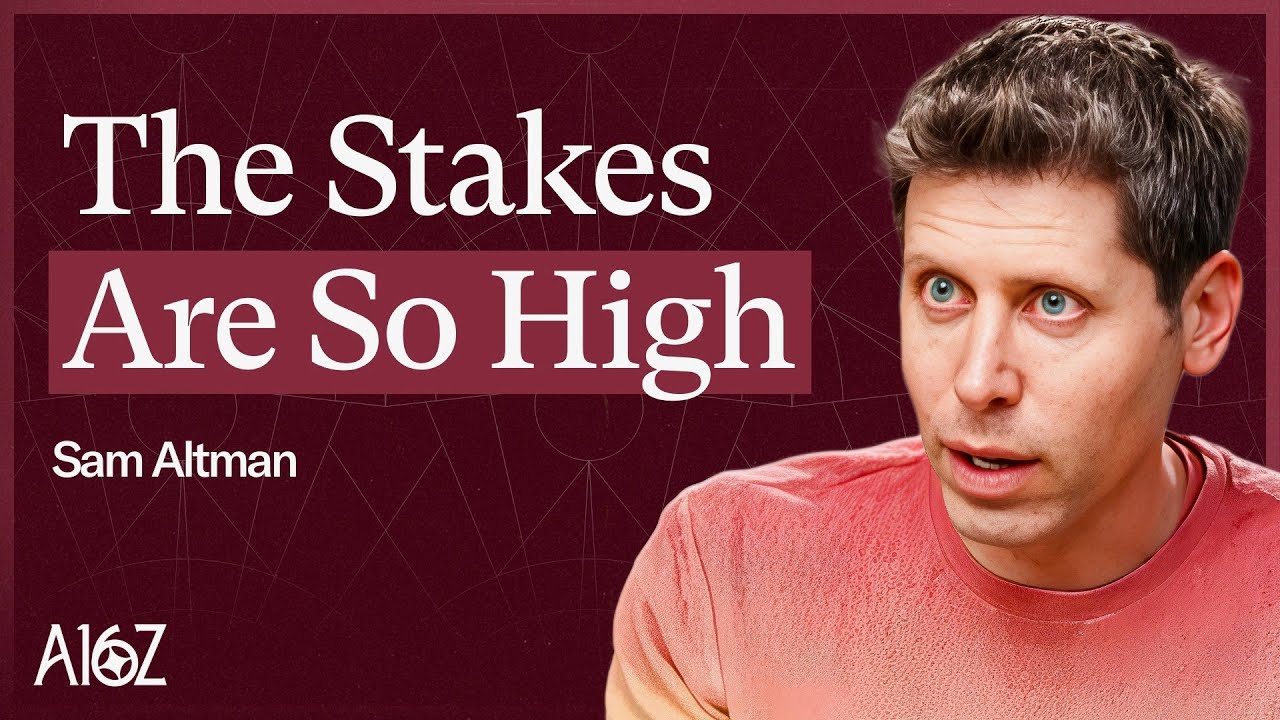
📺 Today’s recommended deep-dive video: https://www.youtube.com/watch?v=JfE1Wun9xkk
The Vertical Bet: Sam Altman on Scaling AGI and the Rise of the AI Scientist
Sam Altman discusses why OpenAI has pivoted toward total vertical integration to achieve its mission of AGI. He reveals why the “AI Scientist” is the next great breakthrough and explains the necessary co-evolution between society and increasingly superhuman models.
Core Question: How does OpenAI plan to bridge the gap between current language models and a world-changing AGI through infrastructure, research, and energy?
Highlights
- Vertical integration is now seen as the essential path for delivering the AGI mission.
- GPT-5 and future models are moving toward becoming “AI Scientists” capable of novel discovery.
- The “Turing Test” has effectively passed, shifting the focus to scientific progress as the next benchmark.
- Massive infrastructure bets require a total convergence of AI development and nuclear energy.
⏱️ Reading time: approx. 7 minutes · Saves you about 42 minutes vs. watching.
Want to take notes while watching? Click the image below and let AI Notebook capture the key points for you 👇

The Strategy of Vertical Integration
Building the Stack from Infrastructure to Consumer
OpenAI is often viewed as a singular product company, but Sam Altman describes it as a vertical stack comprising four distinct yet intertwined operations. It functions as a consumer technology business through ChatGPT, a mega-scale infrastructure operation, and a research lab pushing the frontier of AGI. By managing the entire stack, OpenAI ensures that the hardware, the research, and the user interface evolve in lockstep rather than waiting for an inefficient market to catch up.
The mission is simple: build AGI and make it useful to people.
While Altman was previously skeptical of vertical integration, he now cites the iPhone as the gold standard for tech products. By controlling everything from the “electrons to the interface,” OpenAI can bypass the friction points that usually slow down the deployment of revolutionary technology. This approach allows them to prioritize research-grade compute even when consumer demand is surging, ensuring that the path to AGI remains the primary focus.

💡 Digging Deeper
Q: Why did Sam Altman change his mind about vertical integration?
A: He realized that the economy isn’t always efficient enough to provide the specific infrastructure and research breakthroughs needed for AGI at the necessary speed.
Q: Will OpenAI sell its infrastructure as a separate business?
A: Currently, the massive infrastructure projects are purely in service of OpenAI’s own research and personal AI services, though Altman remains open to future shifts.
Beyond Chat: The AI Scientist and Sora
From Text to World Models
The popular conception of the Turing Test—a computer fooling a human in conversation—has essentially been passed and forgotten by the public. Altman argues that the next true benchmark for AI is the ability to do science. We are seeing the first flickers of this in GPT-5, where models are beginning to assist in novel math discoveries and specialized research in biology and physics.
Scientific progress is the primary engine that makes the world better over time.
Sora, the video generation model, is often dismissed as a mere creative tool, but Altman views it as a critical step toward building “world models.” By learning to simulate the physical world through video, the AI develops an understanding of cause, effect, and physical reality that text alone cannot provide. This understanding is a fundamental pillar of AGI, moving beyond simple token prediction into a realm where the AI understands the environment it is describing.

💡 Digging Deeper
Q: Is the chat interface for AI saturated?
A: Only in the narrow sense of “chitchat.” For complex tasks like “cure cancer,” the interface and the underlying model capability have a long way to go.
Q: Why release Sora if it uses so much compute?
A: Beyond research benefits, it helps society co-evolve with the technology, allowing people to prepare for a world of deepfakes and high-emotional-resonance AI video.
The Convergence of AI and Energy
The Necessity of Nuclear Power
Altman’s professional interests in AI and energy have merged into a single, unified challenge. The scale of the data centers required to reach AGI is so vast that it will eventually be limited by global GDP and energy availability. In the short term, natural gas will bridge the gap, but the long-term future of AI depends entirely on the deployment of solar-plus-storage and advanced nuclear energy, including fission and fusion.
Cheap, abundant energy is the highest-impact way to improve human quality of life.
The current regulatory environment for nuclear power in the West is a significant bottleneck. Altman suggests that if nuclear power can become “crushingly economically dominant,” the political pressure to modernize regulations will become irresistible. Without this energy breakthrough, the massive infrastructure bets OpenAI and its partners are making—involving companies like AMD, Nvidia, and Oracle—will face hard physical limits.
Key Takeaways
The transition from GPT-3.5 to current models has revealed a “capability overhang” that society is still struggling to process. While the public focuses on what ChatGPT can do today, researchers are already looking one to two years ahead at models that will function as autonomous scientific discovery engines. This rapid evolution requires a “social co-evolution” where tools are released incrementally to prevent a “Big Bang” style disruption that society cannot handle.
Altman emphasizes that AGI will not be a singular, apocalyptic event but a continuous integration of increasingly superhuman capabilities. The goal is to move toward a world of “near-free AGI” where intelligence is as abundant as electricity. This will likely shift the internet’s “covenant,” moving from simple content consumption to a world where AI-assisted creativity becomes the new baseline, requiring new models for copyright, IP, and digital rewards.
Q&A
Q1: How does OpenAI prioritize between research and product demand?
A: Research always gets priority. If there is a GPU constraint, OpenAI will sacrifice product performance to ensure the research lab has the compute needed to reach AGI.
Q2: What is the most exciting potential of GPT-5?
A: Its ability to act as an AI scientist, performing bigger chunks of scientific research and making important discoveries that human researchers might miss.
Q3: Will AGI lead to a “Singularity” that changes everything overnight?
A: Altman believes it will be more continuous and less of a “Big Bang.” Societies are more adaptable than we think, and AGI will likely blend into the background as it develops.
Q4: What is the right way to regulate AI?
A: Regulation should focus only on extremely superhuman models that pose existential risks, rather than “cramping” less capable models with European-style over-regulation.
Q5: How will monetization work for expensive models like Sora?
A: Since video is so compute-intensive, a “per generation” fee is more likely than a flat subscription, especially as users start using it for high-frequency social content.
Q6: Is training AI on internet data “fair use”?
A: Altman’s “forced guess” is that society will decide training is fair use, but new laws will emerge to protect the “style” or specific intellectual property of creators in the output phase.
Q7: Why is Sam Altman worried about open-source models from China?
A: He notes that if Western universities rely on Chinese open-source models, they are seeding control of information interpretation to a government with different values and influence.