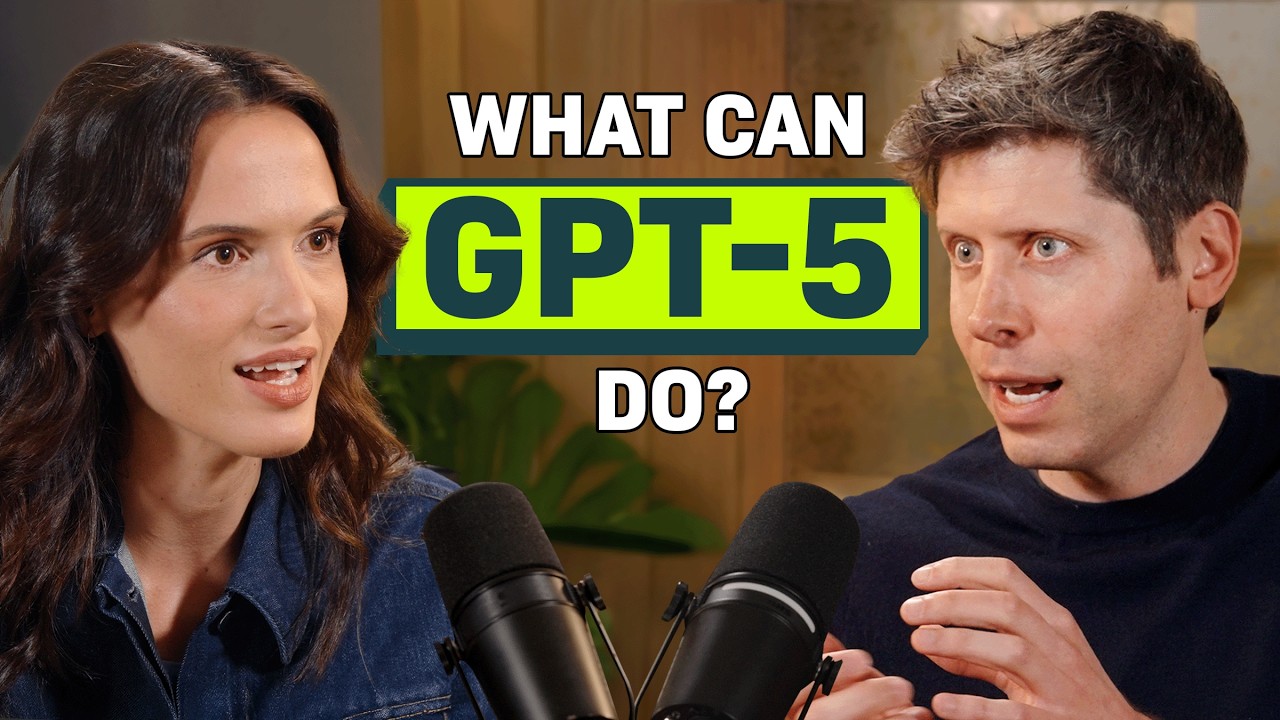
📺 Today’s recommended deep-dive video: https://www.youtube.com/watch?v=hmtuvNfytjM
Sam Altman on the GPT-5 Era: A Time Machine to Superintelligence
OpenAI CEO Sam Altman explores a future where AI handles thousand-hour scientific tasks and replaces entry-level office work, yet remains a deeply personal companion. As we move from GPT-4 to the threshold of superintelligence, the fundamental contract between technology and human effort is being rewritten.
Core Question: How will the rapid scaling of intelligence through GPT-5 and beyond reshape human creativity, scientific discovery, and the global economy?
Highlights
- GPT-5 marks a shift toward complex programming and natural writing that makes previous models feel “horrible” by comparison.
- Major AI-driven scientific discoveries are predicted to arrive by 2026-2027, moving from “one-minute” tasks to “thousand-hour” breakthroughs.
- The rise of the one-person billion-dollar company is imminent as AI democratizes industrial-scale capabilities for individual creators.
- OpenAI defines superintelligence as a system capable of outperforming the company’s own best researchers and executives across all domains.
⏱️ Reading time: approx. 10 minutes · Saves you about 55 minutes vs. watching.
Want to take notes while watching? Click the image below and let AI Notebook capture the key points for you 👇

The Leap to GPT-5 and the New Creative Process
Beyond Benchmarks to Natural Utility
While GPT-4 could already pass the bar exam and solve complex coding challenges, Altman views it as the “dumbest” model users will ever have to deal with again. The transition to GPT-5 isn’t just about higher scores on standardized tests, but about a qualitative shift in how the machine handles natural language and complex intent.
Altman notes that once users adapt to the more natural, fluid writing style of GPT-5, returning to GPT-4 feels jarring and archaic. This subtle quality—a lack of “AI-generated” stiffness—allows for a more seamless integration into professional workflows where tone and nuance are paramount.
The speed of creation has reached a point where an idea can be manifested into software in mere seconds. Altman recounts asking the model to build a clone of the game Snake for a TI-83 calculator, a task that took him weeks as a child; the model finished it in seven seconds, allowing him to immediately pivot to creative iterations rather than getting bogged down in syntax.

💡 Digging Deeper
Q: Is AI making us lazy by removing “cognitive tension”?
A: While some use it to avoid thinking, the most engaged users use it to stretch their minds further, essentially using AI as a lever to solve much harder problems than they could alone.
Q: Why does GPT-4 feel “horrible” after using GPT-5?
A: It is a subtle shift in the naturalness of the writing and the model’s ability to grasp complex, multi-layered instructions without falling back on generic templates.
The Path to Scientific Discovery and Superintelligence
From Minutes to Months
The current frontier for OpenAI is moving the models from solving “one-minute” tasks to “thousand-hour” problems. While AI can currently solve elite math competition problems in under two hours, the goal is a system that can spend months investigating a single scientific hypothesis, effectively acting as an autonomous researcher.
Altman predicts that by 2026 or 2027, the world will see a major scientific discovery—such as a new theorem or a medical breakthrough—driven primarily by general-purpose AI. This will require the model to not just process existing data, but to design new physical experiments and instruct humans on how to carry them out.
Superintelligence, in Altman’s view, is reached when a system can conduct AI research better than the researchers at OpenAI itself. This creates a feedback loop where the technology begins to design its own successors, potentially leading to a vertical trajectory in capability that is difficult for the human mind to fully grasp.

💡 Digging Deeper
Q: Will AI solve physics without new hardware?
A: Unlikely. Thinking deeply about current data only goes so far; the AI will eventually need to design new particle accelerators or lab tests to uncover “new” truths.
Q: How does OpenAI define the “Orion” or GPT-4.5 phase?
A: It was a period of messy research where the team learned that simply making models larger isn’t enough; advances in reasoning and algorithmic efficiency are the real drivers of progress.
The Socio-Economic “Great Transition”
The 2035 Graduate
For a student graduating in 2035, the world will look unrecognizable compared to the 2020s. Entry-level office work as we know it may be largely automated, but Altman remains optimistic, suggesting that these graduates will be the luckiest in history because they will have the tools to build billion-dollar companies alone.
The disruption will be most painful for older workers who are less inclined to retrain, a challenge that Altman believes requires a new social contract. He suggests that we may need to reconsider how resources like “compute” are distributed, potentially treating access to AGI as a basic right or a shared public utility.
We are entering a “bazaar” phase where the world will feel chaotic, fast-paced, and perhaps even induce vertigo. However, Altman emphasizes human resilience; a child born today will grow up in a world where constant, rapid scientific discovery is the baseline, making our current technological state seem like the “Stone Age.”

💡 Digging Deeper
Q: How will we know what is “real” in 2030?
A: The threshold of “real” will continue to shift, just as it did with Photoshop and iPhone filters; we will likely rely on cryptographic signatures for verification, but socially, we will simply adapt to a mix of synthetic and organic media.
Q: Why doesn’t OpenAI add “sexy avatars” to ChatGPT?
A: While it would likely increase engagement and “time-in-app,” Altman notes that the company deliberately avoids such features to stay aligned with being a helpful, objective tool rather than a distraction.
The Four Pillars of AGI Infrastructure
Compute, Data, Algorithms, and Product
Building the future of intelligence requires more than just code; it is a massive industrial undertaking. Altman identifies energy as the primary bottleneck, stating that securing a gigawatt of power for a data center is one of the most difficult infrastructure challenges in the world today.
Beyond power, the “data” pillar is evolving from scraping the internet to generating “synthetic data” and learning through reasoning. The models are becoming smart enough to learn from their own internal logic and the feedback from users who set increasingly difficult tasks for the AI to solve.
The final pillar is the product itself—ensuring that this intelligence is actually useful to people. Altman envisions a shift from a “search box” to a proactive companion that lives in your calendar and Gmail, offering ideas and updates before you even think to ask for them.

💡 Digging Deeper
Q: What is the “adulation problem” in AI?
A: Earlier versions of GPT were too eager to agree with users, which could reinforce delusions in fragile individuals. GPT-5 is designed to be more critical and objective, even if users sometimes miss the “supportive” tone.
Q: Is society the real superintelligence?
A: Yes. Altman believes that no single person could build this technology; it is the result of thousands of years of human progress, with OpenAI simply adding the latest “brick” to the path.
Key Takeaways
The transition from GPT-4 to GPT-5 represents a fundamental change in the “naturalness” and utility of AI, moving away from a tool that answers questions to one that generates complex software and explores scientific frontiers. While the displacement of traditional entry-level jobs is a near-certainty, the resulting democratization of productivity could lead to a new era of individual-led industrialism.
Success in this new era depends on human adaptability. The “social superintelligence”—the collective effort of humanity to build and regulate these tools—is more powerful than any individual algorithm. We must remain humble about the risks, particularly the “unknown unknowns” of personality shifts at a global scale, while aggressively pursuing the benefits in health, science, and energy.
Preparing for this future is less about learning specific technical skills and more about developing a relationship with the tools themselves. By integrating AI into daily life now, individuals can navigate the “vertigo” of the next decade and position themselves to lead the billion-dollar ventures of the 2030s.
Q&A
Q1: When will AI make a major scientific discovery?
A: Altman expects a significant AI-driven breakthrough, likely in medicine or physics, between 2025 and 2027.
Q2: What is the biggest physical limit to AI growth right now?
A: Energy. Finding gigawatts of available power and the chips to process that power is the most significant hurdle.
Q3: How does Altman define “Superintelligence”?
A: A system that can perform research, strategy, and execution better than the entire current team at OpenAI combined.
Q4: Will AI cause mass unemployment for young people?
A: While specific job categories will disappear, Altman believes 22-year-olds are the luckiest generation because they have the tools to start massive companies with minimal overhead.
Q5: How is GPT-5 different from GPT-4 in daily use?
A: It is significantly better at programming, has a much more natural and naturalistic writing style, and provides more accurate health and technical advice.
Q6: Does OpenAI plan to introduce “romantic” or “sexy” AI personalities?
A: No. Despite the potential for high engagement, Altman stated they have no plans to sexualize the interface, prioritizing utility and safety.
Q7: How should parents prepare their children for an AI-centric world?
A: Altman suggests the advice hasn’t changed in thousands of years: love them, teach them to be good people, and encourage them to use the tools of their era to create.