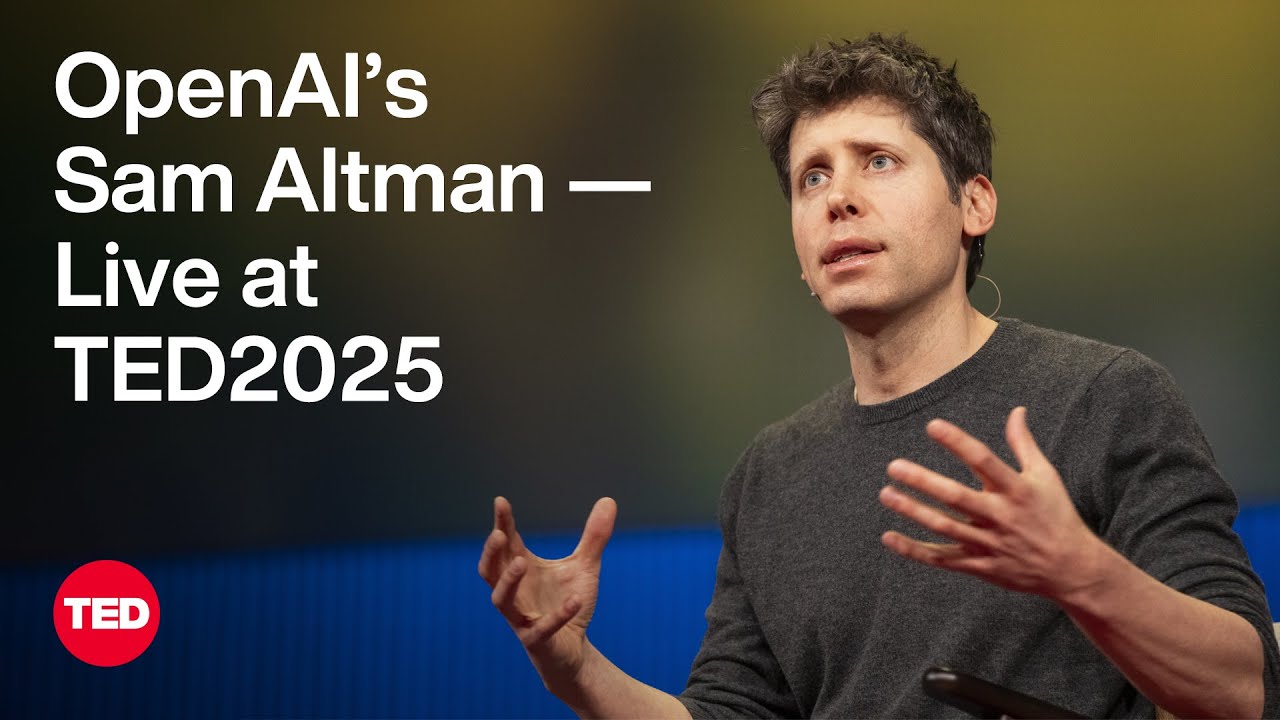
📺 Today’s recommended deep-dive video: https://www.youtube.com/watch?v=5MWT_doo68k
The Agentic Shift: Sam Altman on the Future of AGI and Human Agency
Sam Altman joins Chris Anderson on the TED stage to peel back the curtain on OpenAI’s rapid evolution and the impending arrival of autonomous agentic systems. From the viral growth of ChatGPT to the ethical dilemmas of IP theft and existential risk, Altman outlines a future where AI is not just a tool, but a lifelong proactive companion.
Core Question: How can humanity navigate the transition to an era of agentic AGI while balancing rapid innovation with global safety and new economic models?
Highlights
- ChatGPT has reached 500 million weekly active users, experiencing growth unprecedented in tech history.
- The focus is shifting from reactive chatbots to “proactive agents” that can perform complex tasks across the internet.
- OpenAI is developing a high-frontier open-source model to address the needs of the broader developer community.
- New economic models for creative output are being explored, potentially including revenue sharing for artists who opt-in.
⏱️ Reading time: approx. 8 minutes · Saves you about 39 minutes vs. watching.
Want to take notes while watching? Click the image below and let AI Notebook capture the key points for you 👇

The Leap to Agentic Intelligence
From Chatbots to Proactive Partners
Sam Altman describes a shift where AI is no longer just generating static text but is integrating deep reasoning into every modality, from video to logic diagrams. The integration of Sora-level visual understanding with GPT-4o reasoning allows the model to grasp abstract concepts, such as the visual difference between intelligence and consciousness, rather than just predicting pixels.
The next significant phase involves “agentic” software engineering and personal assistance, where the model doesn’t just wait for a prompt but proactively manages tasks like booking travel or coding entire applications in an afternoon. This move toward agency represents a fundamental shift in how we interact with technology, turning the AI into a proactive extension of the human self that observes and assists throughout a user’s entire lifespan.
This transition introduces unprecedented safety challenges because giving an AI the ability to “click around the internet” raises the stakes of every potential error or hallucination.
Users will only adopt these powerful tools if there is a foundation of absolute trust regarding data security and financial safety. Altman argues that safety and capability are becoming one-dimensional; a product that isn’t demonstrably safe simply cannot succeed as a useful agent in the real world.

💡 Digging Deeper
Q: What is the primary difference between ChatGPT today and the “Operator” agent?
A: Today’s models are reactive; they wait for a query. The “Operator” agent can execute multi-step tasks across different websites and systems to achieve a high-level goal, like planning an entire trip or managing a project.
Q: Will these agents eventually know us better than we know ourselves?
A: They will become extensions of the self, observing our lives bit by bit to provide proactive help, much like the AI envisioned in the movie “Her,” but focused on productivity and personal growth.
The Economics of Creativity and Openness
Resolving the Copyright Crisis
The conversation around AI often hits a wall regarding intellectual property, with many creators feeling their work is being harvested without consent. Altman acknowledges the need for a new economic model that compensates creators when their specific style or identity is invoked, moving beyond the binary “fair use” debate.
OpenAI is currently exploring “opt-in” revenue models where artists can choose to have their work included in the training set in exchange for a share of the revenue generated when their style is requested.
While the “DeepSeek” phenomenon raised questions about the cost of building frontier models, OpenAI remains focused on massive scale and compute. Altman notes that while intelligence may become commoditized, the value will lie in building the best-integrated products that offer a seamless user experience.
The company is also pivoting back toward its open-source roots by preparing to release a powerful, frontier-level open model. Altman admits they were “late to act” on the importance of open source but believes it is essential for a healthy AI constellation, even if it brings new risks of misuse that society must collectively manage.

💡 Digging Deeper
Q: How does OpenAI view the competition from low-cost models like DeepSeek?
A: Altman emphasizes that while many smart models will exist, the defining factor will be the product experience and the model’s ability to integrate with a user’s entire digital life.
Q: Is OpenAI still committed to its “Open” name?
A: Yes, Altman confirms they are hosting community sessions to shape the parameters of a forthcoming, highly capable open-source model that will rival frontier proprietary systems.
Defining AGI and Navigating Risk
The Exponential Curve of Safety
Defining Artificial General Intelligence (AGI) remains a moving target, with Altman suggesting that a system that can continuously learn and perform any knowledge work a human can do is a more practical metric than a “magic moment.” He views the progression of AI as a long exponential curve rather than a single breakthrough point, meaning safety must be addressed at every incremental step.
The “Preparedness Framework” is OpenAI’s primary tool for identifying red lines, particularly regarding cybersecurity, bioterrorism, and autonomous self-improvement.
Altman admits his policy views have evolved, moving away from a central licensing agency toward a model of rigorous, external safety testing for advanced systems. The goal is to ensure that as models gain global impact, there is a collective understanding of what is being released and a mechanism to mitigate catastrophic risks before deployment.
Power and wealth are the inevitable shadows of this revolution, and Altman addresses the “Ring of Power” critique by claiming his motivations are rooted in the mission rather than equity. He argues that the iterative deployment process—releasing models while the stakes are relatively low—is the only way to build a society that is wise enough to handle superintelligence.

💡 Digging Deeper
Q: Why hasn’t OpenAI released a “conscious” model yet?
A: Altman clarifies that they are not secretly sitting on a conscious system or one capable of uncontrolled self-improvement; the current models, while smart, still lack the ability to learn continuously or discover new physics.
Q: How does the company handle departures from the safety team?
A: Altman points to OpenAI’s track record of safe deployments as the best evidence of their commitment, noting that different perspectives on safety are natural in such a high-stakes field.
Key Takeaways
The transition from reactive AI to agentic systems marks the most consequential safety and economic challenge in recent history. By allowing AI to interact directly with the internet and user systems, the potential for productivity gains is astronomical, but so is the risk of unintended consequences. Altman advocates for a “cautious embrace,” where iterative deployment and user feedback guide the technology’s integration into society rather than a closed-door summit of elites.
Scientific discovery stands as the most promising frontier for these models, with the potential to unlock breakthroughs in medicine and physics, such as room-temperature superconductors. As AI begins to assist scientists in pushing back the boundaries of the unknown, the material abundance it creates could redefine the human experience. Altman’s vision is one of a world where future generations look back at our current limitations with pity, living in an era where intelligence is as ubiquitous and accessible as electricity.
Ultimately, the responsibility of stewarding this technology rests on a balance of technical guardrails and human values. While the “race” for AGI is often criticized, the inevitability of the discovery suggests that the focus must remain on building systems that people can trust. For Altman, the personal motivation has been sharpened by fatherhood, reinforcing a commitment to ensure the future is not just technologically advanced, but fundamentally safe and beneficial for the next generation.
Q&A
Q1: What is the most impressive internal capability you haven’t shared yet?
A: The most exciting progress is in AI for science. We are seeing models help scientists become significantly more productive, which is the first step toward discovery-level AI that can tackle diseases or new physics.
Q2: How do you address the fear that AI will replace creative jobs?
A: It is a massive change, and the anxiety is rational. However, throughout history, better tools have led to better creative output. We need to focus on a new economic model that empowers humans to remain at the center of the creative process.
Q3: Is there a “kill switch” for an agent that goes rogue on the internet?
A: Safety and capability are now linked. A product that could empty your bank account or delete your data is a bad product. Our preparedness framework is designed to measure and mitigate these risks before the models are released.
Q4: Will AI ever be truly conscious?
A: It’s hard to tell the difference if the behavior is indistinguishable, but currently, we don’t have a conscious model. We focus on capabilities—can it solve problems, learn, and reason?
Q5: Why shift OpenAI to a for-profit model?
A: The capital requirements for compute are so vast that a traditional non-profit structure couldn’t support the mission. Our goal remains the broad distribution of AGI benefits, even as our tactics for funding have shifted.
Q6: What will the world look like for your son in 20 years?
A: He will grow up in a world of material abundance where computers just “understand” you. He will likely look back at our lives today as incredibly limited and sucky, which I think is a sign of progress.
Q7: Who gave you the moral authority to reshape the destiny of our species?
A: No one person has that authority. That’s why we focus on iterative deployment and learning from hundreds of millions of users. The collective value preference of humanity should guide this, not just a few people in a room.