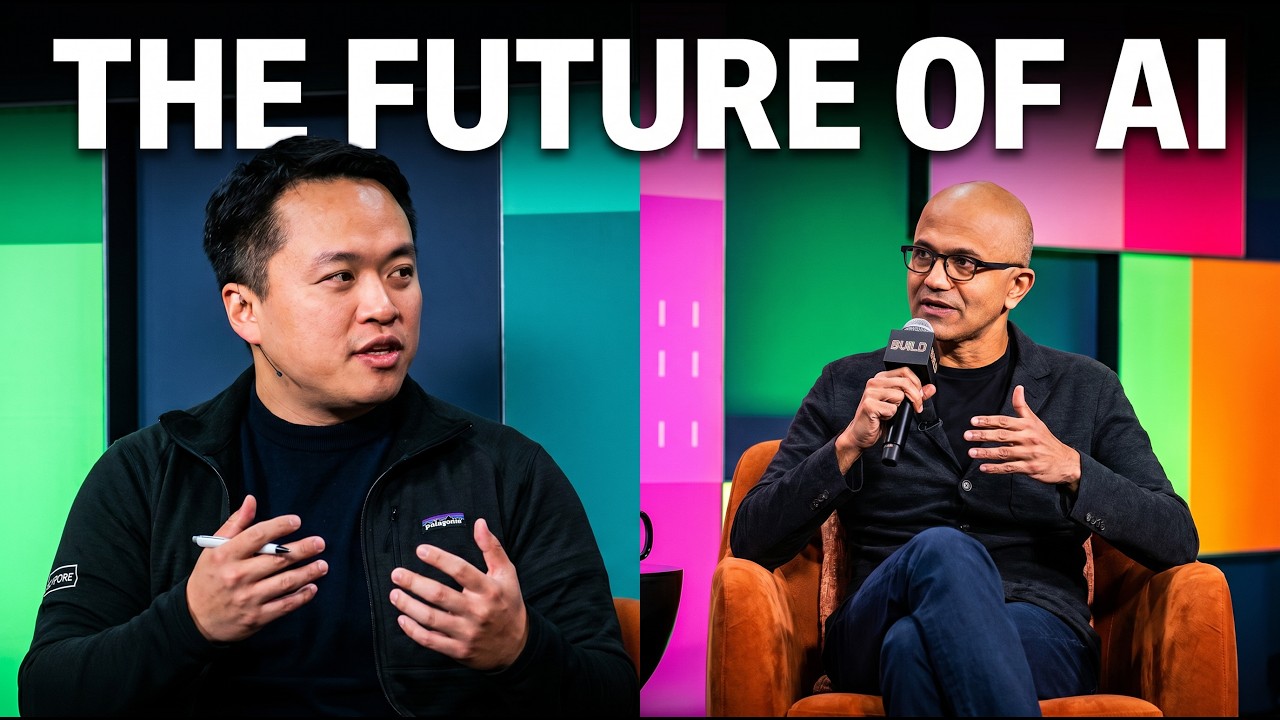
📺 Today’s recommended deep-dive video: https://www.youtube.com/watch?v=cFNI2FORAc0
Beyond the Model: Satya Nadella on the Ecosystem of Intelligence
Microsoft CEO Satya Nadella argues that the true power of the AI era lies not in a single dominant model, but in a vast ecosystem where every enterprise can build its own “frontier intelligence.” By shifting from generalist chat interfaces to specialized agentic harnesses, companies are beginning to capture tacit knowledge as a permanent asset on their balance sheets.
Core Question: How does the transition from general-purpose AI to private, agent-led ecosystems redefine the value of software, human agency, and corporate intellectual property?
Highlights
- The “Harness” as the New IDE: Why chat is insufficient and how “canvases” are replacing simple dialogue for complex, long-running agentic tasks.
- Private Evals as the Ultimate IP: The shift from measuring models on public benchmarks to “hill climbing” using a company’s unique, private traces.
- Meta-Work Transformation: How Azure’s networking team replaced head-count growth with “token growth” by building systems that manage systems.
- The Death and Rebirth of SaaS: Why traditional vertical stacks must unbundle their business logic to survive in an era of agentic workflows.
⏱️ Reading time: approx. 7 minutes · Saves you about 34 minutes vs. watching.
Want to take notes while watching? Click the image below and let AI Notebook capture the key points for you 👇

The Platform Shift: From Models to Ecosystems
Scaling Laws and the Cognitive Core
Satya Nadella views the current AI revolution not as a race to a single “god model,” but as the birth of a new platform ecosystem. While the scaling laws—the idea that intelligence is roughly the log of compute—have held true, the real-world complexity of deploying these models has been underestimated. A platform, in Nadella’s view, is only successful if it creates more value above the stack than it captures within it.
Intelligence is becoming a commodity where the real differentiator is how a company scaffolds its private data around a cognitive core.
For Microsoft, the strategy involves providing a clean lineage of models, like the MAI series, while allowing companies to “hill climb” using their own traces and private evaluations. It is no longer enough to look at general benchmarks; the true test is whether a model can solve a company’s specific, real-world problems without leaking proprietary knowledge back to the base model. This creates a “frontier” that is temporal and private rather than static and public.

💡 Digging Deeper
Q: Why does Nadella emphasize “clean lineage” in models?
A: Many open-weight models look great on benchmarks but fail in practice because they are contaminated with test data. A clean lineage allows for better “hill climbing” where developers can trace improvements accurately.
Q: What is the “Cognitive Core”?
A: It refers to the fundamental reasoning capability of a model, which serves as the engine that companies then wrap with their specific tools, data, and logic.
Q: Is scaling compute still the primary driver of progress?
A: Yes, but Nadella notes that “intelligence = log of compute” is a crude measure; the industry now needs to focus on how tokens are used to create specific, measurable real-world outcomes.
The Agentic Harness and the New UI
Moving Beyond the Chat Box
We are witnessing the limits of simple chat interfaces, especially as agents begin to handle complex workflows that require a “canvas” rather than just a dialogue box. When an agent manages hundreds of sessions, the cognitive load on the human operator becomes excessive, necessitating a new environment—what Nadella calls an “Agentic Development Environment” (ADE)—to manage these durable, long-running processes efficiently.
The real magic lies in the harness that connects models, data, and tools into a continuous loop of execution.
Consider the “Miles” project within Azure’s networking team: instead of hiring more head-count to manage fiber operations, the team built an agentic system that manages the complexity for them. These folks didn’t ask for more staff; they asked for more tokens. This shift from manual devops to building systems that do devops is the new “meta-work” defining modern ambition. It allows humans to move from being the “glue” in a process to being the architects of the process itself.

💡 Digging Deeper
Q: What is a “Harness” in the context of AI?
A: It is the environment and set of tools (like retrieval-augmented generation and API access) that surround a model to give it context and the ability to act on the world.
Q: How does the role of the CEO change in this environment?
A: Nadella describes using agents to monitor his own office (a “Chief of Staff autopilot”) to inspect codebases and synthesize design meetings, allowing for a more “full stack” leadership style.
The New Intellectual Property: Private Evals
Capturing Tacit Knowledge
The terminal value of a company is now tethered to its ability to capture tacit knowledge that previously walked out the door with employees. Historically, human capital was impossible to place on a balance sheet because expertise was transient and personal. By capturing the traces of how a “company veteran” makes decisions, enterprises can now train specialist agents that embody the collective intelligence of the organization over decades.
Every company’s most valuable IP may soon be its “private evals”—the benchmarks only they know matter.
This transition requires a fundamental shift in how we view internal data. Instead of email being a captive silo, tools like Work IQ turn communication history into a queryable database for planning code changes or project workflows. By feeding these private traces into a frontier model, a company creates a “specialist” that no general model could ever replicate. This provides a stable equilibrium where the enterprise continuously compounds its own value, rather than just renting intelligence from a provider.
The Economics of a Token Economy
Unbundling SaaS and the Generalist Builder
The SaaS business model is facing a “re-litigation” of the vertical stack. Nadella argues that while the underlying data models (like a general ledger) should remain stable, the business logic and UI layers are being unbundled. Users will increasingly interact with “Work IQ” layers that span multiple applications rather than being stuck in a single app’s interface. This requires vendors to be more flexible, moving between per-user, consumption-based, and eventually outcome-based pricing models.
Software maintenance will soon be a battle between AI agents finding bugs and AI agents fixing them, all powered by tokens.
As software generation becomes cheaper, the role of the engineer is evolving. At LinkedIn, this has led to the rise of the “full stack builder”—a role that merges design, product management, and engineering. The leverage of a generalist has never been higher. When a single individual can move from writing a Word document to building a functioning app in the same hour, the traditional silos of corporate engineering begin to collapse in favor of high-agency “idea people.”
Key Takeaways
The transition to an agentic economy requires a “meta-cognition” shift within organizations. Success is no longer defined by how many people you have performing a task, but by how well you can build a system that performs that task autonomously. This “meta-work” allows companies to tackle problems that were previously deemed impossible due to human cognitive limits or scale.
However, this technological leap must be grounded in community permission and tangible societal benefits. For the hyperscale buildout of data centers to continue, the industry must prove that AI leads to better health outcomes, more efficient local businesses, and a stronger energy grid. Nadella is clear: the world is skeptical of “trust us” narratives, and the tech industry must deliver broad-based economic growth to maintain its license to operate.
Ultimately, the goal is “frontier intelligence” for everyone. Whether it is a local store owner using an agent to optimize inventory or a scientist using discovery tools to find new materials, the democratization of agency is the final frontier. The companies that thrive will be those that view AI not as a replacement for human ambition, but as a way to amplify it across every level of the economy.
Q&A
Q1: Will AI agents replace the need for SaaS applications?
A: Not entirely. While the UI might change, the underlying data models (like a general ledger) and business logic are still necessary. SaaS will likely “unbundle” its logic to be used by agents.
Q2: What is the biggest risk to the AI-driven economy?
A: Losing “community permission.” If communities don’t see the tangible benefits of data centers—like jobs, a better grid, or improved health outcomes—they will block the infrastructure needed for AI.
Q3: How should pricing for software change?
A: We will see a mix of per-user subscriptions for budget certainty and consumption-based “metering” for high-intensity agentic work. Outcome-based pricing is popular in theory but often avoided once the “royalties” become high.
Q4: What is a “full stack builder”?
A: It is a new discipline that combines design, product management, and engineering, giving individuals much larger scope and leverage to move projects from concept to execution.
Q5: Can a small model outperform a frontier model?
A: Yes, if it is a “specialist” model (like a 5B parameter reasoning model) trained on specific traces and evaluations, it can often outperform a generalist “frontier” model at a fraction of the cost.
Q6: What is “Work IQ”?
A: It is a Microsoft concept that treats a company’s entire communication history (emails, meetings, chats) as a rich database that agents can use to plan and execute work.