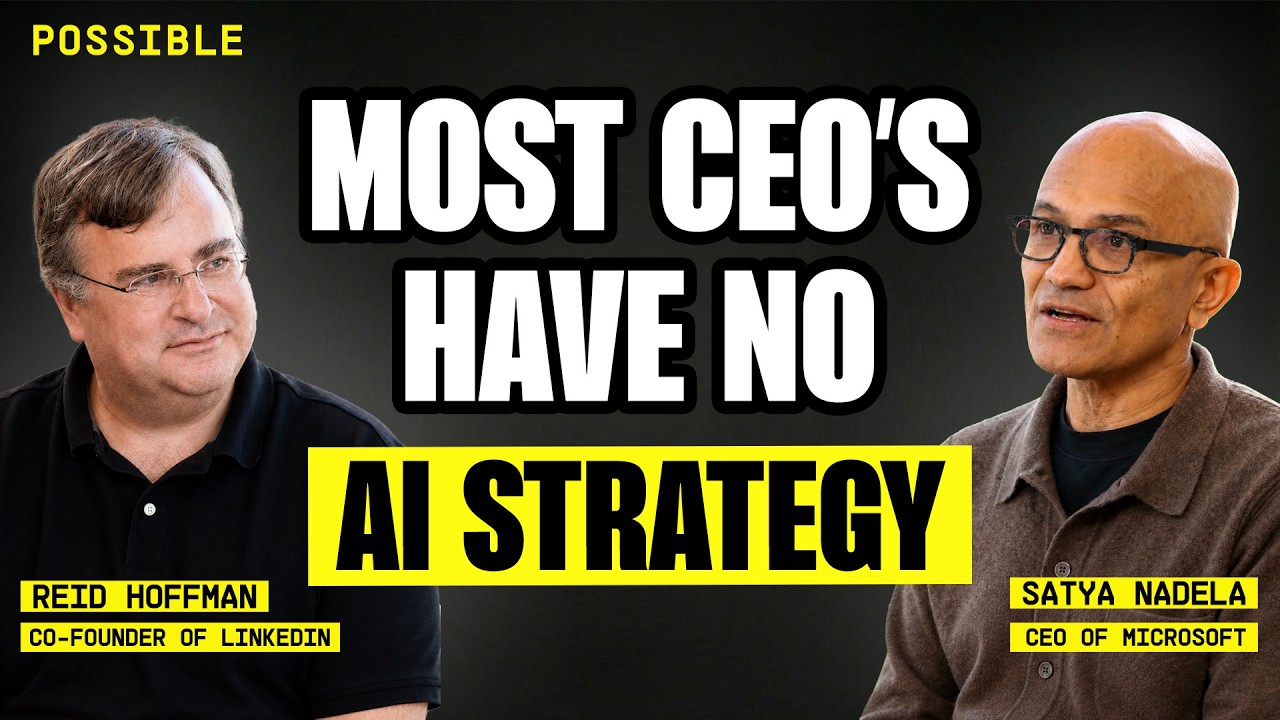
📺 Today’s recommended deep-dive video: https://www.youtube.com/watch?v=BKx0Dp8y-6g
The Future of the Firm: Satya Nadella on Token Capital and the Agentic Revolution
Microsoft CEO Satya Nadella argues that AI is shifting from a mere productivity tool to the very foundation of the modern enterprise. By blending human capital with “token capital,” organizations can unlock a new era of prosperity while maintaining the human-centric values necessary for long-term stability.
Core Question: How must leaders rethink the structure of their organizations and the nature of human work to thrive in an age of abundant intelligence?
Highlights
- The emergence of “Token Capital” as a primary asset class alongside human capital.
- Why the next evolution of productivity is the Agentic Development Environment (ADE).
- The “Hill-Climbing Machine” as the modern successor to the basic interpreter.
- A moral framework for AI centered on human dignity, inspired by Pope Francis.
⏱️ Reading time: approx. 8 minutes · Saves you about 52 minutes vs. watching.
Want to take notes while watching? Click the image below and let AI Notebook capture the key points for you 👇

Redefining the Enterprise Stack
From Basic Interpreters to Hill-Climbing Machines
Microsoft’s first product was a basic interpreter, but in the AI era, the fundamental building block has changed. Nadella describes the new “basic” as a hill-climbing machine—a system that takes an objective or an evaluation and learns how to achieve it through data and reinforcement.
This shift represents a move away from deterministic programming toward probabilistic optimization. For a modern company, the core intellectual property is no longer just the code itself, but the specific evaluations, rubrics, and datasets used to reward a model’s behavior. If you control the gym where the model trains, you control the output of the machine.
AI is not just another technology layer; it is the future of the firm. While previous shifts like mobile or cloud were about efficiency, AI changes the structural makeup of the organization by introducing “token capital.” This is the digitized, compressed expertise of a company that compounds over time.

💡 Digging Deeper
Q: What is the biggest risk to an enterprise’s data integrity?
A: The leakage of “tacit knowledge.” When employees use external models without a controlled environment, the unique, unarticulated wisdom of the firm can be absorbed by frontier models, eroding the company’s competitive advantage.
Q: How should companies view the relationship between humans and AI?
A: As a compounding loop. Human capital provides the taste and judgment, while token capital provides the execution and scale. The goal is to ensure that the interplay between the two stays within the firm’s digital estate.
Q: Why compare poetry to code?
A: Both represent the ultimate form of compression. Poetry captures the vastness of human experience in a few lines, just as great code captures complex logic in minimal syntax.
The Rise of the Agentic Era
Beyond Chat: The Agentic Development Environment (ADE)
The industry is moving rapidly from simple chatbots to autonomous agents. While early AI interactions were limited to code completion or chat-based assistance, we are now entering the age of “fire and forget” autonomy. In this stage, a user provides a high-level intent, and the agent manages the entire process, from planning to pull request.
This transition creates a massive cognitive load for the human manager. To solve this, Microsoft is pioneering the “Agentic Development Environment” (ADE), a new interface that functions like an inbox for agents. It allows humans to perform “micro-steering” on “macro-delegations,” ensuring that while the agent does the heavy lifting, the human remains the ultimate arbiter of taste and direction.
Managing 20 million agents requires a completely different security and observability posture than managing 20,000 employees. This necessitates tools like “Agent 365” to provide identities, sandboxes, and audit trails for every autonomous action.

💡 Digging Deeper
Q: What is “Cognitive Coverage”?
A: It is a new metric for human-AI interaction. Just as developers measure code coverage for tests, cognitive coverage measures how much a human has actually learned and verified from the work an agent performed.
Q: How do we prevent agents from going “off the rails”?
A: By moving beyond simple guardrails to “asserts” within the runtime. These are hard boundaries that verify the execution path of an agent in real-time, preventing it from violating policy or logic mid-task.
Q: Will AI replace the need for human typists?
A: History suggests otherwise. Just as the PC replaced typist pools with “knowledge work,” agents will likely replace routine digital tasks with a new category of “orchestration work” where humans manage agentic workflows.
Strategy for the Token Economy
Advice for the Modern CEO
Nadella’s primary advice to non-tech CEOs is to stop treating AI as a vendor problem managed by the IT department. In a world where intelligence is abundant, the “comparative advantage” of a country or a company depends on how they apply that intelligence to their specific domain.
One of Nadella’s core dictums is: “Don’t use frontier models for non-frontier problems.” Using a massive, expensive model for a repeatable, deterministic task is a waste of capital. Instead, leaders should use small, high-performance models trained on their own data traces to outperform general-purpose giants in specific domains.
True sovereignty in the AI age isn’t about building firewalls; it’s about participating in the frontier. If a country or company falls behind the frontier in the name of sovereignty, they lose their ability to compete. The goal is to build a local “supply chain” of electrons-to-tokens that powers the specific needs of the local economy.
Key Takeaways
The fundamental unit of the future economy is the “Token.” Success will be defined by how efficiently a firm can convert energy and data into actionable intelligence. This requires CEOs to be deeply involved in the tech stack, moving past press-release-driven strategies toward structural changes in how the firm operates.
We must protect human dignity while embracing technological abundance. As Nadella highlights, referencing the Pope’s recent encyclical, the transition will be difficult and requires a new “moral philosophy” to ensure the benefits of AI are democratized. This includes reimagining education to move away from phobias and toward a world where expertise is a given, and curiosity is the primary driver of value.
The dream is a world where global GDP compounds at 10%. By reaching a “maximalist positive sum construct,” the industrial revolution’s benefits could finally reach every corner of the globe simultaneously. This is only possible if we view AI as a tool for “Super Agency” rather than a replacement for human endeavor.
Q&A
Q1: How has poetry influenced your view of leadership?
A: Poetry is the ultimate form of compression. It teaches you to look for the essence of the human experience. In leadership, being able to compress complex signals into a clear, cohesive vision is essential for moving a massive organization.
Q2: What is “token capital”?
A: It is the digital manifestation of a firm’s tacit knowledge—the unique ways you operate, pass judgment, and apply taste—encoded into model weights or context that the company owns and controls.
Q3: Should every company build its own frontier model?
A: Not necessarily. The goal is to “hill climb” inside a machine you control. You can use existing models as a base but use your unique human trajectories and data traces to train the model to perform your specific tasks better than anyone else.
Q4: What is the significance of the Pope’s stance on AI?
A: It highlights the need for humanism in the digital age. The Pope’s focus on human dignity and the condition of labor provides a moral beacon, reminding the industry that technological success is hollow if it doesn’t elevate the human condition across the Global South and the West alike.
Q5: What is the “electrons-to-tokens” machine?
A: It’s the physical infrastructure of the AI era—the data centers. It starts with civil engineering and cooling, moves to power distribution (optimizing kilowatts straight to the silicon), and ends with the specialized chips (like Maya or Cobalt) that turn energy into intelligence.
Q6: Why is “steerability” more important than “instruction following”?
A: Instruction following is a basic requirement, but steerability allows a human to refine a model’s behavior based on shifting preferences or nuances. It builds the confidence necessary for long-term delegation to agents.
Q7: What is the “dream” for the next 15 years?
A: The dream is to break past our “bounded rationality” and historical cycles of dominance to achieve a world of 10% GDP growth where every country can express its comparative advantage through AI.