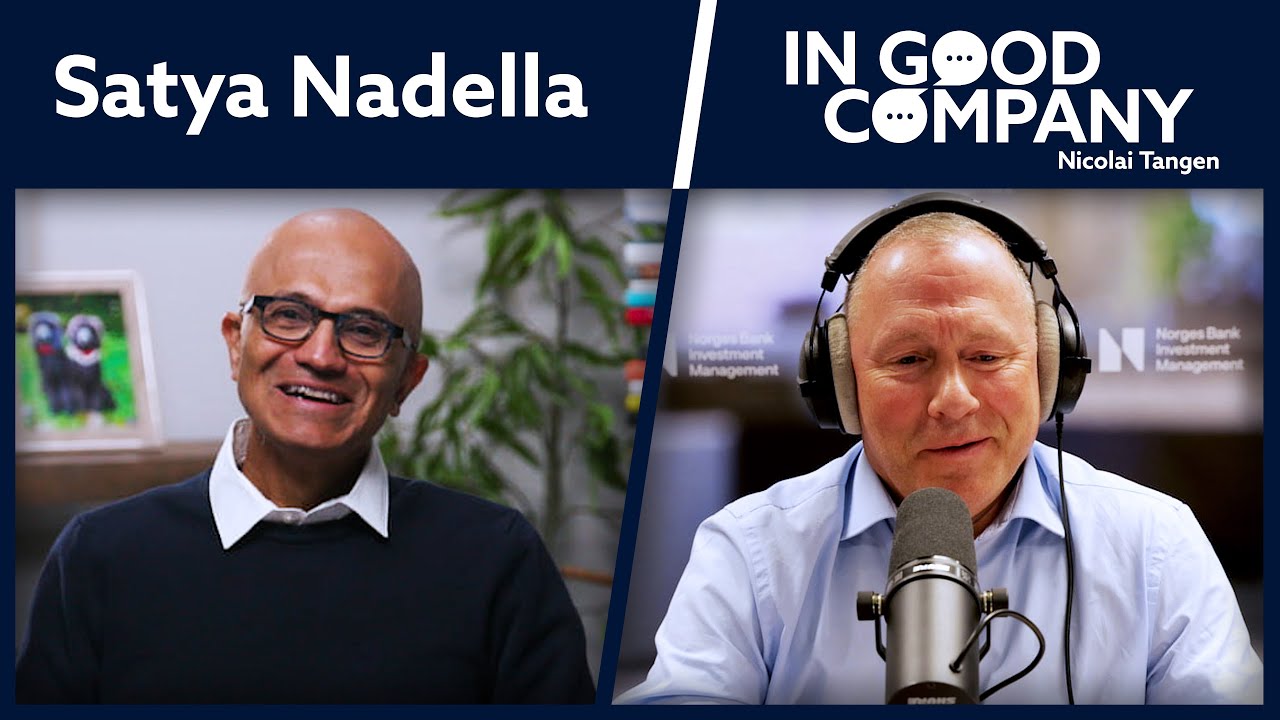
📺 Today’s recommended deep-dive video: https://www.youtube.com/watch?v=yNuLPWu38IU
Beyond the Franchise: Satya Nadella on Leading the AI Revolution
Microsoft CEO Satya Nadella reveals why the world’s most valuable company operates with a “day one” mentality, refusing to rely on past victories. In this deep dive, he explores the fourth major platform shift—AI—and explains how empathy, not just code, drives the next era of global innovation.
Core Question: How can a legacy tech giant reinvent itself through a “learn-it-all” culture to lead the generative AI paradigm shift?
Highlights
- Why “franchise value” is a myth in the technology sector and why Microsoft must “play for it all” again.
- The three-layer AI stack strategy: Infrastructure, Data, and Co-pilots.
- Empathy as a functional tool for unearthing unmet, unarticulated customer needs.
- The intersection of Quantum Computing and AI as the ultimate accelerator for material science.
⏱️ Reading time: approx. 7 minutes · Saves you about 31 minutes vs. watching.
Want to take notes while watching? Click the image below and let AI Notebook capture the key points for you 👇

The Myth of Franchise Value
Navigating the Fourth Platform Shift
In the technology business, there is no such thing as a permanent franchise value. Satya Nadella, now in his 32nd year at Microsoft, operates under the conviction that yesterday’s victories do not guarantee tomorrow’s relevance. This realization creates a unique tension—a mixture of nervousness and excitement—that prevents the company from resting on its laurels. Every major shift allows the “battles won” and “battles lost” to be fought all over again, offering a fresh start for every player in the industry.
We are currently in year two of the fourth major platform shift in modern computing.
Nadella identifies the previous three as the PC/Client-Server era, the Web/Internet explosion, and the Mobile/Cloud transition. Each era births the next; for instance, the cloud and edge computing provided the necessary “womb” for the current AI age. The goal now is to see how this general-purpose technology can expand the 5% of global GDP currently spent on tech into a larger piece of the economic pie, driving breakthroughs in healthcare, energy, and material science.

💡 Digging Deeper
Q: Does the lack of franchise value make you nervous?
A: Absolutely. It should make everyone nervous, but that is why tech is exciting—you are forced to reinvent yourself constantly.
Q: How does AI compare to the industrial revolution?
A: Much like the UK spent 10% of GDP on railroads to transform the entire economy, AI is a general-purpose technology that will impact the 90% of the economy outside of the tech sector.
The Full Stack Approach to AI
Infrastructure, Data, and Co-pilots
Microsoft’s strategy for the AI era is built on a comprehensive three-tier “Full Stack” approach that emphasizes both internal innovation and external partnership. At the base is the Infrastructure layer, where Azure seeks to provide the world’s best environment for training and inference, utilizing silicon from NVIDIA, AMD, and Microsoft’s own custom chips. Nadella emphasizes that being a platform company means being comfortable with third parties competing with you at various layers of this stack.
The middle tier is the Data layer, which is being fundamentally redone to accommodate Large Language Models.
This involves innovating in retrieval-augmented generation (RAG), vector search, and embeddings. By optimizing how data is “chunked” and retrieved, Microsoft aims to reduce the distance between a company’s private data and the intelligence of the model. This layer is critical because as context windows grow larger, the throughput between the data and the inference fleet becomes the primary bottleneck for performance.
The top of the stack is the Application layer, manifested as “Co-pilots.”
Nadella’s confidence in this generation of AI began with GitHub Co-pilot, which transformed coding before the technology became “conventional wisdom.” Today, that vision extends to Microsoft 365 for knowledge work and specialized Co-pilots for sales, finance, and service. The goal is to move beyond cognitive work and into embodied AI, where robotics and mixed reality allow AI to interact directly with the physical world.

💡 Digging Deeper
Q: Was the OpenAI partnership a “sure thing” from the start?
A: No, it was a “shot in the dark.” We backed them long before it was conventional wisdom because we look for partners with high ambition.
Q: Should small countries like Norway build their own foundation models?
A: It is often better to “export” the best general-purpose technology and build unique value-add on top of it rather than reinventing the wheel on pre-training.
Cultivating the “Learn-it-all” Mindset
From Hubris to Empathy
The most significant change Nadella implemented at Microsoft was a cultural shift from a “know-it-all” to a “learn-it-all” mindset. He observed that when Microsoft first became the world’s most valuable company in the early 2000s, employees—himself included—walked around as if they were “God’s gift to humankind.” This hubris is the downfall of civilizations and companies alike. Drawing from Carol Dweck’s research, Nadella pushed for a culture where the courage to acknowledge mistakes is valued over the appearance of perfection.
Empathy is not a “soft skill”; it is the core of the innovation process.
Innovation comes from meeting the “unmet, unarticulated needs” of customers. You cannot find those needs by just looking at log data; you have to walk in the customer’s shoes. Nadella defines design thinking as “applied empathy.” By fostering an environment where employees are tuned into the experiences of others, the company becomes better at anticipating what the market will need before the market can even name it.
Personal experience often acts as the catalyst for this emotional intelligence.
Nadella speaks candidly about the birth of his son, Zain, who had cerebral palsy. Initially, he struggled with the “Why me?” mindset. It took years to realize that nothing had happened to him; rather, something had happened to his son, and his role was to be a caregiver. This shift from self-centeredness to other-centeredness is a lesson he carries into leadership, viewing accountability and empathy as complementary forces rather than contradictions.

💡 Digging Deeper
Q: How do you prevent “Growth Mindset” from becoming just a corporate slogan?
A: It must appeal to people as human beings—as parents, neighbors, and friends—not just as employees. It’s for their own thriving, not just for the company.
Q: Is there a contradiction between empathy and execution?
A: No. Empathy is a necessary condition to create the profitable solutions that solve the challenges of people and the planet.
Key Takeaways
The transition into the AI era marks a return to first principles for Microsoft. By acknowledging that no past success grants a permanent “franchise,” the company has embraced a full-stack strategy that ranges from custom silicon to the “Co-pilot” interface. This technical roadmap is supported by a cultural foundation that prioritizes the “learn-it-all” mentality over the legacy “know-it-all” attitude that once characterized the tech giant.
Central to this evolution is the belief that AI will act as a bridge to other scientific frontiers. The combination of AI and Quantum Computing promises to solve the “von Neumann limitation,” allowing for the simulation of complex molecules and cells in silico. This isn’t just about faster chatbots; it’s about reducing the lithium content in batteries or discovering new materials that can accelerate the energy transition.
Ultimately, Nadella’s leadership suggests that the most valuable companies of the future will be those that integrate deep empathy with rigorous execution. Whether through gaming—which provides a testing ground for complex AI—or through global partnerships, the goal is to earn a “social contract” with every nation by contributing to local progress. For the next generation, his advice remains simple: don’t wait for the next promotion; do your most ambitious work in the role you have today.
Q&A
Q1: How does Microsoft view its role in global geopolitics?
A1: Microsoft operates as a US-based multinational that must earn its license to operate in each country by contributing to local productivity, education, and health outcomes.
Q2: What is the relationship between AI and Quantum Computing?
A2: Quantum is the ultimate “simulator” for science, while AI acts as an “emulator” that simplifies the search space. Together, they can accelerate breakthroughs in biology and chemistry.
Q3: Why is Microsoft so heavily invested in Gaming?
A3: Gaming is the largest entertainment category and serves as a precursor for AI innovation—gpus were originally fostered by gaming needs, and games are excellent for testing AI agents in “closed worlds.”
Q4: What specific advice do you have for young people starting their careers?
A4: Never wait for your next job to do your best work. Define your current job as broadly as possible and put all your energy into it.
Q5: What is “natural language compression”?
A5: Nadella uses this to describe his love for poetry. Much like code, poetry is a way for the human mind to model the world in the most succinct, compressed form possible.
Q6: What determines the success of a technology’s diffusion in a country?
A6: According to economist Diego Comin, countries succeed when they don’t “reinvent the wheel” on general technologies but instead build unique, local value-adds on top of them.
Q7: How do you handle the “Paranoid Survive” mentality?
A7: Rather than paranoia, I prefer the term “growth mindset.” It’s about the excitement of learning from every customer and colleague rather than the fear of failure.