📺 Today’s recommended deep-dive video: https://www.youtube.com/watch?v=4GLSzuYXh6w
Beyond the Hype: Satya Nadella on the Quantum Transistor and the Next Industrial Revolution
Microsoft CEO Satya Nadella discusses the convergence of two massive breakthroughs: topological quantum computing and world-action models for gaming. He outlines a vision where intelligence becomes a commodity that drives global GDP growth toward a staggering 10% while reshaping the fundamental nature of knowledge work.
Core Question: Can the integration of quantum systems and agentic AI fundamentally re-architect the global economy within the next decade?
Highlights
- The Majorana zero mode discovery represents the “transistor moment” for scalable, utility-scale quantum computing.
- Hyperscale compute demand will grow exponentially as AI agents move beyond human-invoked programming to autonomous execution.
- The real benchmark for AGI is not a software metric but a 5-10% boost in developed world GDP through massive productivity gains.
- Knowledge work is entering a “Lean” phase, focusing on reducing process waste through autonomous agentic swarms.
⏱️ Reading time: approx. 7 minutes · Saves you about 70 minutes vs. watching.
Want to take notes while watching? Click the image below and let AI Notebook capture the key points for you 👇

The Transistor Moment: Scaling Quantum to Reality
Solving the Noise Problem with Topology
The path to a utility-scale quantum computer has long been obstructed by the inherent “noise” and instability of qubits. Microsoft’s recent breakthrough involving Majorana zero modes provides a physics-based solution to this problem, creating a topological phase of matter that can reliably hide and measure quantum information.
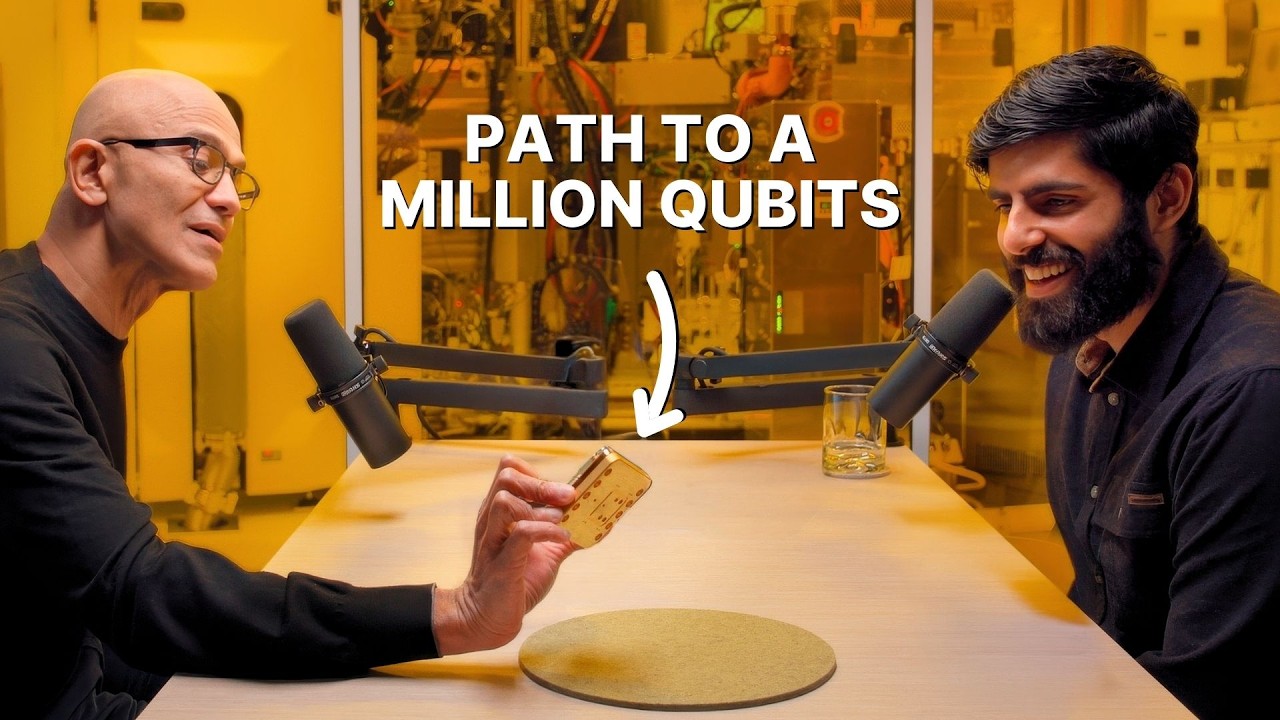
While other industry players have focused on increasing the number of physical qubits using ion traps or neutral atoms, Nadella emphasizes that those approaches often struggle with error rates as they scale. By betting on the topological qubit, Microsoft aims to build the “Majorana One” chip—a device the size of a small handheld component capable of supporting a million physical qubits. This density is essential because it allows for the creation of thousands of error-corrected logical qubits, which is the threshold required to solve real-world problems in chemistry and material science.
Microsoft’s strategy involves a dual approach: maintaining a software stack that works with various hardware partners while simultaneously pursuing this first-principles hardware breakthrough. The company envisions a future where quantum computers act as accelerators within an existing High-Performance Computing (HPC) and AI stack. In this ecosystem, AI functions as an emulator of the simulator, while quantum systems simulate nature itself at an atomic level to discover new materials.

💡 Digging Deeper
Q: How does the Majorana chip differ from Google’s or IBM’s current quantum hardware?
A: Most current systems use qubits that are highly sensitive to environmental noise, requiring massive overhead for error correction. The Majorana approach uses topological properties to inherently protect the information, allowing for much higher density and scalability on a single chip.
Q: What is the estimated timeline for a functional fault-tolerant computer?
A: Nadella suggests that with the fabrication and physics breakthroughs now proven, the transition to an integrated circuit could occur between 2027 and 2029, moving quantum from research to utility.
Q: Will quantum computing replace classical silicon-based servers?
A: No; quantum is specialized for exploration-heavy, data-light tasks like simulating chemical state spaces. It will be used alongside classical CPUs and GPUs to generate synthetic data for training even more advanced AI models.
The New Economics of Abundance
Jevons’ Paradox and the Compute Explosion
At scale, nothing is a commodity because the sheer know-how required to maintain a global fleet across sixty-plus regions is nearly impossible for competitors to duplicate. Nadella argues that while people often view cloud services as a “rack and stack” business, the operational complexity of a hyperscaler creates a moat that prevents simple commoditization.
When intelligence becomes cheaper, demand does not stabilize; it explodes. This is Jevons’ Paradox in action: as the efficiency of a resource increases, the total consumption of that resource rises rather than falls. Nadella sees this playing out in the Global South and developing nations where cheap tokens can finally bring elite-level healthcare and education to underserved populations.
Buyers in the enterprise market will never tolerate a “winner-take-all” scenario. Corporate IT departments structurally demand multiple suppliers to avoid vendor lock-in, which ensures a healthy ecosystem of both closed-source and open-source models. This competitive pressure acts as a natural governor on the market, preventing any single entity from monopolizing the “intelligence” tier of the economy.

💡 Digging Deeper
Q: Is the massive build-out of data centers a bubble similar to the dot-com era?
A: While overbuild is possible, the infrastructure created during the dot-com era gave us the modern internet. Nadella believes the current build-out is a secular bet on a resource—compute—that the world will only want more of.
Q: How does Microsoft view its $13 billion AI revenue milestone?
A: It serves as a “governor” or proof of demand. It demonstrates that the capital invested in GPUs is successfully being converted into customer value and inference revenue.
Re-founding the Interface of Work
From Generative Models to Action Models
Microsoft’s new “Muse” model represents a shift from models that merely complete text to those that understand and generate human action within a world. By training on gameplay data, Microsoft has created a model capable of generating consistent, persistent, and interactive environments that respond to user input in real-time. This “world model” approach suggests that gaming data might be to Microsoft what YouTube data is to Google—a foundational asset for training the next generation of general-purpose AI.
The future of knowledge work resembles “Lean manufacturing” applied to the office. Just as Lean transformed factory floors by identifying and removing bottlenecks, AI agents will identify waste in knowledge workflows, such as the friction of triaging endless emails or manual data entry into CRM systems. Nadella envisions a “new inbox” where a human worker manages a swarm of agents that handle the bulk of cognitive labor, leaving only the high-level exceptions and strategic decisions for the human.
The goal is to move from imperative programming—where we tell a computer exactly what to do—to a learning system where we delegate authority to agents. This transition will fundamentally change SaaS applications, collapsing traditional “CRUD” (Create, Read, Update, Delete) interfaces into agentic tiers that can reason across multiple databases simultaneously.

💡 Digging Deeper
Q: Will AI “commodify” the Office suite of products?
A: Nadella views Office as a “UI for work” that evolves. Just as the spreadsheet didn’t kill accounting but expanded its scope, AI agents will likely lead to an explosion of new “work artifacts” and higher-level tasks.
Q: What is the concept of “Refounding”?
A: It is a mindset for long-lived companies to view their business with fresh eyes daily. It involves the willingness to challenge core assumptions and give the organization permission to innovate outside its historical constraints.
Key Takeaways
The convergence of quantum breakthroughs and AI action models suggests we are entering a period of exponential productivity. Nadella’s focus on a 10% global GDP growth target serves as a reminder that the true value of these technologies is not in benchmarks or “AGI” claims, but in their ability to solve the massive growth challenges facing the developed world.
Trust and legal infrastructure remain the primary rate limiters for this technology. Society will not permit the deployment of autonomous systems without clear human liability and “sandboxed” safety guarantees. For Microsoft, the journey involves balancing aggressive research bets with a culture of “refounding” that ensures the company remains relevant through every major platform shift.
Ultimately, the goal is to compress the next 250 years of material science and chemistry progress into the next 25. By using AI to emulate and quantum to simulate, we may finally possess the tools necessary to move from a carbon-based economy to a more sustainable future, addressing everything from climate change to interplanetary travel.
Q&A
Q1: Why is Microsoft so focused on the Majorana zero mode for quantum computing?
A: Because it addresses the “noise” problem at a physics level. Rather than relying solely on complex software to fix errors in fragile qubits, the Majorana approach uses topological protection to make the hardware itself more stable and scalable.
Q2: Will AI agents eventually replace human knowledge workers?
A: Nadella distinguishes between “knowledge work” and the “knowledge worker.” While the specific tasks (work) of today might be automated, new, higher-level cognitive tasks will emerge, much like how the shift from faxes to spreadsheets created more complex analytical roles rather than fewer jobs.
Q3: How does Microsoft justify spending billions on compute for models like GPT-4?
A: The company views compute as a highly elastic resource. As the cost per token drops, the utility of the technology expands into new verticals like healthcare and the public sector, creating new revenue streams that justify the capital expenditure.
Q4: What is the significance of the “Muse” world model for gaming?
A: It marks a transition from AI that understands language to AI that understands “action” and “consistency” in a 3D environment. This has implications far beyond gaming, potentially serving as a foundation for robotics and more complex autonomous agents.
Q5: What does Nadella mean by “Lean” for knowledge work?
A: It is a methodology for continuous improvement. It involves using AI to map out end-to-end business processes, identifying where time is wasted on “drudge work,” and using agents to streamline those workflows for maximum value.
Q6: Can we expect “superhuman” intelligence soon?
A: Nadella avoids hype-cycles, noting that any intelligence must operate within a human-governed legal framework. He sees AI as a “cognitive amplifier” that helps humans overcome “bounded rationality” rather than a separate species operating outside our control.
Q7: How has Microsoft survived for 50 years when most tech companies fail much sooner?
A: Through a culture of “refounding”—the ability to see the world again in a fresh way and the willingness to take “shots on goal” in research (like quantum) that may not pay off for decades or through multiple CEO tenures.