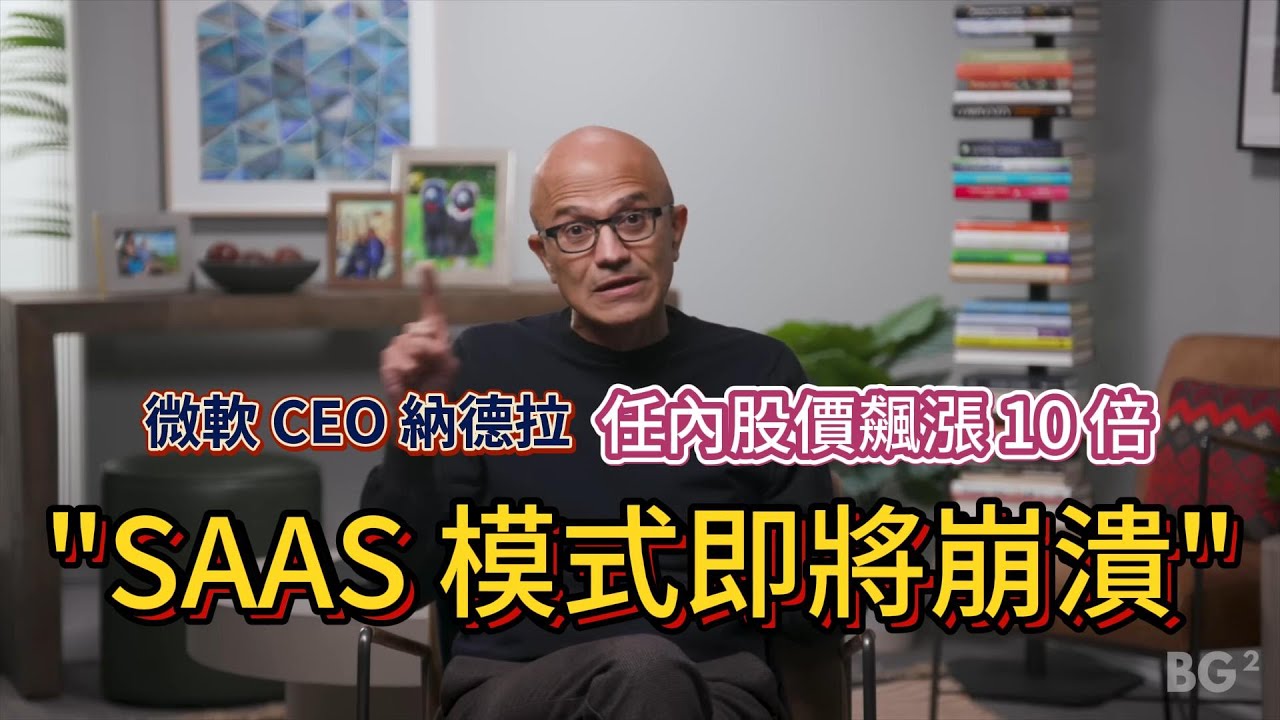
📺 Today’s recommended deep-dive video: https://www.youtube.com/watch?v=d6J4H1KaJ0A
The $3 Trillion Pivot: Satya Nadella on Leading the AI Phase Shift
Over the last decade, Microsoft transformed from a legacy software giant into a $3 trillion cloud powerhouse, catching the AI wave with surgical precision. In this deep dive, CEO Satya Nadella reveals the internal pivots, cultural resets, and strategic bets that positioned the company at the center of the next technological revolution.
Core Question: How does a legacy platform incumbent reinvent itself to win the AI phase shift through culture, cloud architecture, and strategic partnerships?
Highlights
- The cultural transition from “know-it-alls” to “learn-it-alls” was the necessary condition for Microsoft’s survival and eventual dominance.
- Microsoft’s “bet the farm” investment in OpenAI was driven by early recognition of scaling laws and the importance of natural language as a reasoning layer.
- The “AI App Server” represents a new architectural tier where agents collapse traditional database and business logic silos.
- AI is becoming the “Lean methodology” for knowledge work, driving massive operating leverage by automating end-to-end process flows.
⏱️ Reading time: approx. 12 minutes · Saves you about 73 minutes vs. watching.
Want to take notes while watching? Click the image below and let AI Notebook capture the key points for you 👇

The Foundation of a Decade-Long Turnaround
Culture as a Prerequisite for Strategy
Culture isn’t just a buzzword; it is the immune system of a large organization.
When Satya Nadella took the helm in 2014, Microsoft was suffering from a culture of hubris that often follows massive market success. To combat this, Nadella introduced the “growth mindset” concept borrowed from Carol Dweck, shifting the internal identity from “know-it-alls” to “learn-it-alls.” This wasn’t merely a HR initiative; it was a strategic imperative to ensure the company could recognize and act on new patterns without the baggage of past triumphs.
The turnaround required a brutal assessment of Microsoft’s structural position in the market. Nadella recognized that while Microsoft had missed the search and mobile transitions, it had “permission” from its customers to win in the cloud. By focusing on where the brand and technical assets already had authority—specifically infrastructure and productivity—the company was able to build a $66 billion Azure business from the ground up.

💡 Digging Deeper
Q: What was the core thesis of Nadella’s original 10-page CEO memo?
A: It centered on “ambient intelligence” and “ubiquitous computing,” which eventually became the “mobile-first, cloud-first” mantra, focusing on the cloud as the core theory of the firm.
Q: How does Nadella define “structural permission”?
A: It is the alignment between what a company is capable of building and what its customers and partners actually want it to win at, such as enterprise infrastructure.
Q: Why is the “know-it-all” culture dangerous for tech giants?
A: Hubris blinds leaders to new category shifts, leading them to compete out of envy rather than building where they have a legitimate right to lead.
The Architecture of the AI Era
Betting on Scaling Laws and Natural Language
Scaling laws are the North Star of modern AI development, suggesting that intelligence scales predictably with compute and data.
Microsoft’s early investment in OpenAI wasn’t just a financial hedge; it was a bet on the idea that language is the ultimate interface for information management. Nadella reflects on how previous attempts to “schematize the world” (like the infamous WinFS project) failed because the human brain organizes information through inner monologue and reasoning, not rigid databases. By betting on Transformers and large-scale language models, Microsoft bypassed the limitations of traditional data structures.
Today, the focus is shifting from raw pre-training to “test-time compute” or inference-time reasoning, exemplified by models like OpenAI’s o1. This shift allows models to “think” longer before answering, creating a new scaling law for inference. As these models become more stateful and capable of using tools, they move from being simple chatbots to autonomous agents that can navigate complex workflows.

💡 Digging Deeper
Q: Is the era of massive pre-training clusters over?
A: No, but it is being augmented by a new scaling law focused on inference-time compute and “Chain of Thought” reasoning.
Q: What is the “AI accelerator” in the context of cloud billing?
A: It is a new “meter” in the cloud, where every application now requires a model running on an AI accelerator alongside traditional database and compute services.
Q: How is Microsoft managing the massive Capex required for AI?
A: By treating it as a software-intensive industrial build-out, using high utilization rates and aging older GPUs from training into inference to maintain high returns on invested capital (ROIC).
The Future of Work and Agentic Workflows
AI as the “Lean” for Knowledge Work
We are entering an era of “business process re-engineering” driven by autonomous agents.
Nadella views AI as the digital equivalent of “Lean” manufacturing for the office. By looking at end-to-end process flows—like supply chain management or customer support—AI can identify waste and automate high-value tasks. For example, a supply chain agent can monitor supplier communications in real-time, update inventories, and flag risks before a human analyst even opens a spreadsheet.
The traditional software interface is also being disrupted. Excel, when paired with a Python-powered Co-pilot, transforms from a grid of numbers into a sophisticated data analysis platform where the user “reasons” with the AI to generate insights. This collapses the distance between having data and making a decision, effectively turning every employee into a high-level manager supported by a fleet of specialized agents.

💡 Digging Deeper
Q: Will AI agents replace traditional SaaS applications like CRM?
A: Agents will likely “collapse” the logic tier, acting as an orchestrator that updates multiple back-end databases, making the specific UI of the SaaS app less relevant.
Q: What does “near-infinite memory” mean for the user experience?
A: It allows agents to become stateful, remembering past interactions and grounding new queries in the user’s specific context, files, and organizational history.
Q: How does Microsoft 365 Co-pilot change the CEO’s own workflow?
A: It eliminates the need for manual “briefing docs” by allowing the CEO to query internal CRM, emails, and meeting notes in real-time to prepare for customer engagements.
The Competitive Landscape: Mag 7 and OpenAI
Managing “Coopetition” in a Crowded Field
The relationship between Microsoft and OpenAI is perhaps the most scrutinized partnership in tech history.
Nadella describes the alliance as a multi-faceted construct: OpenAI is a partner, an IP provider, a massive customer for Azure, and a competitor in certain segments. Despite the “coopetition,” he remains committed to the long-term stability of the partnership, noting that OpenAI’s “escape velocity” benefits Microsoft shareholders, even when OpenAI strikes deals with competitors like Apple.
Beyond OpenAI, the broader industry is “awake” to the AI shift in a way it wasn’t for Cloud or Mobile. Every major player—Google, Meta, Amazon—is heavily capitalized and moving fast. Nadella welcomes this competition, arguing that the world demands multiple providers of frontier models. He views open-source efforts, like Meta’s Llama, as a smart strategy to commoditize the “compliments” of their core business, while Microsoft focuses on being the best platform for running any model the customer chooses.

💡 Digging Deeper
Q: Why was Microsoft okay with OpenAI partnering with Apple?
A: Because OpenAI is an Azure customer; their success on any platform increases Azure’s inference revenue and strengthens the overall ecosystem Microsoft invested in.
Q: Is there a risk of “Value Leakage” when licensing data to other platforms?
A: Yes, but Nadella argues that maintaining presence (like allowing Outlook to sync with Apple Mail) is often necessary to prevent being locked out of a dominant ecosystem entirely.
Q: How does Microsoft view the “Open vs. Closed” source debate?
A: As two different tactics for creating network effects. Safety and regulation, however, must apply equally to both to prevent national security risks.
Key Takeaways
The transformation of Microsoft under Satya Nadella serves as a masterclass in corporate reinvention. By prioritizing a “learn-it-all” culture, the company was able to pivot its massive engineering and capital resources toward the AI frontier before its competitors could lock them out. The strategy relies on a sophisticated stack where Azure provides the “foundry” for models, and Co-pilot provides the “organizing layer” for the user.
Moving forward, the focus shifts toward “agentic” computing, where AI moves from answering questions to taking autonomous actions within secure enterprise boundaries. As scaling laws evolve to include inference-time reasoning, the economic model of the cloud will continue to shift toward high-value, stateful interactions. For Microsoft, the goal is clear: provide the essential infrastructure and the primary user interface for the AI-powered economy, ensuring they remain the “company of this generation.”
Q&A
Q1: How did Satya Nadella handle the “Irrelevance of Microsoft” narrative when he became CEO?
A: He focused on “pattern matching” when the company was successful in the past, realizing that Microsoft succeeds when it acts as a platform and partner company, riding the wave of new infrastructure shifts rather than fighting them.
Q2: What is the significance of the o1 model’s “Chain of Thought” processing?
A: It represents a new scaling law where increased compute is applied at the moment of inference (test-time) rather than just during initial training, allowing for verifiable, high-level reasoning.
Q3: How does Microsoft justify spending $70 billion in a year on Capex?
A: By treating it as a demand-driven build-out. Unlike past tech bubbles, the current demand is diverse, spanning global enterprises, startups, and internal hit apps like GitHub Co-pilot.
Q4: Will AI lead to a reduction in headcount for major corporations?
A: Nadella predicts that “total people costs” may go down while “cost per head” increases. The goal is to create operating leverage where revenue grows significantly faster than headcount by using AI for “lean” knowledge work.
Q5: What is Microsoft’s “Foundry” approach to models?
A: It is an “AI App Server” concept where Azure hosts a variety of models (proprietary and open-source) and provides the necessary tools, security, and data connectors for developers to build stateful applications.
Q6: Why does Nadella believe search is finally being “relitigated”?
A: Because the habit of the “navigational query” is being replaced by the “agentic answer.” As commercial intent migrates from 10 blue links to chat interfaces, the dominant distribution of the past (like Google on mobile) is vulnerable to new agents.
Q7: How does Microsoft balance its partnership with OpenAI with its own internal AI research?
A: Through a disciplined “bet the farm” approach. They avoid redundant pre-training of identical models, instead focusing internal resources on post-training, verification, and model adaptations while leveraging OpenAI’s frontier research.