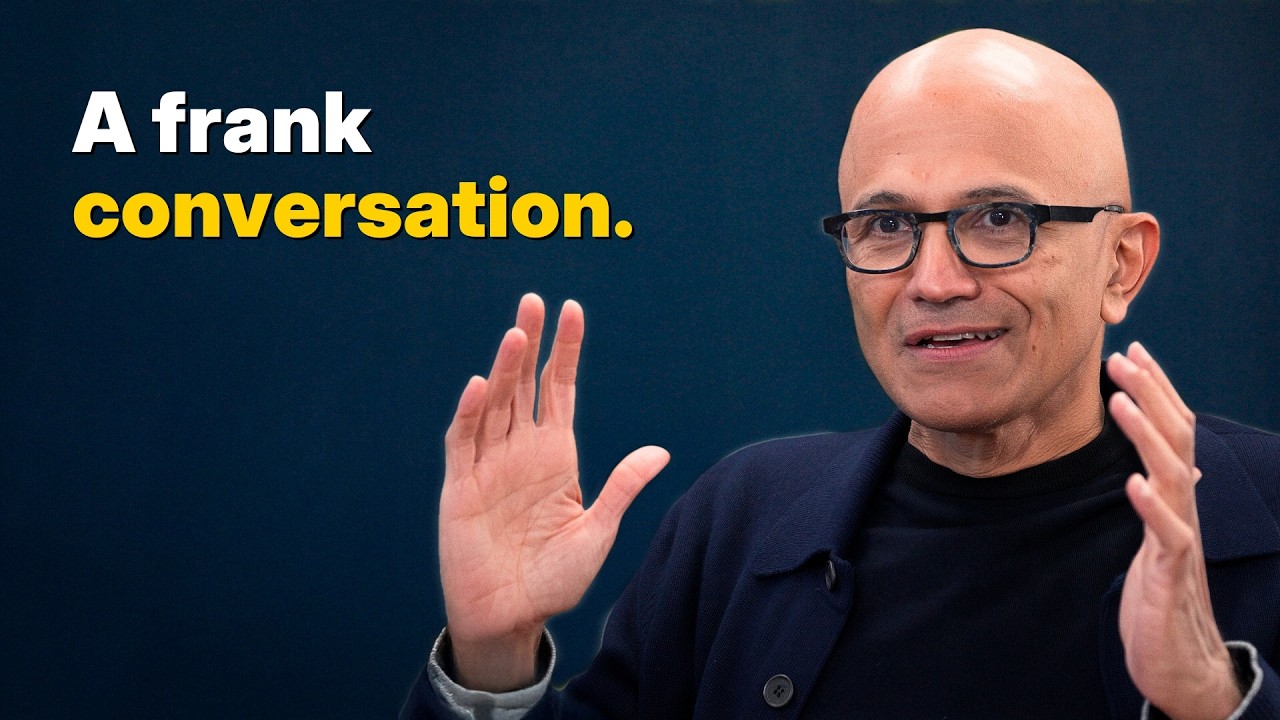
📺 Today’s recommended deep-dive video: https://www.youtube.com/watch?v=8-boBsWcr5A
Scaling the Industrialization of Intelligence: A Conversation with Satya Nadella
Microsoft is fundamentally re-engineering itself from a software-centric company into a capital-intensive industrial powerhouse to meet the demands of the AI era. In this deep dive, Satya Nadella outlines a vision where data centers are no longer just server rooms but a global, high-bandwidth nervous system for autonomous agents.
Core Question: How can Microsoft maintain a leadership position by balancing massive infrastructure investments, a unique partnership with OpenAI, and the development of its own world-class AI lab?
Highlights
- Microsoft is 10x-ing its training capacity every 18 to 24 months, with individual data centers now housing millions of network connections.
- The business model is shifting from “per-user” subscriptions to “per-agent” infrastructure, where every autonomous bot requires its own provisioned computer and security identity.
- Nadella argues that the “scaffolding”—the middleware and data integration—is just as valuable as the underlying models in capturing long-term economic margin.
- Global sovereignty is becoming a first-class requirement, necessitating “sovereign clouds” that respect regional data residency while leveraging American innovation.
⏱️ Reading time: approx. 12 minutes · Saves you about 76 minutes vs. watching.
Want to take notes while watching? Click the image below and let AI Notebook capture the key points for you 👇

The Physical Substrate of Scaling
Building the Global AI WAN
Microsoft’s new Fairwater 2 data center represents a paradigm shift in scale, featuring a network capacity that equals the entirety of Azure’s global footprint from just two and a half years ago. This isn’t just a single building; it is a node in a petabit-scale network designed to aggregate floating-point operations across multiple regions, like Milwaukee and Wisconsin, to train the next generation of models.
The goal is absolute fungibility within the fleet to ensure that investments aren’t stranded as model architectures evolve.
By linking these “super pods” across a massive Wide Area Network (AI WAN), Microsoft can run training jobs that treat geographically separated sites as a single, unified supercomputer. This infrastructure isn’t just for training; it is designed to pivot seamlessly between data generation, inference, and fine-tuning, ensuring the capital remains productive regardless of the specific workload.

💡 Digging Deeper
Q: Why build across multiple regions rather than one giant site?
A: Aggregating flops across sites provides resilience and circumvents local power constraints, allowing Microsoft to scale capacity by 10x every 18-24 months without being bottlenecked by the development timeline of a single campus.
Q: How much of this scale is a “bet” on the future of scaling laws?
A: Satya views it as an engineering necessity; the scaling laws have held so far, and the infrastructure must be ready to support models that are an order of magnitude larger than GPT-4 or GPT-5.
Q: Is this just a software company anymore?
A: Satya admits Microsoft is now a “capital-intensive and knowledge-intensive” industrial business, where software’s role is to maximize the Return on Invested Capital (ROIC) of the physical hardware.
The New Economics of Agents
From SaaS to Infrastructure-as-an-Agent
The transition from traditional Software-as-a-Service (SaaS) to AI-driven workflows fundamentally changes the cost structure, as the incremental cost per user is replaced by the high Cost of Goods Sold (COGS) of inference tokens. Nadella suggests that while the “meters” (subscriptions, consumption, ads) remain the same, the focus is shifting toward “Agent HQ”—a control plane that allows enterprises to manage, observe, and steer multiple autonomous agents.
This shift expands the market massively; where Microsoft once sold tools for human analysts, it now provisions infrastructure for the AI agents that are the analysts.
As agents begin to work for days at a time on complex tasks, the “per-user” business model will naturally evolve into a “per-agent” model. Every autonomous entity will need its own provisioned Windows 365 environment, a secure identity, and a set of observability tools to track its actions within a corporate repository.

💡 Digging Deeper
Q: Will model companies take all the margin, leaving the “scaffolding” worthless?
A: Satya believes the market is too diverse for a winner-take-all scenario, arguing that data liquidity and the ability to “ground” models in specific business logic provide a moat for the scaffolding layer.
Q: How does Microsoft compete with new coding tools like Cursor or Claude Code?
A: By positioning GitHub as the “cable TV of agents,” where a single subscription provides access to all frontier models (OpenAI, Anthropic, Grok) while maintaining the central repository and developer workflow.
Q: Is the per-user business dying?
A: No, but it is being augmented by a per-agent business; Microsoft expects the number of “agent seats” to eventually exceed the number of human employees in many organizations.
The Multi-Model Frontier
The Strategy for Microsoft AI (MAI)
While Microsoft remains deeply partnered with OpenAI, the formation of the Microsoft AI lab under Mustafa Suleyman signals a high-ambition move to build world-class internal models. The strategy is to avoid duplicative effort by using OpenAI’s GPT family for general-purpose applications while focusing internal R&D on specialized “omni-models” optimized for cost, latency, and specific product tasks like audio or image generation.
Microsoft retains the rights to OpenAI’s IP for the next seven years, allowing them to fork and innovate on the GPT lineage while building their own superintelligence team.
This dual-track approach ensures Microsoft isn’t beholden to a single provider. By building an infrastructure fleet that is “speed-of-light” compatible with Nvidia but also supports internal silicon like Maia, the company maintains the flexibility to swap models and hardware as the technological frontier moves.

💡 Digging Deeper
Q: Why was Microsoft’s recent model ranked 36th in Chatbot Arena?
A: That model was a small-scale proof of concept (trained on only 15,000 H100s); the goal was to master instruction-following before scaling up to larger, “omni-mode” architectures.
Q: What happens when the OpenAI agreement ends?
A: Satya is confident that by then, Microsoft will have built a world-class lab and team (including talent from DeepMind and Gemini) capable of leading the frontier independently.
Q: Does Microsoft get access to OpenAI’s custom silicon?
A: Yes, Microsoft has access to all of OpenAI’s system-level innovation and IP, excluding only their consumer hardware efforts.
Sovereignty and the Bipolar World
Trust as a Technical Feature
In a world increasingly split between US and Chinese tech spheres, Satya views “trust” as the most critical feature of the American tech stack. Microsoft is leaning into “sovereign clouds” and the “EU Data Boundary” to allow nation-states to maintain agency over their data while still benefiting from frontier-class AI models.
Sovereignty isn’t just a political buzzword; it’s a technical requirement involving confidential computing in GPUs and localized key management.
As countries like India, France, and Germany seek to build their own “sovereign AI,” Microsoft’s role is to provide the underlying rails. By allowing for data residency and localized hosting of model weights, Microsoft positions itself as the partner of choice for governments that want resilience without sacrificing the performance of the latest American innovations.

💡 Digging Deeper
Q: Can a country really have “sovereign AI” if the chips come from Taiwan or the US?
A: True sovereignty is rare in a global economy, but “resilience” is the actual goal; nations want to know that their critical supply chains can’t be shut off overnight.
Q: How does Microsoft navigate the US-China bipolarity?
A: By ensuring the US tech stack remains the most trusted globally, which requires respecting foreign direct investment and building legitimate “data boundaries” for international partners.
Q: Why did Microsoft pause some data center leases?
A: The “pause” was a course correction to ensure the fleet remains fungible and geo-diverse, rather than being lopsided toward a single generation of hardware in one location.
Key Takeaways
The AI revolution is entering its industrial phase, where the winners will be those who can master both the physics of the data center and the logic of the autonomous agent. Satya Nadella’s Microsoft is betting that its history as a platform company—one that builds the “substrate” for others—will allow it to thrive even as the traditional SaaS model is disrupted.
Microsoft is positioning itself as the indispensable middleman of the AI era. Whether it is providing the bare-metal servers for a frontier lab, the “Agent HQ” for a Fortune 500 company, or the sovereign cloud for a nation-state, the goal is to own the infrastructure of intelligence.
By diversifying its model sources and hardware fleet, Microsoft is hedging against the “winner’s curse” of the model layer. As long as the company can provide the storage, security, and connectivity that agents require, it remains at the center of the economic growth generated by the “cognitive amplifiers” of the future.
Q&A
Q1: How does Microsoft justify the massive $500 billion hyperscaler capex predicted for next year?
A: Satya views this as an R&D expense for the next 50 years. While it is capital-intensive, the software improvements in throughput (tokens-per-dollar-per-watt) are growing 5x to 40x year-over-year, which drives the necessary efficiency.
Q2: Is the OpenAI partnership still exclusive?
A: OpenAI’s API (their “PaaS” business) remains Azure-exclusive. While OpenAI can run their consumer-facing ChatGPT (their “SaaS” business) anywhere, any third-party partner wanting to use their stateless API must do so through Azure.
Q3: Why isn’t Microsoft building as many internal chips as Google or Amazon?
A: Microsoft is scaling “Maia” silicon in a tight feedback loop with its own internal models. However, they prioritize speed-of-light execution with Nvidia, as the Nvidia fleet is currently “life itself” for customer demand and general-purpose workloads.
Q4: Will AI agents eventually replace software like Excel?
A: Nadella sees a “hybrid world.” While an agent might work autonomously in the background, humans will still need “artifacts” (like spreadsheets) to communicate, triaging the agent’s work and providing steering.
Q5: What is “Agent HQ” or “Mission Control”?
A: It is a conceptual control plane Microsoft is building into GitHub and Office to allow users to fire off tasks to multiple agents (Claude, GPT, etc.), monitor their progress in independent branches, and triage their output from a single heads-up display.
Q6: Does Microsoft worry about open source models commoditizing the model layer?
A: Satya welcomes it. Open source provides a “check” on concentration risk and ensures that customers can move their data liquidity between models, which ultimately drives more traffic to Azure’s infrastructure.
Q7: How fast can Microsoft deploy new capacity?
A: In leading sites like Atlanta, Microsoft has achieved “speed-of-light” execution, moving from receiving hardware to handing off to a live workload in just 90 days.