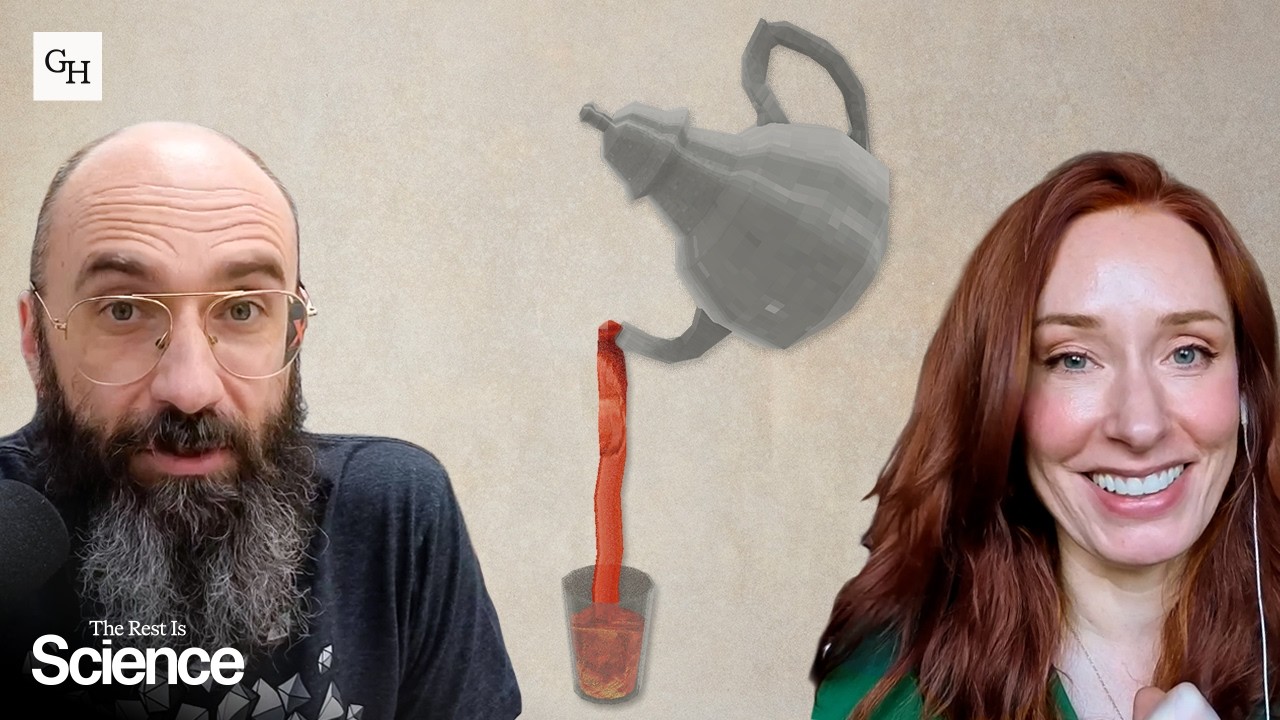
📺 Today’s recommended deep-dive video: https://www.youtube.com/watch?v=rB5jpFHq06w
The Physics of the Perfect Pour: Lessons from a Moroccan Teapot
Beyond the mint and sugar, Moroccan tea service is a sophisticated display of fluid mechanics hiding in plain sight. By examining the unique geometry of the S-shaped spout, we can uncover how ancient design achieved optimal laminar flow long before modern physics equations existed.
Core Question: How does the evolutionary design of the Moroccan teapot master fluid dynamics to create its characteristic foam?
Highlights
- The chemistry of “soap-like” saponins that create the tea’s resilient foam.
- Why the S-shaped spout is mathematically superior for creating laminar flow.
- The surprising impact of altitude on atmospheric pressure and cooking times.
- Data revealing that humans have physically stepped on only 5% of the Earth’s surface.
⏱️ Reading time: approx. 6 minutes · Saves you about 30 minutes vs. watching.
Want to take notes while watching? Click the image below and let AI Notebook capture the key points for you 👇

The Alchemy of the Moroccan Pour
Saponins and Sand
A professional Moroccan tea pour is a mesmerizing feat of gravity, involving a high-altitude stream that plunges into a glass to create a thick, beer-like foam.
This foam isn’t just for show; it serves a practical purpose in the desert by trapping airborne sand so it can be blown away or avoided while sipping. The chemistry behind it involves saponins, natural soap-like molecules found in green tea leaves that act as surfactants, effectively lowering the liquid’s surface tension to form stable bubbles. When combined with high sugar content to increase viscosity and mint oils for further stabilization, these bubbles create a resilient layer of protection.
Interestingly, the visual presence of this foam has evolved into a hallmark of quality and hospitality. If a host serves a cup without that characteristic froth, it indicates either poor ingredients or a lack of skill in the traditional pouring technique.

💡 Digging Deeper
Q: Why doesn’t standard British black tea produce this same foam?
A: While both come from the same plant, the processing of green tea preserves higher levels of saponins, and the addition of sugar and fresh mint oils in the Moroccan method provides the necessary stabilizers.
Q: Is the foam purely for hygiene?
A: Historically, yes, to filter out desert dust, but it now serves as a visual indicator that the tea is sufficiently sweet and made with fresh, high-quality mint.
Engineering Laminar Flow Without Math
The Magic of the S-Curve
The secret to a perfect high-altitude pour lies in the “S-shaped” spout, a design choice that facilitates what physicists call laminar flow.
Unlike standard U-shaped spouts found on British teapots, the dual curves of the S-shape effectively “straighten” the water molecules, eliminating internal turbulence before the liquid exits the tip. This allows the tea to maintain a tight, needle-like stream even when poured from a full arm’s length above the glass, ensuring the liquid doesn’t “rain” messily around the cup.
The geometry also leverages the Bernoulli principle and the Venturi effect by starting with a wide base at the bottom of the pot—where pressure is highest—and tapering to a sharp, narrow tip. This sharp edge prevents the “teapot effect,” where liquid dribbles down the side of the pot, a solution fluid dynamicists only mathematically “solved” in the 1990s. The fact that traditional craftsmen arrived at this optimal design through generations of trial and error is a stunning example of design evolution.

💡 Digging Deeper
Q: What is the benefit of pouring from such a great height?
A: Beyond creating foam, the long fall through the air cools the tea significantly, allowing it to be sipped immediately even if the water in the pot is still boiling.
Q: How did these designs reach perfection without formal physics?
A: It is a form of cultural “natural selection” where designs that worked better were replicated over centuries, eventually matching what modern computer simulations would suggest.
Altitude, Pressure, and the Human Footprint
Atmospheric Limits
Science extends from the teapot to the very mountains we climb, where the weight of the atmosphere dictates the rules of boiling water.
In high-altitude locations like Boulder, Colorado, the boiling point of water drops to around 95°C (203°F) because there is less atmospheric pressure holding molecules in their liquid state. This means cooking a “hard-boiled” egg takes significantly longer than it does at sea level, requiring culinary adjustments that can frustrate those moving between different elevations.
Shifting from the verticality of mountains to the surface of the planet, we find that despite our global presence, humans are remarkably clustered. Urban infrastructure occupies a mere 1% of the Earth’s land, and combined with agriculture, we still leave over half the planet as untouched wilderness. If we calculate the actual physical area touched by human feet, accounting for the literal size of a footprint, only about 5% of the total Earth surface has ever felt the weight of a person.

💡 Digging Deeper
Q: How does the “shrinking Earth” thought experiment affect boiling?
A: If the Earth’s volume decreased but kept the same atmosphere, the air would become denser, increasing pressure and raising the boiling point of water everywhere.
Q: Do we count climbing routes as “touched” land?
A: Even with a million established climbing routes, the total vertical surface area touched by humans is an infinitesimal “rounding error” compared to the vastness of the planet.
Key Takeaways
The Moroccan teapot stands as a testament to the power of iterative design, proving that humanity often discovers the “truth” of physics—like laminar flow and surfactants—long before we develop the vocabulary to describe them. By simply observing a cup of tea, we can witness a convergence of thermodynamics, botany, and fluid dynamics that has been refined by centuries of cultural tradition.
Furthermore, our understanding of the physical world is deeply tied to our sensory perception and environment. Whether it is the way we feel texture through the “extension” of a shoe or how we adjust our cooking for the thin air of a mountain, science is not a distant laboratory pursuit but a constant, lived experience. We inhabit a planet that remains largely untouched by our physical presence, yet we have mastered its most complex rules through the simple act of brewing a drink.
Q&A
Q1: Why does boiling water at high altitude take longer to cook food?
A1: Because the water boils at a lower temperature due to less atmospheric pressure, the heat transfer to the food is less intense, requiring more time to reach the same level of “doneness.”
Q2: What is a surfactant in the context of tea?
A2: It is a molecule (saponin) that has one water-loving end and one water-hating end. These molecules line up at the surface of air bubbles, stabilizing them and allowing foam to persist.
Q3: How much of the Earth is actually wilderness?
A3: Approximately 52% of the Earth’s landmass is considered nature or wilderness, relatively unaffected by human infrastructure or agriculture.
Q4: Can humans feel texture through inanimate objects like shoes?
A4: Yes, the brain interprets micro-vibrations and resistance as sensory data, effectively treating tools, shoes, or canes as extensions of our own nervous system.
Q5: What is the “teapot effect”?
A5: It is the tendency of a liquid to curl around the lip of a spout and dribble down the pot. It is prevented in Moroccan teapots by having an extremely sharp, tapered edge on the spout.
Q6: How does sugar affect the bubbles in Moroccan tea?
A6: Sugar increases the viscosity of the liquid, which slows down the drainage of fluid from the bubble walls, making the foam last much longer.
Q7: Does the “S” shape of the spout serve a decorative purpose?
A7: While beautiful, its primary function is to eliminate turbulence by forcing the water through two opposing curves, which aligns the molecules for a smooth, laminar exit.