📺 Today’s recommended deep-dive video: https://www.youtube.com/watch?v=CYlon2tvywA
Beyond Six Degrees: The Secret Geometry That Links the World
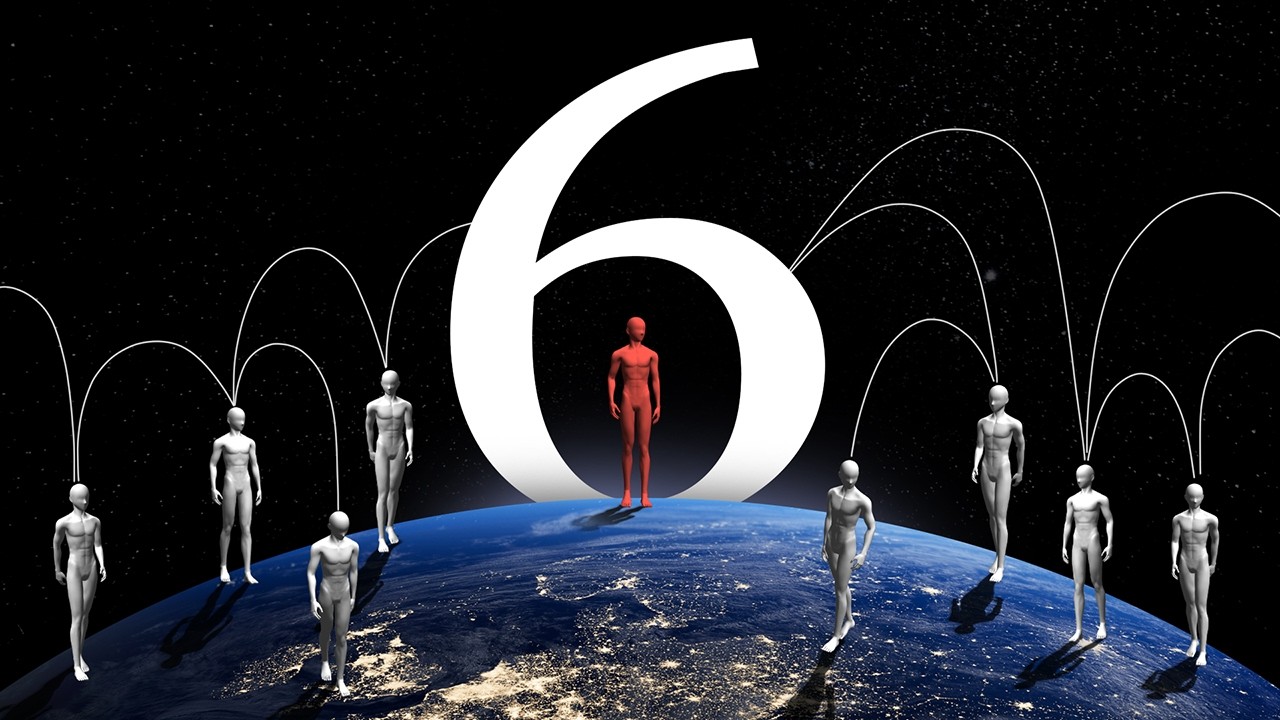
In 1999, a German falafel salesman successfully connected himself to Marlon Brando through a chain of just six people, proving that the world is much smaller than its eight-billion-person population suggests. While we naturally live in tight, local clusters, a tiny fraction of “shortcut” connections can bridge the gap between anyone on Earth in an instant.
Core Question: How do a few random links transform vast, isolated networks into a “small world” where information and disease spread at lightning speed?
Highlights
- The “Six Degrees” theory relies on a few “shortcut” links that bridge massive geographic clusters.
- Hubs—highly connected nodes like major airports or keystone species—create both efficiency and an “Achilles’ heel” in networks.
- Mathematical models prove that even a 1% shift toward randomness can collapse the distance between billions of people.
- Network structure, not just individual personality, determines whether cooperation or toxicity flourishes in a community.
⏱️ Reading time: approx. 7 minutes · Saves you about 26 minutes vs. watching.
Want to take notes while watching? Click the image below and let AI Notebook capture the key points for you 👇

The Mathematics of a Small World
Bridging the Local Clusters
We typically assume the world is massive, but mathematically, it is surprisingly compact. If you have 100 friends and each of them has 100 friends, you are already just two steps away from 10,000 people; by the fifth power, you have surpassed the total human population.
This simple calculation is flawed because we don’t pick friends at random.
In reality, people cluster geographically and socially. Your friends likely know each other, creating a “highly clustered” network where your “degree of separation” from someone on the other side of the planet should, theoretically, be millions of steps long. Yet, experiments consistently show the number is closer to six.
The Power of the Shortcut
In the mid-1990s, mathematicians Duncan Watts and Steve Strogatz solved this paradox by introducing the “randomness knob.”
They started with a perfectly ordered circle where everyone only knew their immediate neighbors. Then, they began rewiring just a tiny fraction of those links to random nodes across the circle.
The result was staggering: when only 1% of links were turned into “shortcuts,” the average distance between any two people dropped from 50 steps to 10. The world became small almost instantly, even though it remained highly clustered. For the eight billion people on Earth, we only need three out of every 10,000 friendships to be a “shortcut” for the average degree of separation to drop to six.

💡 Digging Deeper
Q: Why do we call them “weak ties”?
A: Sociologists found that people often get jobs through acquaintances (weak ties) rather than close friends (strong ties) because acquaintances serve as the “shortcuts” to social circles you don’t already belong to.
Q: Did nature discover this before humans?
A: Yes. The neural network of the C. elegans worm follows this exact pattern, allowing its 282 neurons to communicate across the body in an average of just 2.65 steps.
Q: Is six degrees a hard limit?
A: It’s an average. In the digital age, research on Facebook and Veritasium viewers suggests the average degree of separation has actually shrunk to between 3 and 4.
The Rise of the Hubs
Preferential Attachment
While Watts and Strogatz focused on random shortcuts, Albert-László Barabási discovered another feature of real-world networks: Hubs. In 1998, mapping the early World Wide Web revealed that it didn’t look like a bell curve where every page has a similar number of links. Instead, a few “super-connectors” like Yahoo or Google held thousands of times more links than the average page.
These hubs emerge through a process called “preferential attachment.”
Think of it like a new airport opening. As more airlines choose to fly there, it becomes more attractive to passengers, which in turn attracts even more airlines. This “rich-get-richer” feedback loop ensures that hubs are an inevitable result of any growing network, from metabolic reactions in our cells to the prefrontal cortex in our brains.
The Achilles’ Heel of Networks
Hubs are the reason you can fly almost anywhere in the world with one or two transfers, but they are also a massive liability.
If a thunderstorm shuts down Chicago O’Hare, the ripple effect cancels flights in London and Tokyo within hours. This is the “Achilles’ Heel”: networks are incredibly robust against random failures, but they collapse if you target the hubs.
This principle has revolutionized medicine; instead of broad treatments, researchers now design drugs to target the “hub” molecules in a bacteria’s metabolic network, effectively starving the disease.

💡 Digging Deeper
Q: How did Thailand use hub theory to fight HIV?
A: Rather than general public service announcements, they targeted “hubs” of transmission—specifically brothels—requiring 100% condom use. This targeted approach prevented an estimated five million infections.
Q: Are hubs always man-made?
A: No. In ecosystems, “keystone species” like Atlantic cod act as hubs in food webs. Removing them can cause the entire ecosystem to destabilize and collapse.
Q: Why do hubs make the world smaller?
A: Hubs act as universal shortcuts. Instead of hopping through ten neighbors to reach someone in another country, you both likely share a connection to a major “hub” (a celebrity, a global corporation, or a massive social platform).
Social Networks and Human Behavior
The Toxicity of the Crowd
The way we are connected doesn’t just change how fast we get information; it changes who we are. Watts and Strogatz simulated the “Prisoner’s Dilemma”—a game where players choose to cooperate for a small reward or betray each other for a larger one—on different types of networks.
In a clustered, “local” world, cooperation thrives because you interact with the same people repeatedly, building trust.
However, once they introduced shortcuts, the cooperators were annihilated.
The shortcuts allowed “defectors” (betrayers) to reach into distant clusters and exploit them before moving on. This explains the “keyboard warrior” phenomenon: the internet removes the “neighborhood” clusters that keep us polite, exposing us to a global stream of toxicity where the consequences of being nasty are diluted.
The Power of Individual Agency
It isn’t all bad news. While a network can be “poised on a knife-edge” where one person’s negativity ruins the mood, the reverse is also true.
In real life, unlike a computer simulation, we have the power to prune our connections.
Duncan Watts found that when humans were allowed to choose who they played with, they actively disconnected from defectors. This simple act of being proactive transformed the network back into a cooperative space. It proves that while the network shapes our behavior, we are the ones who build the network. One stubborn person starting a movement can leverage these shortcuts to spread a positive change just as fast as a virus.

💡 Digging Deeper
Q: Can one person really change a global network?
A: Yes. Small-world networks are highly sensitive to “cascades.” Just as one infected person can start a pandemic, one person with a “shortcut” link to a hub can trigger a social movement that reaches millions.
Q: Why does the internet feel so negative?
A: The internet is a “randomized” network where the cost of defection (being mean) is low. Without the “clumps” of local accountability, the mathematical incentive to be “nice” often disappears.
Q: What is the “Public Goods” game?
A: It’s an experiment where people contribute money to a common pot. Research shows that if you can’t see who is contributing, people stop giving; if you can choose your neighbors, people cluster with other givers and the pot grows.
Key Takeaways
The “Small World” phenomenon is not a coincidence or a quirk of modern technology; it is a fundamental law of networks. Whether we are looking at the neurons in a worm, the power grid of the United States, or the friends on your social media feed, the presence of a few shortcuts and major hubs is what allows complex systems to function efficiently.
However, this connectivity is a double-edged sword. It creates the pathways for rapid innovation and global cooperation, but it also provides the conduits for “malevolence,” disease, and systemic collapse. The same shortcuts that allowed a falafel salesman to reach Marlon Brando also allow a single viral post to spread misinformation to billions.
Ultimately, understanding network science empowers the individual. Our actions—whom we choose to connect with and how we choose to treat our immediate neighbors—ripple through the network in ways we cannot see. We are not just nodes in a machine; we are the architects of the web that binds us all together.
Q&A
Q1: Is the “Six Degrees of Separation” theory actually true?
A: Yes, in principle. While the original 1960s experiments were small, modern data from Facebook and Microsoft Messenger confirms that the average distance between any two people is between 4 and 7 steps.
Q2: What is the difference between a “shortcut” and a “hub”?
A: A shortcut is a random link between two distant, low-connection nodes (like a friend you met on vacation). A hub is a single node with an enormous number of links (like a celebrity or a major website) that everyone else connects through.
Q3: How do shortcuts make diseases spread faster?
A: In a perfectly regular world, a virus must travel person-by-person down a line. Shortcuts allow the virus to “jump” to a new, uninfected cluster thousands of miles away, leading to exponential growth across the entire network almost simultaneously.
Q4: Why did the FBI call the mathematician Steve Strogatz?
A: They were interested in “Hair and Fiber” networks. They wanted to know the mathematical probability that a victim’s hair could end up on a suspect through “secondary transfers” (shortcuts) rather than direct contact.
Q5: What is “Preferential Attachment”?
A: It is the “rich-get-richer” rule of networks. New nodes are more likely to link to nodes that already have many links, which naturally leads to the creation of massive hubs over time.
Q6: Does social media make us more or less cooperative?
A: It depends on how it’s used. While the “small world” nature of the internet can expose us to toxicity, the ability to proactively choose and prune our social circles allows us to build cooperative “clumps” even in a digital space.