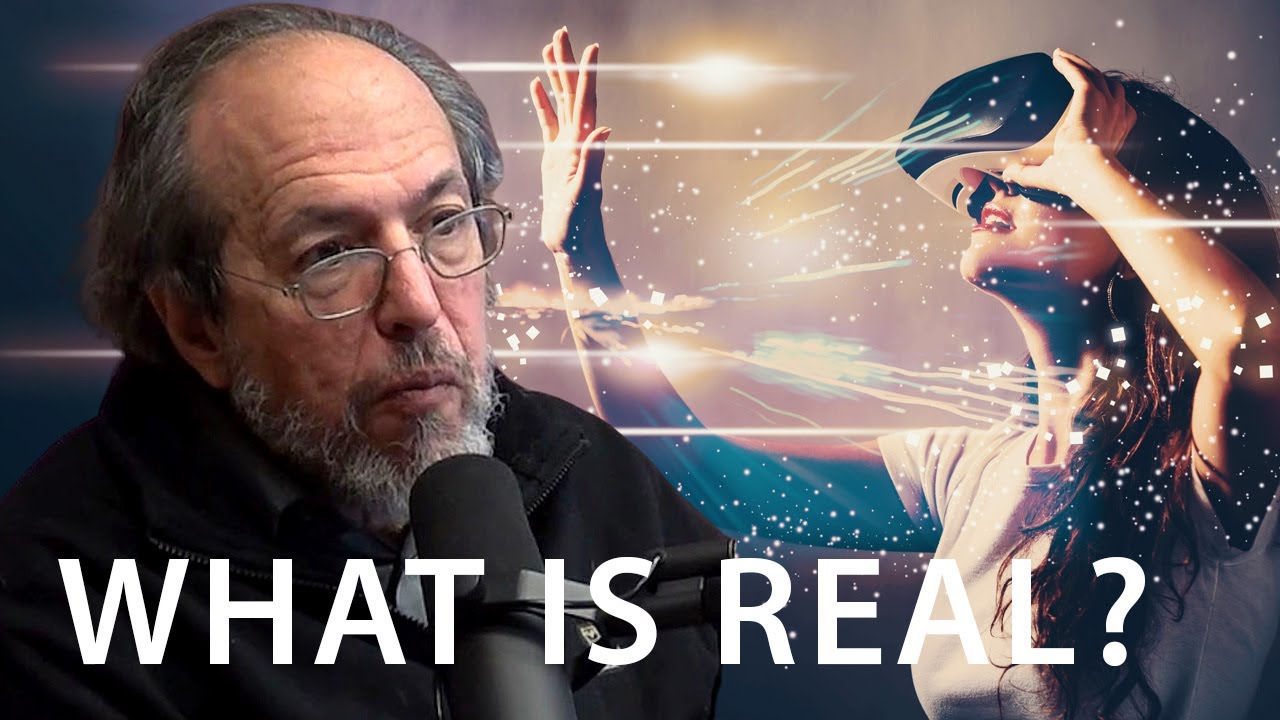
📺 Today’s recommended deep-dive video: https://www.youtube.com/watch?v=IbHgcbo8uKc
Beyond the Veil: Searching for the Real World in a Processed Reality
We often assume that what we see and feel is the definitive truth of the universe, yet science suggests our brains are actually masters of illusion, filtering raw data into manageable stories. While we rely on the tools of physics to bridge the gap between perception and reality, the very methods we trust may be more social than mathematical. By examining the tension between realism and anti-realism, we can begin to uncover whether the universe exists independently of us or if it is merely a conversation we are having with ourselves.
Core Question: Does an objective reality exist independent of human experience, or is science just a cognitive construct used to navigate our own perceptions?
Highlights
- The definition of “Realism” as the belief in an external world that persists without human observers.
- The controversial claim that there is no singular “Scientific Method,” only a community bound by ethical precepts.
- A look at the “Partial Revolution” of physics, which stalled in the 1970s after decades of rapid technological advancement.
- The potential for a “Universal Language” of mathematics to eventually decode the fundamental nature of existence.
⏱️ Reading time: approx. 6 minutes · Saves you about 16 minutes vs. watching.
Want to take notes while watching? Click the image below and let AI Notebook capture the key points for you 👇

The Realist’s Gambit
Perception vs. The Objective World
Realism is essentially the conviction that an external world exists entirely independent of human experience, regardless of whether we have the capacities to observe or understand it. It is the belief that if every human vanished tomorrow, the planets would still orbit and the laws of physics would still govern the vacuum of space.
What we experience is not the raw world, but a highly processed, active construction generated by our brains to ensure our survival as biological entities. Our ape ancestors didn’t need to understand the wave-particle duality of light to find fruit; they needed a visual cortex that could distinguish a tiger from a bush in a fraction of a second. This biological necessity means we are always viewing reality through a “mirror veil,” a cognitive interface that simplifies a complex, chaotic universe into a set of usable, three-dimensional stories.
The realist physicist argues that despite this veil, there is a “bottom” to the universe—a fundamental level that can be described with total objectivity and precision.

💡 Digging Deeper
Q: Is the human mind just a collection of molecules, or does consciousness play a fundamental role in realism?
A: Realism generally views humans as naturalistic systems, yet it struggles to explain how subjective perception emerges from objective physical processes.
Q: Can a realist accept a universe governed by chance rather than strict determinism?
A: Yes; a realist can believe in an objective world that includes fundamental randomness, as long as that randomness is a property of the world itself and not just a limit of our knowledge.
Q: How do we know if we are getting “closer” to the truth if we can’t see the raw world?
A: We measure progress by the predictive power of our models and the degree to which our theories survive the rigorous attempts of the scientific community to debunk them.
The Myth of the Scientific Method
A Community of Ethical Constraints
Many people believe in a rigid, step-by-step “Scientific Method” that guarantees truth, but many philosophers and physicists argue this is a convenient fiction used to simplify how science actually works. There are times when progress requires a scientist to ignore data that seems to contradict a promising new theory, just as Galileo had to challenge the prevailing Aristotelian common sense of his era to propose the principle of inertia.
Science is not a machine; it is a community of people bound by a specific set of ethical rules, such as the requirement to report all results and the refusal to lie about data. The training of a scientist is less about learning a magical formula for discovery and more about mastering the art of “checking.” A PhD is essentially a license granted once a student can build a defense so robust that a room full of skeptical experts cannot find a single loose thread to pull.
This social structure serves as a filter for human error, ensuring that while individuals may be wrong, the collective movement of ideas trends toward a more accurate description of the real world.

💡 Digging Deeper
Q: Why did Paul Feyerabend argue against a single scientific method?
A: He used historical examples to show that every proposed rule of science has been broken at some point to allow for a major breakthrough.
Q: What is the primary role of a PhD defense in this social structure?
A: It serves as a rite of passage where the candidate proves they can account for contradictions and minimize the mistakes the community has to later fix.
Q: How does the community handle “fast judgments” made by individual scientists?
A: Through a rigorous, multi-century process of lining up interconnected cases until a new paradigm, like Newtonian physics, becomes undeniable.
The Great Stagnation
The Revolution That Stopped
The period between the late 1890s and the 1970s was a golden age of physics, witnessing the birth of relativity, quantum mechanics, and the electrification of the modern world. These were not just abstract ideas; they were triumphs that led directly to the transistors, lasers, and nuclear power that define our current civilization.
However, since the 1970s, fundamental physics has entered a strange period where the link between new theories and practical, experimental validation has seemingly frayed. While we have developed incredibly complex mathematical structures like string theory, they have yet to produce the same kind of transformative technological leap seen in the early 20th century. This suggests that our current stories about the universe might be stuck in a “dead end,” waiting for a new revolutionary insight to break the stalemate.
We are currently in a waiting room of history, looking for a way to bridge the gap between our symbolic mathematical systems and the raw reality they are meant to describe.

💡 Digging Deeper
Q: Was the scientific revolution of the early 20th century “complete”?
A: No, it is considered a partial revolution because it left many fundamental questions about the nature of space and time unanswered.
Q: Why hasn’t string theory led to new technology like quantum mechanics did?
A: So far, it lacks the concrete, validated predictions that can be translated into engineering and practical applications.
Q: Does David Deutsch’s idea of “universality” offer hope for the future?
A: Yes; it suggests that our mathematical and symbolic systems are powerful enough to eventually reference and understand any aspect of the objective world.
Key Takeaways
The quest to define what is “real” is a journey from the instinctive, fast-paced judgments of our ancestors to the highly disciplined, error-checking rigors of modern physics. While we may never escape the “processed world” created by our biological senses, the community of science acts as a collective lens, refining our stories until they align more closely with the objective universe. Realism remains a powerful aspiration, driving us to look past our own perceptions in search of a truth that exists without us.
We must acknowledge that progress is not a straight line, as evidenced by the relative stagnation in fundamental physics over the last fifty years. This lull suggests that our current models may be incomplete or that we are reaching a temporary limit of our cognitive tools. Yet, the history of science shows that every period of stagnation is eventually broken by a new way of seeing, proving that our curiosity is a universal force capable of peeling back the veil.
Q&A
Q1: What is the main difference between a realist and an anti-realist like Niels Bohr?
A1: A realist believes science describes an objective world that exists in our absence, while Bohr argued that science is an extension of human conversation meant to describe our interactions with nature.
Q2: Does the “Scientific Method” actually exist?
A2: According to philosophers like Feyerabend, there is no fixed method; rather, science is a social community that follows ethical rules to minimize human error and deception.
Q3: Why is our perception of the world considered “processed”?
A3: Our brains do not show us the raw data of the universe; instead, they construct useful cognitive models—like space and time—to help us survive and act quickly on incomplete information.
Q4: Has physics made significant progress since the 1970s?
A4: While mathematics has advanced, there has been a lack of major “triumphs” or practical applications in fundamental physics compared to the revolution of the early 20th century.
Q5: What is the role of a PhD in the scientific community?
A5: It serves as a license certifying that a researcher has been trained in rigorous error-checking and can defend an argument against intense community scrutiny.
Q6: Can human beings ever truly grasp the “real world”?
A6: Realists aspire to this, but it remains an open question whether our biological and cognitive limits will eventually prevent us from understanding the most fundamental aspects of reality.
Q7: What does David Deutsch mean by the “universality” of explanation?
A7: He suggests that because our symbolic and mathematical systems can reference themselves, they have the potential to eventually explain anything that exists in the universe.