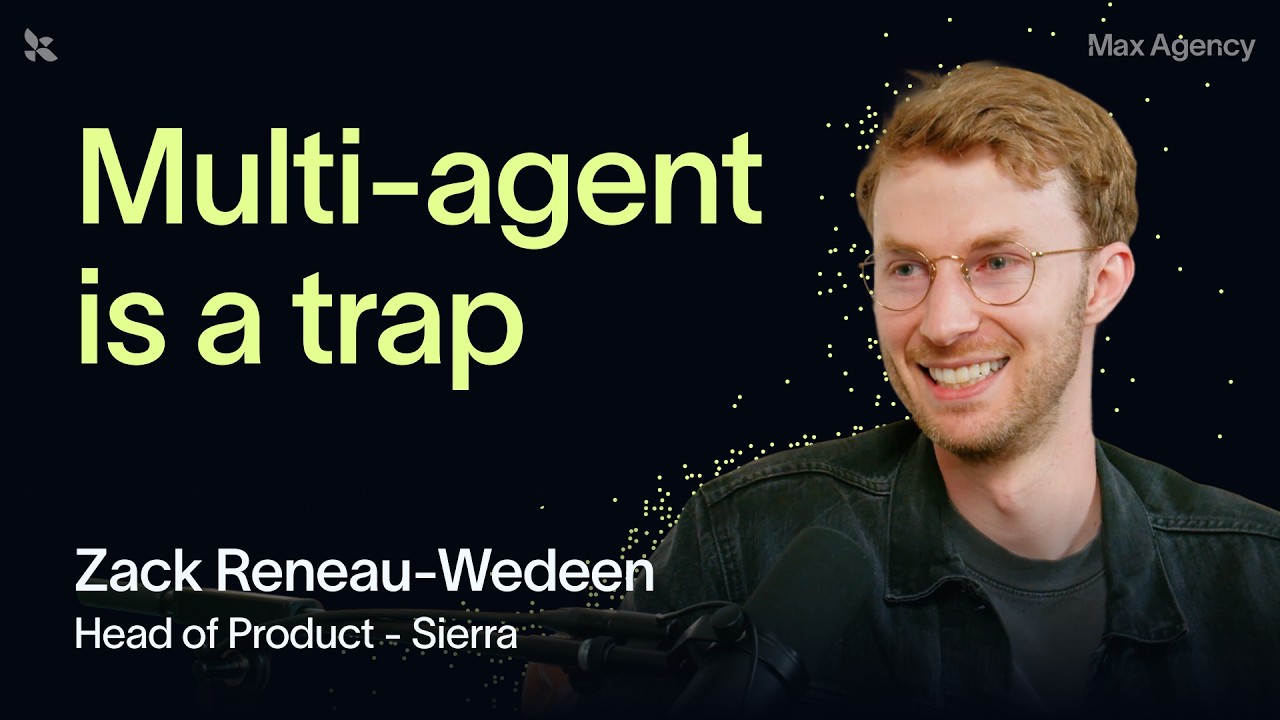
📺 Today’s recommended deep-dive video: https://www.youtube.com/watch?v=uCKhOmth2ms
Beyond Chatbots: How Sierra is Engineering the Future of Agentic Commerce
Sierra is moving past simple customer support to build an engagement platform where AI agents handle everything from flight bookings to complex payment processing. By prioritizing voice-first architecture and a deterministic “Journey” layer, they are enabling the world’s largest brands to deploy reliable, high-stakes agents.
Core Question: How does Sierra architect low-latency, payment-certified agents that shift the business model from usage-based fees to outcome-driven commissions?
Highlights
- Sierra uses a “Journeys” no-code layer that compiles deterministically into a code-based SDK for reliability.
- Voice agents parallelize thinking, listening, and talking to maintain human-like latency under two seconds.
- Agentic commerce is predicted to surpass e-commerce as personal AI assistants begin interacting directly with brand agents.
- The platform utilizes a constellation of 10-15 models per turn, ranging from specialized classifiers to frontier reasoning models.
⏱️ Reading time: approx. 8 minutes · Saves you about 79 minutes vs. watching.
Want to take notes while watching? Click the image below and let AI Notebook capture the key points for you 👇

The Architecture of Agentic Engagement
From Code to Journeys
Zack Reno Wedeen explains that Sierra isn’t just for support; it’s an engagement platform where agents can even earn commissions on sales.
Most development now happens in “Journeys,” a declarative no-code layer that maps to standard operating procedures. This layer compiles isomorphically down to a code-based SDK, allowing operations teams with deep domain knowledge to build complex behaviors without being engineers themselves. This ensures that the people closest to the customer experience—not just the developers—can iterate on the agent’s logic and personality directly.
The underlying “Agent OS” utilizes a constellation of ten to fifteen different models for a single conversation turn. While frontier models handle high-level reasoning, smaller, specialized models handle classification or speculative execution to keep costs down and latency low. This hybrid approach ensures that the most expensive “brainpower” is only used when strictly necessary for the interaction’s success, while faster models handle the “interim” work.

💡 Digging Deeper
Q: Why use a DSL like “Journeys” instead of raw natural language?
A: Pure natural language is non-deterministic; you risk the agent “hallucinating” the process. A structured layer ensures the agent follows specific policies, like collecting an email before confirming a flight.
Q: Can developers still use code?
A: Yes, the platform supports Git-based workflows and custom tool coding for streaming APIs or complex enterprise integrations that no-code can’t handle.
Solving the Voice Paradox
Parallelism and Speculative Execution
Voice conversations impose a strict 1-2 second latency requirement, which forces a complete rethink of standard agent harnesses.
Sierra optimizes for this by looking up knowledge answers before it even knows if they are needed, using speculative execution to stay ahead of the user. If the system waits for a full transcription and a reasoning step before fetching data, the resulting silence feels robotic and broken. By parallelizing the “thinking” and “retrieval” phases, the agent can provide a response almost as soon as the user stops talking.
A major challenge in voice is handling diverse accents and avoiding hallucinations during silence, which Sierra solves through model ensembling. For instance, they might run two transcription models simultaneously—one that is high-quality but prone to silence-hallucination, and another that is robust at detecting silence. The system then dynamically trusts the specific model that is best suited for that exact audio moment, such as navigating a thick regional UK accent.

💡 Digging Deeper
Q: How does the agent handle interruptions?
A: The architecture parallelizes “listening” even while “talking.” If the voice activity detection (VAD) picks up a user interrupt, it kills the current speech generation immediately.
Q: Will native voice-to-voice models (like GPT-4o) replace this pipeline?
A: Eventually, but current modular pipelines are still 10x cheaper and better at multi-lingual reliability for global Fortune 20 brands.
The Shift to Agentic Commerce
Payments and PCI Compliance
Zack believes agentic commerce will eventually dwarf e-commerce as users shift from clicking websites to delegating tasks to personal AI assistants.
To facilitate this, Sierra became the first voice-payment platform to achieve PCI DSS Level 1 certification, a massive infrastructure undertaking. Because no major LLM providers are currently certified to handle credit card data, Sierra had to build isolated infrastructure where payment info never touches an external model. This allows for a cohesive checkout experience without the friction of transferring the user to a separate, non-AI platform, which usually kills conversion rates.
The future likely involves personal agents (like Claude or ChatGPT) talking directly to brand agents via protocols like MCP. Instead of brands just offering APIs, they will offer agent endpoints that understand the brand’s nuances and preferences, ensuring the interaction is both efficient and high-fidelity. This creates a world where brands compete not just on their website UX, but on how “agent-friendly” their commerce interface is.

💡 Digging Deeper
Q: What does “Outcome-Based Pricing” look like?
A: Instead of charging per message, Sierra might get paid a commission on a completed sale or a flat fee for a successfully resolved support ticket.
Q: How early are we in personal agents buying things?
A: Very early. Zack notes he doesn’t order paper towels with AI yet, but cancelling subscriptions is the “low-hanging fruit” currently emerging.
Evals, Monitors, and the “Agent Builder”
Scaling Reliability
Sierra uses “Simulations” to test agents against dozens of personas and adversarial conditions before they ever hit production.
This high-dimensional testing is crucial for the Fortune 20 companies Sierra serves, who cannot afford a public-facing agent hallucinating a price or violating a policy. By running thousands of synthetic conversations, developers can see how a change in one “Journey” might negatively impact a separate loyalty program logic. It’s the AI equivalent of unit testing, but for non-deterministic conversation flows.
As AI makes coding easier, the “Agent Builder” role has shifted to require deep customer intuition and a high degree of “agency.” Sierra interviews for this using an AI-native process where candidates build a product end-to-end in a few hours. This reveals who views their role as narrowly defined versus those who will move mountains to solve a customer problem using the “faster car” that AI provides.

💡 Digging Deeper
Q: What are “Monitors”?
A: They are evaluators that run on 100% of production traffic, looking for specific flags like customer frustration or incorrect technical advice.
Q: Why release benchmarks like TaoBench?
A: To define “what good looks like” for the industry. It helps evaluate third-party providers for transcription or tool-calling accuracy.
Key Takeaways
Context engineering remains the most critical skill in the agentic era. Zack emphasizes that when an agent fails or seems “dumb,” it is almost always a failure of the human designer to provide the right context at the right time. By practicing “progressive disclosure”—bringing context into the prompt only when relevant—developers can avoid the incoherence that leads to hallucinations.
The business model of AI is shifting toward alignment. Outcome-based pricing forces AI vendors to care about the same metrics as the business, such as resolution rate or conversion. This cuts through the typical “PoC hell” of enterprise software because the value is self-evident in the revenue generated or saved by the agent.
Finally, the organizational impact of agents is profound. Successful companies will empower “Agent Builders” who possess a hybrid of technical depth and product judgment. As coding becomes a commodity, the ability to architect complex human-AI systems and advocate for the end-user becomes the ultimate competitive advantage.
Q&A
Q1: Does Sierra support the Model Context Protocol (MCP)?
A: Yes, Sierra agents can act as both MCP clients and servers, allowing them to interface with tools or appear as “apps” within ChatGPT.
Q2: How does Sierra handle long-term memory?
A: Memory is a first-class primitive. The agent can remember a user’s flight preferences or past frustrations, but it requires strict authentication to ensure sensitive data isn’t leaked to the wrong caller.
Q3: Are multi-agent systems recommended for brand agents?
A: Zack is a “monolith loyalist.” He warns that multi-agent systems often result in “shipping your org chart” and can deprive agents of the holistic context needed to solve a problem efficiently.
Q4: What is the biggest hurdle for voice agents today?
A: Latency and naturalism. Solving these requires modularity—using different providers for transcription, reasoning, and synthesis based on what each is best at for a specific language or accent.
Q5: How does Sierra use Reinforcement Learning (RL)?
A: RL is used to improve specialized tasks like knowledge retrieval, but Sierra remains agile enough to swap to new frontier models when they outpace the performance of fine-tuned open-weights models.
Q6: What is “Ghostwriter”?
A: It is an internal agent similar to Claude Code or Codex, specifically designed to help Sierra customers build and iterate on their “Journeys” no-code logic.
Q7: Why is PCI compliance so difficult for AI?
A: Because LLM providers aren’t certified to store or process credit card data. Sierra had to build a parallel, isolated infrastructure to strip that data out before it ever reaches a generative model.