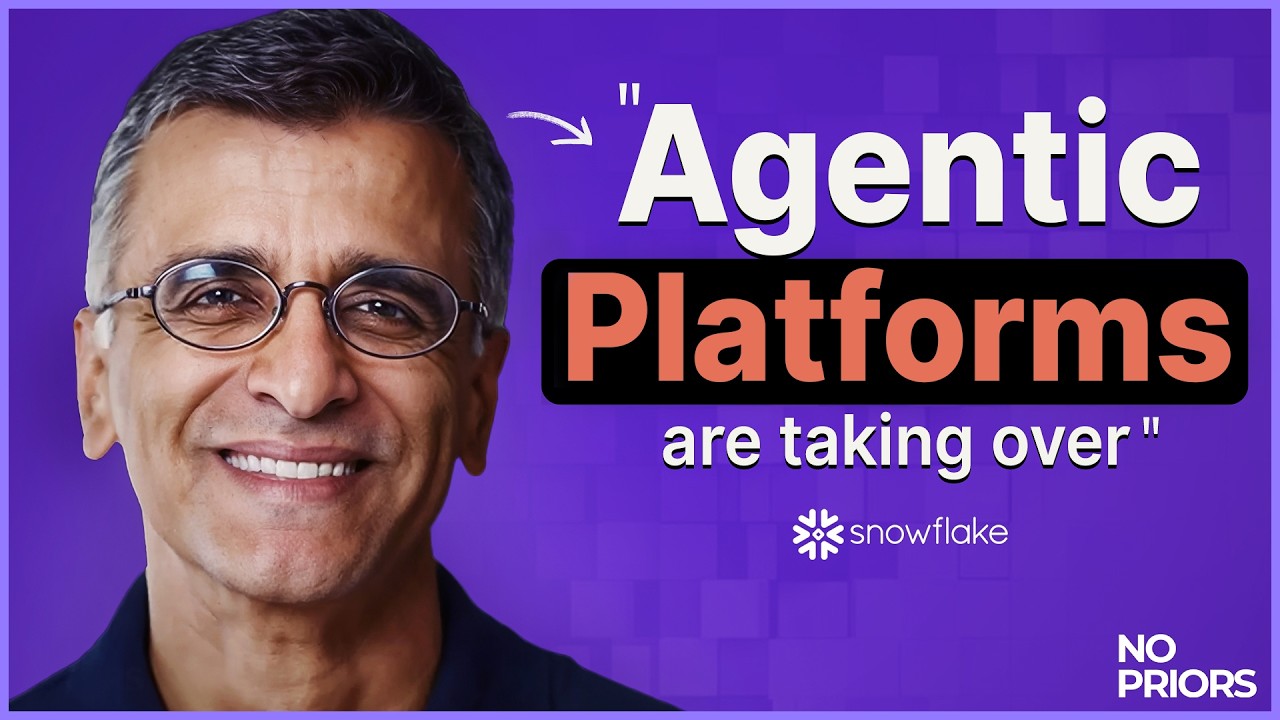
📺 Today’s recommended deep-dive video: https://www.youtube.com/watch?v=UIDMhKgpqkg
Moving at the Speed of Intelligence: Sridhar Ramaswami on the AI Data Cloud
Snowflake CEO Sridhar Ramaswami details the high-stakes transformation of the data giant into an AI-first agentic platform. He shares hard-won lessons on organizational speed, the reality of enterprise AI ROI, and why the most successful AI systems must leverage traditional search tools rather than attempting to solve every problem within the model alone.
Core Question: How can a legacy-scale data company pivot to an “opinionated” agentic architecture while maintaining the trust and governance required by the Fortune 2000?
Highlights
- Reducing organizational distance: Why Snowflake moved from ten layers of management to agile, accountable “pods.”
- The shift to Snowflake Intelligence: Moving beyond 2D dashboards toward an interactive, agentic interface for all employees.
- Defensibility through execution: Why technical moats are built daily rather than strategized in multi-year vacuum plans.
- The “Tool-Use” Philosophy: Why the smartest AI systems should use Python or search APIs for math and facts rather than relying on pure generation.
⏱️ Reading time: approx. 7 minutes · Saves you about 35 minutes vs. watching.
Want to take notes while watching? Click the image below and let AI Notebook capture the key points for you 👇

The Transformation of a Titan
Retooling for an Unpredictable Era
Transitioning from the largest software IPO to an AI-first era required a fundamental shift in mindset. When Ramaswami took the helm from Frank Slootman, he inherited a company with impeccable product-market fit but a structure that had grown too specialized and layered for the rapid iteration AI demands.
In the early “rocket ship” phase, Snowflake had developed nearly ten layers of management between engineers and customers. This distance worked for a winning cloud data warehouse but failed in a tumultuous tech landscape where new breakthroughs happen monthly. Ramaswami moved to flatten the organization, prioritizing accountability and direct lines to the go-to-market teams. This retooling was not just about hierarchy but about embracing the “pod” model where small, focused groups iterate on product insights before market currents shift.
Speed wins, and the ability to iterate always trumps even the most carefully laid out strategies.
The transition from being “The Data Cloud” to “The AI Data Cloud” was a moment of self-discovery. By acknowledging they were neither a CSP nor a foundation lab, Snowflake found its niche: making the massive amounts of Fortune 2000 data already on the platform actionable through AI. This focus on the “data platform layer” ensures that the governance established over the last decade remains the bedrock for every new generative feature.

💡 Digging Deeper
Q: Why was the leadership change from Frank Slootman to Sridhar Ramaswami necessary?
A: Frank presciently felt the company was entering a tumultuous product phase and wanted a “product-first” leader to navigate the AI wave.
Q: What is the primary metric for success in the first six months of a CEO transition?
A: Speed of iteration and the reduction of the distance between the person building a feature and the customer using it.
Q: How does Snowflake view its position relative to foundation model labs?
A: With humility; they pivoted away from building their own base models to focus on how AI accelerates value for data already stored in Snowflake.
Snowflake Intelligence and the Rise of Agents
Beyond the 2D Dashboard
Snowflake Intelligence (SI) represents a shift away from the 2D limitations of traditional BI dashboards. While a dashboard provides a static view of a complex data surface, SI offers an “opinionated” agentic platform designed to answer the specific, nuanced questions business users ask daily. By moving beyond text-to-SQL into a true interactive interface, the goal is to empower every employee—not just the data team—to extract immediate value from both structured and unstructured datasets.
Trust is the non-negotiable foundation of enterprise AI.
Ramaswami emphasizes that AI should be treated with the rigor of software engineering rather than “Yolo AI,” where users receive a mix of good and terrible answers. This philosophy led to the development of Raven, an internal sales assistant that aggregates customer contracts, consumption data, and recent meeting notes into a single, reliable stream. It proves that the line between “pure software” and “agentic systems” is blurring, as agents begin to handle tasks once reserved for complex ERP or CRM interfaces.
The platform is deliberately not a “do-it-all” system like those offered by some cloud providers. By staying focused on the data platform layer, Snowflake ensures that governance and security remain intact even as users leverage generative capabilities. This integrated approach avoids the “subscription fatigue” of per-seat models, moving instead toward a consumption-based structure where users pay for the actual value they derive from their queries and agentic interactions.

Strategy, Partnerships, and ROI
Earning the Sun
In the current technical environment, defensibility is built, not strategized. Ramaswami notes that even companies previously thought to be unassailable now feel threatened by AI. This environment demands that a data platform earn its position every day through innovation rather than relying on legacy moats.
For enterprises seeking ROI, the “stack rank” of use cases is becoming clearer. Coding agents provide the most immediate return by demystifying technology for non-developers and accelerating internal projects. Customer support follows closely, leveraging AI’s ability to tap into massive repositories of human knowledge. However, Ramaswami warns against obsessing over massive ROI too quickly; instead, companies should take “shots on goal” by running small, $1,000 projects to build internal intuition.
Partnerships have also matured into a bidirectional exchange of value.
Snowflake’s relationship with Microsoft and SAP has shifted from pure competition to a “1+1=3” model. By integrating with Microsoft Fabric or enabling bidirectional data sharing with SAP, Snowflake positions itself as the “connective tissue” of the enterprise. This approach acknowledges that while the hyperscalers have infinite budgets, a neutral data platform that spans across clouds offers a higher level of abstraction and simplicity that the “services-first” providers often struggle to match.

Key Takeaways
The transition of a massive software company into an AI-driven entity is less about choosing the right model and more about organizational agility. Sridhar Ramaswami’s experience shows that flattening management layers and creating a culture of rapid iteration are the prerequisites for AI success. By moving the focus from “data storage” to “agentic insight,” Snowflake is betting that the most valuable companies of this century will be those that treat data as a living influence on their products rather than a historical afterthought.
Ultimately, the goal of the modern data platform is to provide “Inception to Insight.” This means being the companion for a company’s data from the moment it is conceived to the moment it generates a business decision. As AI becomes the interface for this journey, the winners will be those who prioritize trust, cite their sources, and use the “best tools available”—even if those tools are traditional Python scripts rather than the latest LLM.
Q&A
Q1: How should companies measure the risk of using AI agents?
A1: Companies must implement “eval loops” for every new feature, treating AI outputs with the same binary “right or wrong” rigor used in traditional software engineering to avoid “Yolo AI” scenarios.
Q2: What is the most immediate ROI for AI in the enterprise today?
A2: Coding agents are the top priority because they dramatically lower the barrier to creating demos, internal apps, and data visualizations, followed by automated customer support.
Q3: Does the ad-supported model of the internet survive the chat-AI era?
A3: Yes, the ad model is here to stay, but it will reinvent itself. The key is ensuring it doesn’t become “insidious” and that users can still distinguish between organic insights and sponsored content.
Q4: Why shouldn’t LLMs do math or retrieve facts purely from memory?
A4: A “maximalist” intelligence uses reliable tools. It is more efficient and accurate to have an LLM write a few lines of Python to solve a math problem or use a search API for facts than to rely on probabilistic generation.
Q5: What was the biggest lesson Ramaswami learned from his startup, Neeva?
A5: The experience taught him the necessity of “hustling” and not taking success or distribution for granted—attributes that are essential even when leading a giant like Snowflake.
Q6: How does Snowflake handle “subscription fatigue” in AI?
A6: By sticking to a consumption-based model where people pay for what they use, rather than forcing high-priced, per-user monthly licenses for every employee.
Q7: What is the “opinionated” approach to AI agents?
A7: Instead of offering an “infinity of things” you can do, Snowflake Intelligence focuses specifically on realizing value from data through predefined, high-value business workflows.