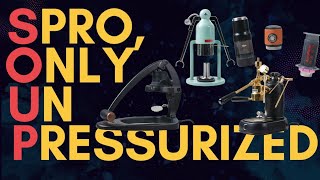
📺 Today’s recommended deep-dive video: https://www.youtube.com/watch?v=_GeFEwNfLZg
Stop Brewing Sour Light Roast: The Ultimate Guide to “Soup”
Traditional espresso parameters were designed for dark roasts, leaving modern light-roast lovers trapped between extreme sourness and muddy bitterness. “Soup” is a radical brewing paradigm that abandons high pressure in favor of a gentle soak and rapid flow, delivering the clarity of filter coffee with the punch of a concentrated shot.
Core Question: How can a high-flow, low-pressure brewing method solve the inherent extraction inconsistencies of ultra-light roast espresso?
Highlights
- The historical mismatch between 9-bar pressure standards and modern light roast chemistry.
- Why a “gentle soak” prevents puck compression and enables higher, more even flow rates.
- A deep dive into “Soup” hardware: from the OXO Rapid Brewer to the Cafelet Robot and Flare 58.
- Technical heuristics for grind size, water alkalinity, and achieving 20% extraction without pressure.
⏱️ Reading time: approx. 8 minutes · Saves you about 34 minutes vs. watching.
Want to take notes while watching? Click the image below and let AI Notebook capture the key points for you 👇

The Philosophy of the Soak
Beyond the 9-Bar Standard
Espresso was born in an era of dark roasts. The strictures we follow today—high pressure, fine grinds, and specific timings—were optimized in the 1940s and 50s for robusta-heavy, oily beans that required intense force to extract flavor. When we apply these same rigid rules to modern ultra-light roasts, we often encounter a “hit or miss” situation where the coffee is simultaneously sour and astringent because the water cannot move evenly through the dense, finely ground puck.
The “Soup” method, popularized by members of the Espresso Aficionado Discord like the user DC, seeks to replicate the flavor explosions and balance of a V60 or Aeropress within an espresso format. By grinding much coarser and virtually eliminating pressure, you allow for a juice-like clarity that traditional espresso simply cannot reach.
It is essentially a melding of different ingredients into a harmonious liquid state, much like a culinary stew.

💡 Digging Deeper
Q: Why does traditional high pressure fail light roasts?
A: High pressure “pounces” on the puck, compressing the grounds and creating avenues of uneven flow (channeling), which leads to simultaneous under-extraction and over-extraction.
Q: Is Soup just a watery espresso?
A: Not at all. It maintains the concentration and TDS (Total Dissolved Solids) of espresso, often hitting 18-20% extraction, but without the harshness associated with high-pressure brewing.
Q: What is the ideal flow rate for Soup?
A: Aim for a rapid flow of approximately 5 to 6 grams per second after the initial saturation.
Mastering the Mechanics
The Importance of the Gentle Soak
The secret to a successful Soup shot lies in the “soak rate,” or how gently the puck is saturated before the main flow begins. If you blast the puck with water immediately, you compress the bed and restrict the flow, which is counterproductive when dealing with light roasts that already have low resistance. A gentle soak—where you saturate the puck until the entire bottom of the basket is visibly coated with liquid—preserves the internal avenues of the coffee bed, allowing for a much faster, more homogeneous draw-through.
While pump-driven machines struggle with this because of the “fill rate” (the time it takes to fill the void above the puck), manual levers like the Cafelet Robot excel. Because there is no air gap between the water and the coffee in a Robot, you go straight into the soak.
This tactile feedback allows you to feel the puck’s resistance, giving you a level of control that automated algorithms simply cannot match yet.

💡 Digging Deeper
Q: How do I know if my soak was successful?
A: Use a small mirror under your portafilter; the entire bottom of the basket should be evenly dark and dripping before you apply full flow.
Q: Should I use paper filters?
A: Yes. A bottom paper filter is highly recommended to aid even flow across the basket, and a top filter or mesh screen prevents the water from digging craters into the coffee bed.
The “Soup” Machine Arsenal
The OXO Rapid Brewer Revelation
Surprisingly, one of the most effective tools for this method is the OXO Rapid Brewer, a budget-friendly device that uses an air-displacement piston. Discovered by Bailey of Intelligencia, this machine is almost incapable of exceeding one bar of pressure, making it a “built-for-soup” device that is virtually foolproof for travel. It allows for a gentle soak followed by a rapid manual pump, resulting in a clean, vibrant cup that has converted even the most die-hard espresso traditionalists.
For those using the Aeropress, the method is possible but requires modifications like the JoPresso or a flow-control cap to handle the coarser grind and deeper puck required for Soup.
If you are using a Flare 58 or a Picopresso, the principle remains the same: ignore the pressure gauge and focus on maintaining that high-velocity flow.

💡 Digging Deeper
Q: What grind size should I start with?
A: A good heuristic is to find the midpoint between your burr-lock (zero) and your standard V60 filter grind.
Q: Does Soup work for milk drinks?
A: It isn’t typically recommended, as the high clarity and lower bitterness that make Soup great for straight shots may get lost when diluted with milk.
Key Takeaways
Soup brewing proves that espresso is far more difficult than we previously thought. By hitting 20% extraction yields with double the grind size and half the contact time of a traditional shot, we see just how much “dirty” or uneven extraction occurs in standard 9-bar espresso. The forgiveness of this method is its greatest strength; once you find a grind size that works for your palate, it tends to be consistent across almost all light roasts.
This paradigm shift encourages us to redefine what espresso can be: not just a bitter, concentrated shot, but a succulent, juicy, and balanced experience. Whether you use a high-end manual lever or a $35 travel brewer, the goal is the same—stop chasing the “Godshot” through finer grinds and start finding it through better flow.
Q&A
Q1: Can I make Soup on a standard semi-automatic pump machine?
A1: Yes, but it requires careful manipulation. You must perform a very slow pre-infusion to gently soak the puck, then transition to a high-flow stage, which is easier on machines with flow control.
Q2: Is the mouthfeel different from traditional espresso?
A2: Yes. While it lacks the heavy, syrupy crema of a dark roast, it offers a “velvety” or “succulent” mouthfeel driven by total dissolved solids rather than just suspended oils and CO2.
Q3: Why does alkalinity matter for Soup?
A3: Because Soup produces high perceived acidity, you may need to increase your water’s buffer (alkalinity) to 50-70 ppm to prevent the shot from tasting overly sour at shorter ratios.
Q4: Do I need to preheat my equipment?
A4: Not necessarily. For Soup, a brew temperature between 88°C and 90°C inside the basket is often sufficient, and many find they can skip the elaborate preheating routines required for traditional light-roast espresso.
Q5: What ratio works best for Soup?
A5: It is incredibly flexible. You can experiment anywhere from a concentrated 1:2 ratio up to a long 1:8 “Allongé” style extraction depending on the coffee’s roast degree.
Q6: Why use a manual machine over a Descent or other smart machines?
A6: Manual machines provide tactile feedback; you can literally feel the puck soaking and resisting, which makes the process more intuitive and less reliant on trial-and-error algorithms.
Q7: Does this method work for medium roasts?
A7: Absolutely. It can help mute roasty bitterness and highlight the underlying acidity in Nordic or American light-medium roasts.