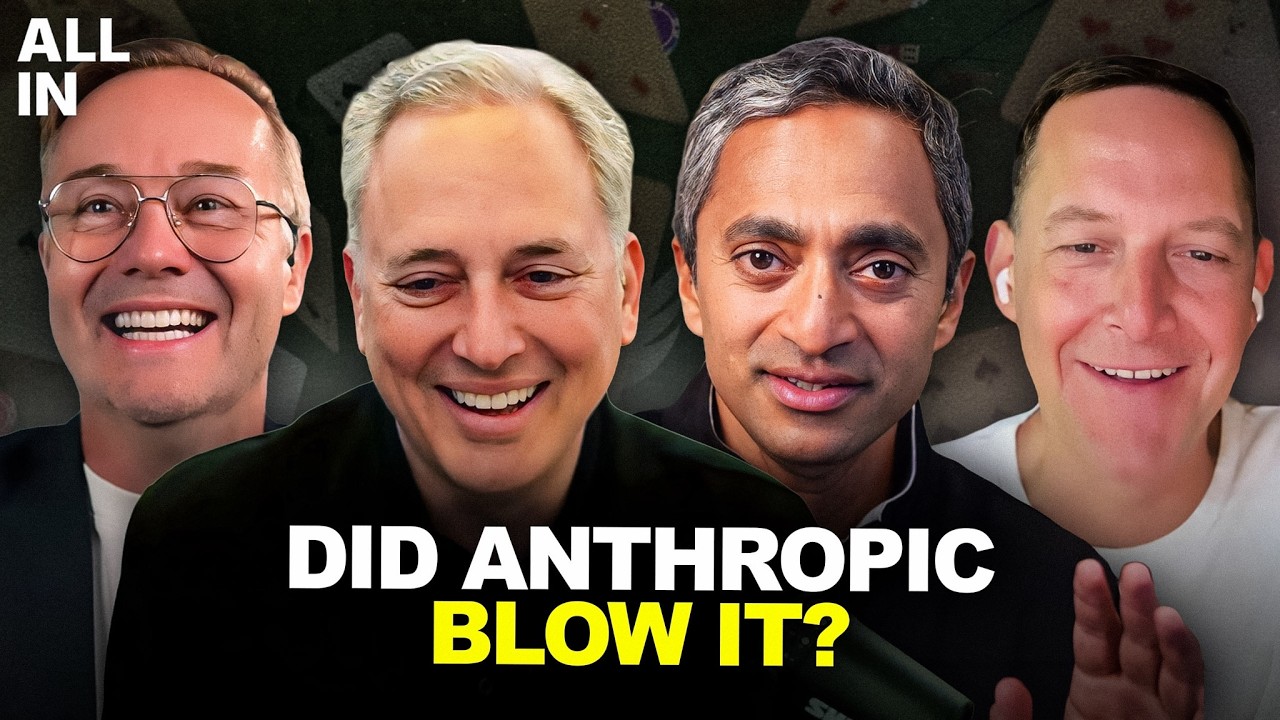
📺 Today’s recommended deep-dive video: https://www.youtube.com/watch?v=3Amlu4y94Ho
The American Politburo and the Trillion-Dollar Frontier
In this high-stakes session, the Besties dissect the shifting landscape of American liberty, the record-breaking public debut of SpaceX, and the geopolitical fallout of a landmark peace deal. From the psychological dangers of “learned helplessness” to the regulatory capture of AI by hyperscalers, the conversation explores whether the U.S. is still a land for the makers.
Core Question: How does the erosion of private property and individual agency threaten the future of innovation and economic mobility in the United States?
Highlights
- David Friedberg’s fiery critique of the “American Politburo” and the rise of bureaucratic control over the means of production.
- Analysis of SpaceX’s historic IPO and the acquisition of the AI coding agent Cursor to solidify vertical integration.
- The breakdown of trust between Anthropic and the White House following the “Mythos” cyber-weapon controversy.
- The implications of a 60-day ceasefire and nuclear deal with Iran brokered by the Trump administration.
⏱️ Reading time: approx. 12 minutes · Saves you about 72 minutes vs. watching.
Want to take notes while watching? Click the image below and let AI Notebook capture the key points for you 👇

The Erosion of Liberty and the “Politburo”
The Maker vs. Taker Divide
The United States is witnessing the formation of a modern Politburo where political elites dictate economic flow and dismantle the foundational right to private property.
David Friedberg argues that the current legislative trend, exemplified by new tax laws in Illinois, signals a shift toward a society where the government can seize assets you’ve already paid taxes on. This isn’t just about targeting billionaires; it is an attack on the very concept of ownership. When the state removes the incentive to build and own, it effectively traps the citizenry in a cycle of dependency, destroying the dream of upward mobility. This is the hallmark of an unfree society masquerading as a quest for equity.
Chamath Palihapitiya adds a personal dimension to this theory, recounting his childhood on welfare. He observes that “learned helplessness” sets in when government support exceeds the threshold of necessity. This dynamic reduces capable human beings to shadows of their potential, stripping them of the agency required to transform from a “wage slave” into an owner of capital.

💡 Digging Deeper
Q: What is the “American Politburo”?
A: A term used by Friedberg to describe leaders like Elizabeth Warren and Bernie Sanders who seek to centralize the means of production and control the media/education.
Q: Why is “learned helplessness” so dangerous to the economy?
A: It creates a threshold where individuals stop attempting to solve easy problems because the government provides just enough to survive, killing the ambition to progress.
SpaceX’s Trillion-Dollar Milestone
From Labor to Capital
SpaceX’s debut at $135 a share represents the culmination of 25 years of relentless iteration and engineering risk.
Despite the staggering $2 trillion market cap, the hosts remind viewers that wealth in this context isn’t cash in a bank, but the discounted future value of a machine that makes things. Sacks points out that the “intelligentsia” class often resents this wealth because they produce only “hot air” while entrepreneurs produce infrastructure that enhances global productivity. This is a fundamental misunderstanding of how a capitalist machine functions.
True economic mobility is the fluid transition from being labor to becoming an owner of capital through sweat equity.
The acquisition of Cursor for $60 billion highlights a strategic focus on the vertical integration of AI and hardware. By securing a coding agent that doesn’t rely on competitors like Anthropic, SpaceX ensures its developmental velocity remains unmatched. This success is inclusive; a welder at SpaceX becoming a millionaire through stock options is the quintessential American success story. It proves that when the market is open, everyone has the capacity to participate in the upside of the machines they help build.

💡 Digging Deeper
Q: Did Elon Musk get richer after the IPO?
A: Technically no; his balance sheet remained the same. The public simply placed a higher value on the shares he already owned, which are now locked up for a year.
Q: Why was the Cursor acquisition significant?
A: It was a “shiv” move against Anthropic. SpaceX used its hardware at Colossus to help Cursor build its own model after Claude attempted to restrict access.
The Anthropic “Mythos” Controversy
Epistemic Exceptionalism and Regulatory Fails
The recent pulling of Anthropic’s Fable 5 model by the Commerce Department underscores a massive breakdown in trust between Silicon Valley and Washington.
CEO Dario Amodei’s refusal to immediately patch a reported jailbreak—viewed by the White House as a cyber-weapon vulnerability—led to a heavy-handed export control letter. This incident serves as a warning that if frontier labs continue to “doom troll” the public about the dangers of AI, they will walk themselves into a regulatory prison. The administration’s move wasn’t a policy shift, but a frantic reaction to a perceived national security threat that Anthropic failed to manage gracefully.
Chamath notes that this “own goal” by Anthropic creates a perfect lane for hyperscalers like Amazon and Microsoft to act as the “adults in the room.”
They are now positioned to gatekeep AI technology behind KYC (Know Your Customer) requirements, effectively centralizing the most powerful tool for human progress ever created. When a company believes its reasoning is the only “uncorruptible reference point,” it risks alienating the very institutions required to maintain a free and open innovation ecosystem. This “epistemic exceptionalism” is the silent killer of collaborative technological progress.

The Iran Peace Accord
Geopolitical Realignment in Geneva
The signing of the Geneva MOU represents a significant shift in U.S. foreign policy, focusing on de-escalation rather than the failed cycles of regime change.
Sacks defends the deal as the best of several bad alternatives, arguing that a land invasion of a “mountain fortress” like Iran would be a suicide mission requiring millions of troops. By reopening the Strait of Hormuz and freezing enrichment, the deal aims to stabilize global energy markets and avoid another “forever war.” The core of the agreement lies in the verification of nuclear stockpiles, which provides a 60-day buffer to reach a permanent solution.
Ultimately, the success of this peace will depend on whether the Iranian people can eventually lead their own revolution without forced Western intervention.
While skeptics point to the $300 billion reconstruction fund and lifted sanctions, the removal of enriched uranium is the core security win. If the material leaves the country, the nuclear threat is set back by at least a decade, providing a necessary buffer. We cannot enforce democracy from the outside; we can only contain the threats while waiting for the internal dynamics of a country to change.

Key Takeaways
The “All-In” quartet highlights that individual agency is the only infinite resource for human progress. Whether through SpaceX’s market success or the personal struggle against government dependency, the path to a flourishing society requires protecting private property and the freedom to build without bureaucratic overreach.
Regulatory capture in the AI space remains a looming threat that could hand a monopoly to a few hyperscalers.
Geopolitical stability is currently a fragile balance of high-stakes negotiation. The Iran deal and the SpaceX IPO are two sides of the same coin: one attempts to manage the risks of the old world, while the other builds the infrastructure for the new one. Both require a commitment to realism over ideology to ensure that the “makers” of the world can continue to drive humanity forward into the next century.
Q&A
Q1: Why did David Friedberg call the leaders “evil”?
A: He argues they use virtue-signaling words like “equity” and “justice” to mask a fundamental desire to seize control of the economy and erode individual liberty.
Q2: What is the significance of the SpaceX IPO for retail investors?
A: Roughly 20-30% of the IPO was allocated to retail via platforms like Robinhood, allowing regular citizens to participate in the wealth creation of a private-turned-public giant.
Q3: How did the SK Telecom connection affect Anthropic?
A: Reports suggest Anthropic shared its “Mythos” model with the South Korean firm without White House approval, raising concerns about potential Chinese access to sensitive cyber-capabilities.
Q4: Is the Iran deal permanent?
A: No, it is currently an MOU (Memorandum of Understanding) that extends a ceasefire and enrichment freeze for 60 days while a final deal is codified.
Q5: What is “epistemic exceptionalism” in AI leadership?
A: It is the belief that one’s own reasoning is the only correct path, and disagreement from others is evidence of their corruption rather than a valid difference of opinion.
Q6: Why did SpaceX pass Amazon and Microsoft in value briefly?
A: It was driven by the massive “green shoe” demand and the public’s appetite for a “one-of-one” company that represents the future of space and telecommunications.
Q7: Who is paying for the $300 billion Iran reconstruction?
A: According to Sacks, the U.S. is not on the hook; the funds will likely come from Iran’s frozen assets and contributions from Gulf states.