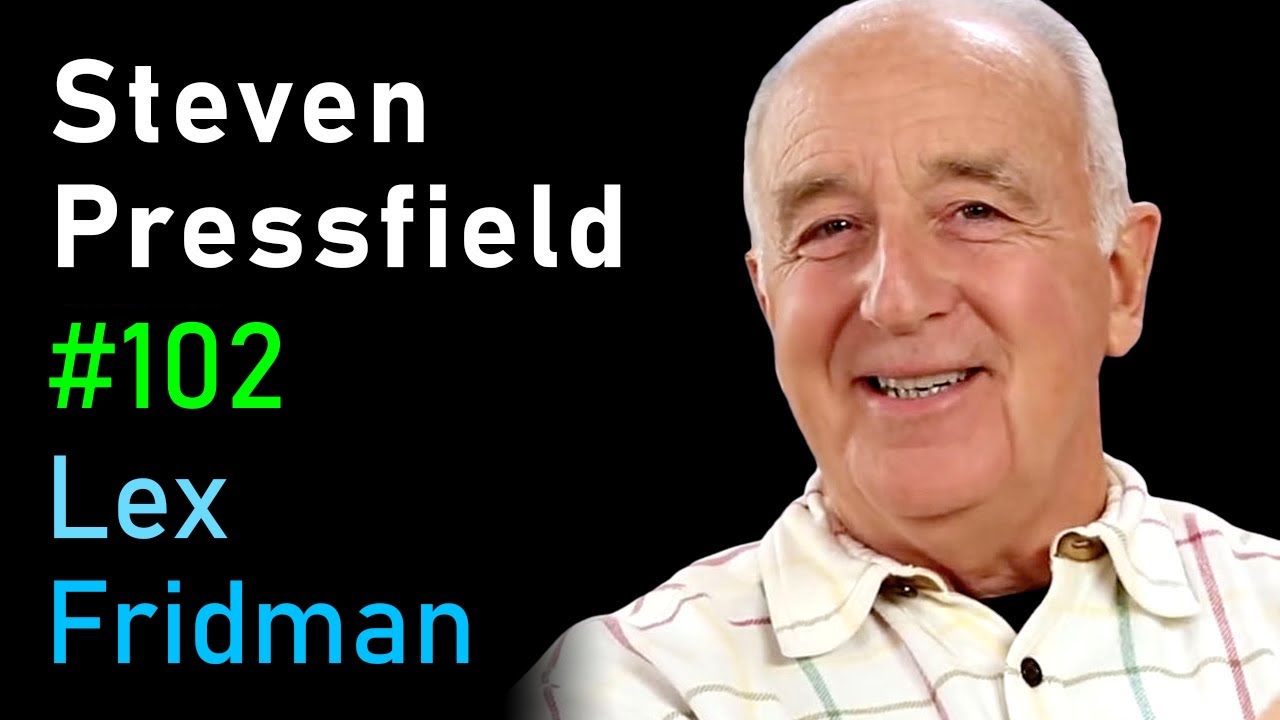
📺 Today’s recommended deep-dive video: https://www.youtube.com/watch?v=PgtedwKGhXs
The Warrior Within: Conquering Resistance and the Muse
Author Steven Pressfield joins Lex Fridman to discuss the internal mechanics of creativity, the Jungian battle between the Ego and the Self, and why war serves as the ultimate metaphor for the struggle against our own limitations. He reveals his rigorous 3:00 AM routine and explains why the fear you feel toward a project is actually a compass pointing toward your destiny.
Core Question: How can creators overcome the invisible force of “Resistance” to fulfill their unique spiritual calling?
Highlights
- Resistance as a Universal Law: The “Yetzer Hara,” or the negative force that sabotages our highest ambitions, is a natural byproduct of the Ego’s fear of growth.
- The Ego vs. The Self: Success requires moving our identity from the fearful, zero-sum Ego to the infinite, love-based Self.
- The Muse is a Partner: Ideas are not invented but “received” from a higher consciousness that requires us to pay our dues through hard work.
- Professionalism is a Ritual: Overcoming procrastination isn’t about willpower; it’s about establishing a mundane, warrior-like routine that silences internal chatter.
⏱️ Reading time: approx. 8 minutes · Saves you about 79 minutes vs. watching.
Want to take notes while watching? Click the image below and let AI Notebook capture the key points for you 👇

The Metaphor of War and the Human Condition
Sublimating the Tribal Urge
Pressfield argues that humans are essentially the same creatures we were in the cave. The tribal “us-versus-them” dynamic is baked into our DNA, a universal imperative for conquest that hasn’t changed in hundreds of thousands of years. In the modern world, this aggression must be sublimated into sports, business, or art, where we can compete intensely while still relating to our opponents as fellow human beings.
War is less about the blood and soil and more about the internal struggle against one’s own negativity.
When writing about the Spartans at Thermopylae or the Israeli paratroopers in the Six-Day War, Pressfield is exploring the warrior archetype as a necessary stage of human development. This archetype represents the transition from student to protector, a phase where we test our limits against extreme adversity. Eventually, we must move beyond this toward becoming teachers or fathers, but the lessons of total commitment and sacrifice for a greater cause remain the foundational stones of a meaningful life.

💡 Digging Deeper
Q: Was war an inevitable creative force for society?
A: While it helped spread and mix cultures, it is primarily a realization of the human urge for conquest. However, its greatest value today is as a metaphor for the struggle within the individual soul.
Q: Why does Pressfield focus on the Israeli side of the Six-Day War?
A: He views it through the lens of a return from exile and the re-establishment of identity. It serves as a metaphor for standing one’s ground against overwhelming odds, a psychological necessity for any minority or vulnerable group.
Resistance, the Ego, and the Self
The Fear of the Soul’s Expansion
Resistance is a “protean” force that constantly changes shape—laziness, excuses, self-doubt—to prevent you from doing your highest work. It is essentially the voice of the Ego, which feels threatened when we attempt to grow. The Ego believes that death is real, that time is linear, and that we are all separate individuals, making fear its dominant emotion.
The conflict arises from the dichotomy between the Ego and the Self.
The Self operates on the plane of the “divine ground,” where time is an illusion and love is the primary driver. Resistance is the Ego’s survival mechanism, screaming because it feels it will be rendered obsolete if the soul expands into the infinite. Every story’s villain is essentially a manifestation of this resistance, whether it’s a literal monster or the internal justification to skip the gym.

The Creative Process and the Muse
Tuning into the Cosmic Radio
The Muse is not a whimsical fairy but a sophisticated consciousness attempting to communicate through a thin membrane between dimensions. In Jewish mysticism, this is the Neshama, a soul on a higher plane trying to reach down while the practitioner tries to reach up through prayer or creative work. It is a collaborative partnership where the artist serves as a radio receiver, tuning into a frequency of potentiality that already exists in the universe.
There is no hack for this connection; you simply show up until the goddess decides you’ve finally paid your dues.
Pressfield describes the creative act as an “Artist’s Journey,” a continuation of something that started long before birth. We arrive with unique destinies and themes, much like Bruce Springsteen, whose body of work follows an almost predetermined trajectory of evolution. Our job is to stay out of the way of the Ego and let the Muse speak through us, recognizing that the “idea” is often smarter than the person writing it down.

💡 Digging Deeper
Q: How do you “let go” and clear the channel for the Muse?
A: It is a process of years, not minutes. It involves “beating your head against the wall” until the Ego finally gives up, allowing the unconscious to take over the steering wheel.
Q: Does Pressfield miss his characters when a book is done?
A: He feels an affection for them similar to children who have gone off to college; they are a part of him, but they now belong to the world.
The Discipline of the Daily Grind
Mundane Weapons for a Spiritual War
Discipline is the mundane weapon used to fight a spiritual war. Pressfield’s day begins at 3:00 AM, a start that allows him to hit the gym before the sun rises. This physical “resistance training” serves as a dress rehearsal for the mental battle he will face later at the desk, building the necessary callouses for the soul.
Once at the keyboard, he doesn’t “fuck around” with trivialities; he dives immediately into the work to outpace the Ego’s excuses.
The workday is surprisingly short, usually capped at three or four intense hours. Writing burns through mental energy at a rate that makes longer sessions counterproductive. Once the office door closes, it stays closed. He refuses to obsess over the work during his off-hours, trusting the Muse to handle the heavy lifting in the background while he walks or enjoys dinner, maintaining the health required for the next day’s battle.

Key Takeaways
The more fear you feel toward a specific project, the more certain you can be that the project is your true calling. Fear is an indicator, a compass that points exactly toward where the Ego is most afraid of losing control. If a project doesn’t scare you, it likely isn’t challenging enough to trigger the growth necessary for the next stage of your “Artist’s Journey.”
Success in any field requires a transition from amateur to professional, which Pressfield defines as the ability to silence the Ego and show up regardless of mood.
By treating the creative process with the ritualized discipline of a warrior, we move from being victims of Resistance to being masters of our own output. It is not about the result—the gold medal, the bestseller, or the Oscar—but about the sacred service to the work itself. When we stop trying to control the outcome, the Muse is finally free to do her best work through us.
Q&A
Q1: Why is resistance so strong right when we start a project?
A: Because that is when the threat to the Ego’s status quo is greatest. The Ego knows that if you finish that project, you will be a different, more evolved person, and it wants to keep you exactly as you are.
Q2: Is the writing process lonely?
A: Not at all. If you are truly in the work, you are with your characters and the world you are creating. It is often more lonely to be at a dinner party where the conversation is superficial than to be at a desk with the Muse.
Q3: Can a single individual learn to not hate the “other”?
A: Yes, but it requires a spiritual shift. Hatred often dissipates when there is mutual respect and a balance of power, allowing both sides to see each other as equals rather than victims or oppressors.
Q4: Do you visualize success like an athlete?
A: No, because visualizing a “gold medal” (an Oscar or a bestseller) is an Ego-driven activity. Instead, one should visualize being in the “flow” and doing the work to the best of their ability.
Q5: What is the role of an editor in this process?
A: An editor provides the perspective the writer has lost. They ensure the writer hasn’t violated the conventions of the genre and keep the “Golden Gate Bridge” of the story from sagging.
Q6: Does Resistance ever go away?
A: Never. It is a law of nature. You simply get better at recognizing its tricks and develop the discipline to work through it anyway.