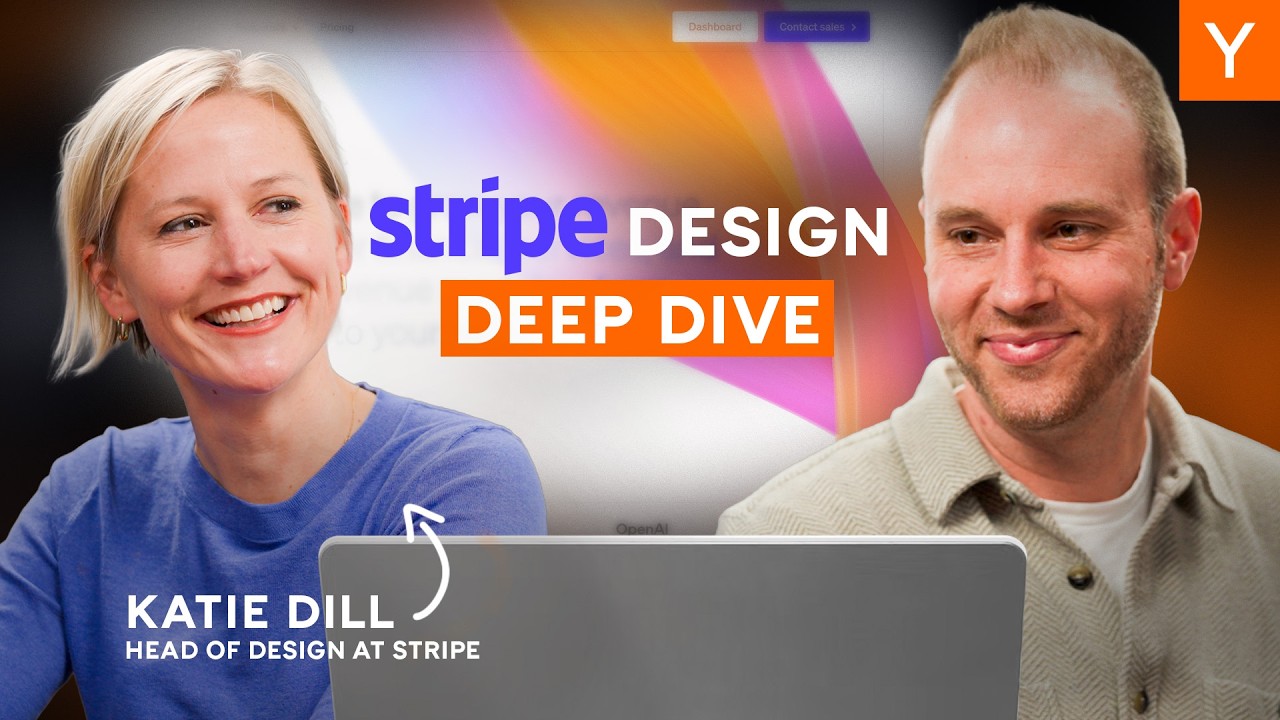
📺 Today’s recommended deep-dive video: https://www.youtube.com/watch?v=ypzNhwpmOD4
Crafting the New Standard: Behind Stripe’s Homepage Redesign
Stripe recently overhauled its iconic homepage, balancing a legacy of design excellence with the needs of an evolving, multi-product business. Head of Design Katie Dill reveals the meticulous process, custom internal tools, and the role of AI in shaping their latest digital manifesto.
Core Question: How does a design-led organization like Stripe evolve its visual identity while scaling to meet the demands of global financial infrastructure and the AI revolution?
Highlights
- The “Bento Box” UI pattern enables progressive disclosure without overwhelming the user.
- A custom-built “Wave Tool” was developed to fine-tune the site’s signature gradients.
- AI is used to raise the “design floor,” allowing for faster prototyping and custom brand imagery.
- The “Walking the Store” culture ensures quality through cross-disciplinary QA and founder involvement.
⏱️ Reading time: approx. 6 minutes · Saves you about 38 minutes vs. watching.
Want to take notes while watching? Click the image below and let AI Notebook capture the key points for you 👇

Evolution of the Narrative
The Move to Progressive Disclosure
Stripe’s previous homepage, launched in 2020, served as a gold standard for tech design, yet the business eventually outgrew its own story as the product suite expanded far beyond simple payment processing.
Instead of just adding more sections for different users, the team introduced the “Bento” layout, a visual grid that allows for progressive disclosure without forcing users to navigate away from the main page. This approach balances the need for breadth with a clean, low-text interface that lets imagery do the heavy lifting.
By utilizing interactive modals that pop up directly over the grid, Stripe keeps potential customers within the flow of their narrative while providing the specific details needed for diverse products like Billing, Issuing, and Tax. It transforms the browsing experience into a lean-back journey rather than a heavy reading task, ensuring that even users who scroll quickly can grasp the sheer scale of the financial infrastructure being offered.

💡 Digging Deeper
Q: Why keep the headline “Financial infrastructure to grow your revenue” for six years?
A: It remains the core manifesto of the company; while the products changed, the fundamental mission of enabling global commerce remained the same.
Q: What is the purpose of the live GDP counter?
A: It serves as ultimate social proof, quantifying Stripe’s massive scale and reliability to enterprise clients who need to know the platform can handle billions in volume.
The Art of Intentional Animation
Perfecting the Wave
To perfect their signature aesthetic, the engineering team built a custom internal tool specifically to manipulate the “Perfect Wave,” allowing designers to fine-tune grain, blur, and rotation in real-time.
Every animation on the site, from the shifting gradients to the interactive data visualizations, is calibrated to signal a high level of care and technical competence. The team actually delayed the launch by weeks to ensure transitions between animations were smooth rather than “cludgy,” demonstrating that in a world of standardized SaaS templates, polish is a primary differentiator for brand trust.
Motion acts as the site’s heartbeat, making the digital experience feel alive and responsive to human interaction.

💡 Digging Deeper
Q: How do you prevent animations from becoming distracting?
A: Through relentless prototyping; the team adjusted the speed and line count of animations until they felt like “delicate movements” rather than noise.
Q: Why delay a launch for a transition effect?
A: Because the homepage is a manifesto; if the site feels “cludgy,” a user might assume the underlying financial code is equally unrefined.
Designing for the AI Era
Raising the Floor with AI
AI hasn’t replaced the designer’s craft at Stripe, but it has drastically raised the floor, allowing the team to explore twenty concepts in the time it once took to create two.
The team used AI to generate custom imagery for customer logos, painstakingly critiquing every detail—like the way a shadow falls on a glass cube—to ensure the output met their rigorous standards of taste and realism. It acts as a partner in prototyping, enabling the rapid testing of different copy and layouts for specific user segments during research phases.
Designers are now shifting their focus from basic pixel-pushing to defining new paradigms of interaction, such as how users and autonomous agents will traverse the internet of tomorrow. As tools make reaching “good” nearly instantaneous, the designer’s role evolves into that of a curator and craftsperson who must push beyond the baseline to achieve something truly exceptional.

💡 Digging Deeper
Q: What is “Squeezy Boy”?
A: A fun internal name for a dynamic UI section that showcases changing content like Black Friday stats or podcasts, using responsive containers that expand and contract.
Q: How does AI change the design system?
A: AI can help scale components by taking a designer’s rough sketch and instantly applying the company’s design system tokens to create a high-fidelity mockup.
Key Takeaways
The most dangerous force in any growing company is the “gravitational pull to mediocrity,” where it becomes easier to ship “good enough” rather than fighting for excellence. Stripe combats this by prioritizing the “MVQP” (Minimum Viable Quality Product) over the traditional MVP, ensuring that even the earliest version of a feature reflects the brand’s commitment to craft.
To maintain this bar, the team practices “Walking the Store”—a culture where everyone from engineers to founders regularly tests the live product from a user’s perspective. By looking for “dead ends” and inconsistent details, they ensure the product suite feels like a cohesive home rather than a collection of mismatched rooms.
Ultimately, great design is about intentionality. Whether it is the grain of a gradient or the response time of an API modal, every detail is a signal to the customer that the company is worthy of their trust.
Q&A
Q1: How long did the 2020 version of the site last?
A: It lasted about six years, which is an eternity in tech, proving that high-quality design can stand the test of time even as the business evolves.
Q2: What is “Walking the Store”?
A: It is an internal QA process where employees across all disciplines (Design, Eng, PM) use the product as a customer would to find friction points and “dead ends.”
Q3: How did the team use the custom Wave Tool?
A: It allowed designers to save “states” of different gradient variations, testing them against text readability and brand vibrancy before committing to the final code.
Q4: Does AI replace the need for design taste?
A: No; if anything, it makes taste more important. While AI can generate a 7/10 design instantly, a human designer is needed to push it to a 10/10 by fixing technical errors and ensuring emotional resonance.
Q5: Why did the team move toward a “Bento” layout?
A: Because users are in a “lean-back” browse mode on homepages; the grid provides a visual map of the entire ecosystem that is easier to digest than a long, scrolling narrative.
Q6: What happens when the founders “walk the store” every Friday?
A: They demonstrate the company’s values to all employees, showing that no detail is too small for the leadership to care about, which helps fight the pull to mediocrity.
Q7: How does Stripe handle dark mode for developers?
A: The site transitions into a dark mode “integration” section specifically to speak the visual language of developers, a carry-over from their successful previous designs.