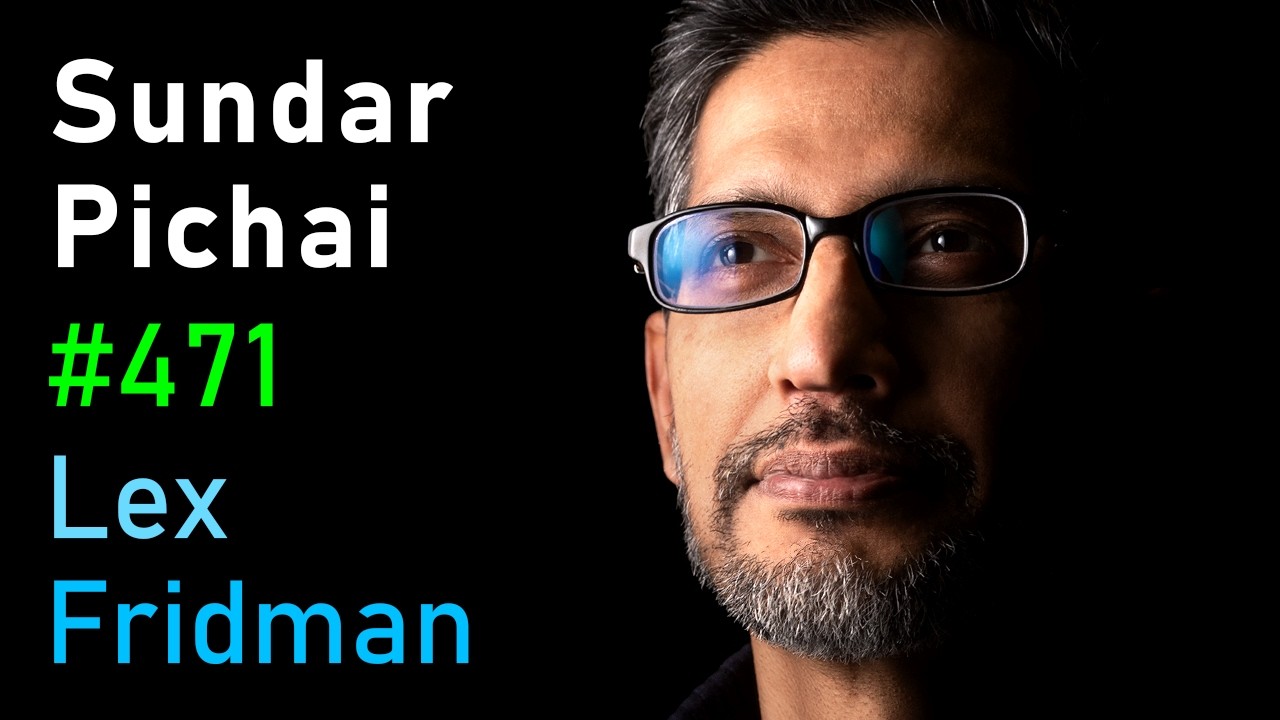
📺 Today’s recommended deep-dive video: https://www.youtube.com/watch?v=9V6tWC4CdFQ
From Rotary Phones to AGI: Sundar Pichai on Google’s AI Future
Sundar Pichai, the CEO of Google and Alphabet, shares a rare look into his journey from a tech-scarce childhood in India to leading one of the world’s most influential companies. This conversation explores the profound shift in Google’s strategy as it pivots to meet the AI moment while navigating internal mergers and external competition.
Core Question: How can humanity harness recursively self-improving technology to solve existential problems while preserving the “human essence” of creativity and connection?
Highlights
- AI is more profound than fire or electricity because it is recursively self-improving and accelerates the process of creation itself.
- Pichai predicts that by 2030, humanity will be dealing with the “mind-blowing” consequences of near-AGI systems across every sector.
- The merger of Google Brain and DeepMind was a consequential leadership decision to unify talent for the “Pro” and “Ultra” model scaling race.
- Despite “P-doom” risks, Pichai is optimistic that the global alignment required to stop catastrophic failure will naturally modulate the underlying danger.
⏱️ Reading time: approx. 14 minutes · Saves you about 118 minutes vs. watching.
Want to take notes while watching? Click the image below and let AI Notebook capture the key points for you 👇

The Subliminal Power of Access
From Chennai to the Silicon Valley C-Suite
Growing up in Chennai, India, technology was a scarce luxury rather than a daily utility, often requiring five-year waiting lists for a simple rotary telephone. For the young Pichai, the arrival of running water or a refrigerator wasn’t just a convenience; it was a discrete “step change” that fundamentally altered the fabric of his family’s daily existence. This early exposure to the scarcity of information—and the subsequent hunger for it—is what ultimately drew him to Google’s mission of organizing the world’s knowledge.
Technology changes lives at the baseline of human dignity.
His leadership philosophy relies on a balanced, even-tempered approach that mirrors his love for sports strategy, particularly the “man-management” styles seen in elite soccer. He believes that while cutthroat behavior is often associated with top leadership, mission-oriented people respond better to motivation and trust than to fear-based management. While he admits to moments of frustration, he views silence or a few firm, spoken words as far more resonant tools for steering a multi-trillion-dollar organization than losing his temper.

💡 Digging Deeper
Q: Why does Pichai prefer Messi over Ronaldo?
A: While he respects Ronaldo’s unmatched commitment to excellence, he views Messi as a singular example of human artistry and genius that evokes a deep, almost indescribable emotional response.
Q: How does his childhood influence Google’s current products?
A: He views products like the “AI Mode” in search as tools that unlock the cognitive potential of the entire eight billion people on Earth, much like the rotary phone unlocked his family’s world.
The AI Package: Beyond Fire and Electricity
The Recursive Nature of Intelligence
Pichai famously claimed that AI is more profound than fire or electricity, a statement he defends by pointing to the technology’s unique ability to improve itself. Unlike previous industrial revolutions, which provided static tools for human use, AI is a “recursively self-improving” force that can eventually achieve superhuman performance on its own research and development. This creates a feedback loop where the technology doesn’t just change the world, but it changes the very speed at which we can innovate.
We are currently in the era of “Artificial Jagged Intelligence,” where models show flashes of brilliance alongside trivial errors.
By 2030, the debate over the exact definition of AGI will likely be moot because the “mind-blowing” progress in coding, reasoning, and multimodal understanding will already be reshaping society. Pichai notes that while early researchers predicted a 20-year window for AGI in 2010, we are now seeing “move 37” moments in almost every domain, from protein folding to weather prediction. The “AI Package” will include second and third-order effects—like the total reorganization of social hierarchies—that are currently impossible for us to predict accurately.

💡 Digging Deeper
Q: Is the scaling law still holding strong?
A: Yes, Pichai believes there is significant headroom left in pre-training and post-training, though he notes that progress is often compute-limited by the sheer cost of serving “Ultra” models.
Q: What is Pichai’s view on “P-doom”?
A: He estimates the risk is real, but he believes that as the threat becomes concrete, humanity will align globally to solve it, making him a “short-term skeptic but long-term optimist.”
Steering the Google Tanker
Turning the Tide on the AI Race
Last year, a flurry of articles suggested that Google had lost its magic and that Pichai was the “wrong guy” to lead the company through the AI revolution. Internally, however, Pichai was focused on tuning out the “choppy noise” of the surface to focus on the calm, deep-water execution of merging Google Brain and DeepMind. This was a consequential leadership decision designed to end internal friction and align the company’s world-class researchers toward a single, unified roadmap for the Gemini models.
The hardest part of leadership is making the few decisions that actually matter while ignoring the thousand that don’t.
Since that merger, Google has scaled its token output by 50x in just twelve months, moving from 9.7 trillion tokens per month to a staggering 480 trillion. Pichai views the integration of AI into Search—through “AI Overviews” and the experimental “AI Mode”—as an evolution that preserves the human-created web while providing a context layer that fuels deeper curiosity. He argues that this doesn’t replace journalism or creativity; it simply removes the “grunt work” of gathering information, allowing humans to focus on the “human essence” of interpretation.
💡 Digging Deeper
Q: How does Google decide when to kill a project?
A: It is a matter of resource prioritization; however, Pichai notes that “Moonshots” like Waymo or Quantum Computing are defended even during periods of intense external criticism.
Q: What is the significance of the 10% engineering velocity increase?
A: By using AI to write and refactor code, Google has effectively added the equivalent of thousands of new engineers without increasing headcount, a massive productivity multiplier.
Key Takeaways
The transition from a “Search first” company to an “AI first” company is not merely a rebranding but a fundamental shift in how Google builds infrastructure. By developing custom TPUs and merging its elite research labs, Google has positioned itself to treat intelligence as a utility, similar to electricity. This allows for horizontal innovation where a single model improvement can simultaneously upgrade Search, YouTube, Waymo, and Google Workspace.
Ultimately, Pichai’s vision for the future is one of “despecialization.” As AI becomes the ultimate specialist in coding, law, or medicine, the most valuable human skill will be the ability to be a “generalist” and a creative integrator. The goal of technology, in his eyes, remains the same as it was in his childhood: to decrease the friction of existence and give people more time to spend on what they find truly meaningful.
Q&A
Q1: Will AI eventually replace the “10 blue links” of Google Search?
A: Search is evolving into a continuum where AI provides a context layer and dialogue (AI Mode), but the core design principle remains taking the user to the human-created web for deeper exploration.
Q2: Should students still study Computer Science?
A: Yes. Computer science is about first-principles thinking, not just coding; AI will handle the grunt work, making the field more about architecture, design, and creative problem-solving.
Q3: What is the “Project Astra” vision?
A: It is the move toward “universal agents” that can see what you see and hear what you hear through glasses or phones, providing proactive assistance in the physical world.
Q4: How does Google manage the “edgy” nature of AI creativity?
A: Pichai views AI as a “paintbrush” and believes in defending artistic free expression, though the company remains responsible for ensuring the models don’t cross fundamental societal lines of safety.
Q5: What was the most fun Pichai had building a product?
A: Building Google Chrome from the ground up, because it involved bringing core operating system principles to the web to make it faster, safer, and more dynamic.
Q6: If AGI could answer one question for Sundar, what would it be?
A: He would ask questions that help us understand ourselves and human nature better, though he also likes the idea of AI helping us solve the Fermi Paradox regarding alien civilizations.