📺 Today’s recommended deep-dive video: https://www.youtube.com/watch?v=_PwhiWxHK8o
Beyond the Decision Line: The Geometry of Support Vector Machines
How do you draw the perfect line between data points when a simple split isn’t enough? Professor Patrick Winston explores the elegant mathematics of Support Vector Machines (SVMs), a tool that revolutionized machine learning by finding the “widest street” through complex, cluttered datasets.
Core Question: How can we mathematically identify the optimal decision boundary and project data into higher dimensions to solve previously inseparable problems?
Highlights
- The “Widest Street” concept for maximizing classification margins.
- How Lagrange multipliers transform complex constraints into solvable optimization problems.
- The discovery that decision rules depend entirely on the dot product of vectors.
- The “Kernel Trick” for classifying data that cannot be separated in its original space.
⏱️ Reading time: approx. 7 minutes · Saves you about 42 minutes vs. watching.
Want to take notes while watching? Click the image below and let AI Notebook capture the key points for you 👇

The Widest Street Approach
Defining the Optimal Boundary
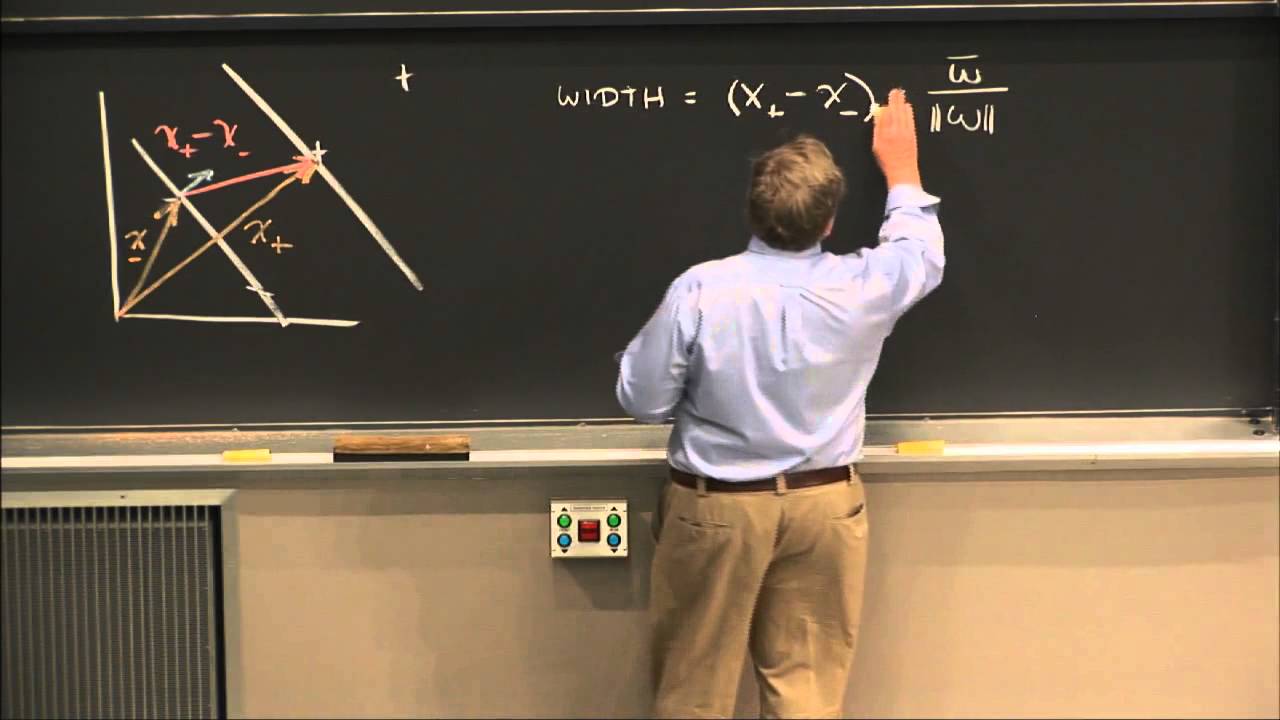
Imagine a cluster of positive and negative data points scattered across a two-dimensional grid, where a simple nearest-neighbor or decision tree approach might draw a jagged or overly snug boundary. Instead of just separating them, we want to find the most robust dividing line possible—one that maintains the maximum distance from the nearest points of each class.
This strategy is often called the “widest street” approach because it seeks a median line bounded by two parallel gutters that push as far apart as the data allows.
By establishing these gutters, we ensure that the model doesn’t just pass the test on existing data but possesses enough margin to handle new, unknown samples reliably. This margin acts as a safety buffer against noise and variations, making the support vector machine a highly civilized and mathematically rigorous tool for modern classification tasks.

💡 Digging Deeper
Q: Why is a “wide street” better than a simple line?
A: A narrow street is prone to errors if a new data point is slightly offset; a wide street maximizes the “safety zone,” leading to better generalization on unseen data.
Q: What are the “Support Vectors” in this context?
A: They are the specific data points that lie exactly on the gutters; they are the only points that actually “support” or define the position of the street.
The Mathematical Miracle
From Constraints to Lagrange Multipliers
The beauty of this method lies in how we mathematically constrain the problem by defining a decision rule where a vector $w$ is perpendicular to the street’s median. We establish a strict requirement that all positive samples must fall at or beyond a functional value of $+1$, while negative samples must reside at or below $-1$, effectively carving out a no-man’s-land in the center.
Maximizing this street width is mathematically equivalent to minimizing the magnitude of the vector $w$, a transformation that turns the problem into a standard quadratic optimization task.
To solve this under constraints, we employ Lagrange multipliers to create a new expression that can be maximized without further worrying about the individual boundaries. As the math begins to “sing,” we discover a stunning property: the entire optimization depends solely on the dot products of the sample vectors. This means the actual coordinates matter less than how the vectors relate to one another, a realization that opens the door to much more powerful computations.

💡 Digging Deeper
Q: Is the optimization prone to local maxima?
A: No. Because the space is convex, the algorithm is guaranteed to find the global maximum, avoiding the “plague of local maxima” common in neural networks.
Q: What happens to points that are not on the gutters?
A: Their Lagrange multipliers ($alpha$) become zero, meaning they have no influence on the final orientation of the decision boundary.
The Kernel Trick and High-Dimensional Perspectives
Escaping the Limits of 2D Space
When data is linearly inseparable in its native space—picture a ring of positive points surrounding a cluster of negative points—a straight line will inevitably fail to classify them correctly. However, we can escape this frustration by shifting our perspective and projecting the data into a higher-dimensional space where a flat plane can finally slice through the clusters.
This shift is achieved through a “kernel function,” a mathematical shortcut that computes dot products in high dimensions without the computational cost of an actual transformation.
Vladimir Vapnik developed these ideas in the 1960s, yet they sat dormant for three decades because the computing power required to test them simply didn’t exist in the Soviet Union. It wasn’t until he joined Bell Labs in the 1990s that a friendly dinner bet proved support vector machines could outperform neural nets at handwriting recognition, sparking a global revolution in machine learning theory. Today, kernels like the Radial Basis Function allow us to wrap complex boundaries around data, provided we are careful to avoid the trap of overfitting.

Key Takeaways
The Support Vector Machine stands out because it is grounded in clear geometric intuition and robust optimization theory. By focusing on the “widest street,” it provides a level of mathematical certainty that simpler methods lack, ensuring that the chosen boundary is not just one of many possibilities, but the mathematically optimal one.
The real “magic” is the dependence on dot products, which allows for the Kernel Trick. This allows researchers to solve incredibly complex, non-linear problems by pretending they are in a higher-dimensional space, all while keeping the actual calculations simple and efficient.
Ultimately, the history of SVMs serves as a reminder that great ideas often require the right environment and technology to flourish. Vapnik’s 30-year journey from a Ph.D. thesis to the forefront of Bell Labs highlights that persistence and a “change in perspective” are as vital to science as the equations themselves.
Q&A
Q1: How does an SVM differ from a simple Decision Tree?
A1: While a Decision Tree makes axis-parallel splits to isolate data, an SVM finds the single best angular line (or hyperplane) that maximizes the gap between classes.
Q2: Can SVMs handle data that isn’t perfectly separable?
A2: Yes, through “soft margins” and kernel transformations, SVMs can navigate overlapping data, though the lecture primarily focuses on the “widest street” for separable cases.
Q3: Why did it take 30 years for SVMs to become popular?
A3: Vladimir Vapnik lacked the computational power to implement them in the 1960s; it took the hardware of the 1990s and a successful application in handwriting recognition to prove their worth.
Q4: What is the primary risk of using complex kernels?
A4: The main risk is overfitting, where the “street” becomes so convoluted that it memorizes the training points but fails to predict new data accurately.
Q5: Why is the dot product so important in the SVM formula?
A5: It serves as a measure of similarity between vectors; because the decision rule only requires this similarity score, we can use kernels to calculate it in higher dimensions without actually moving the data.
Q6: Is a Support Vector Machine a type of Neural Network?
A6: No, it is a distinct statistical learning method, though both can be used for similar classification tasks. SVMs offer the advantage of a guaranteed global solution due to their convex nature.