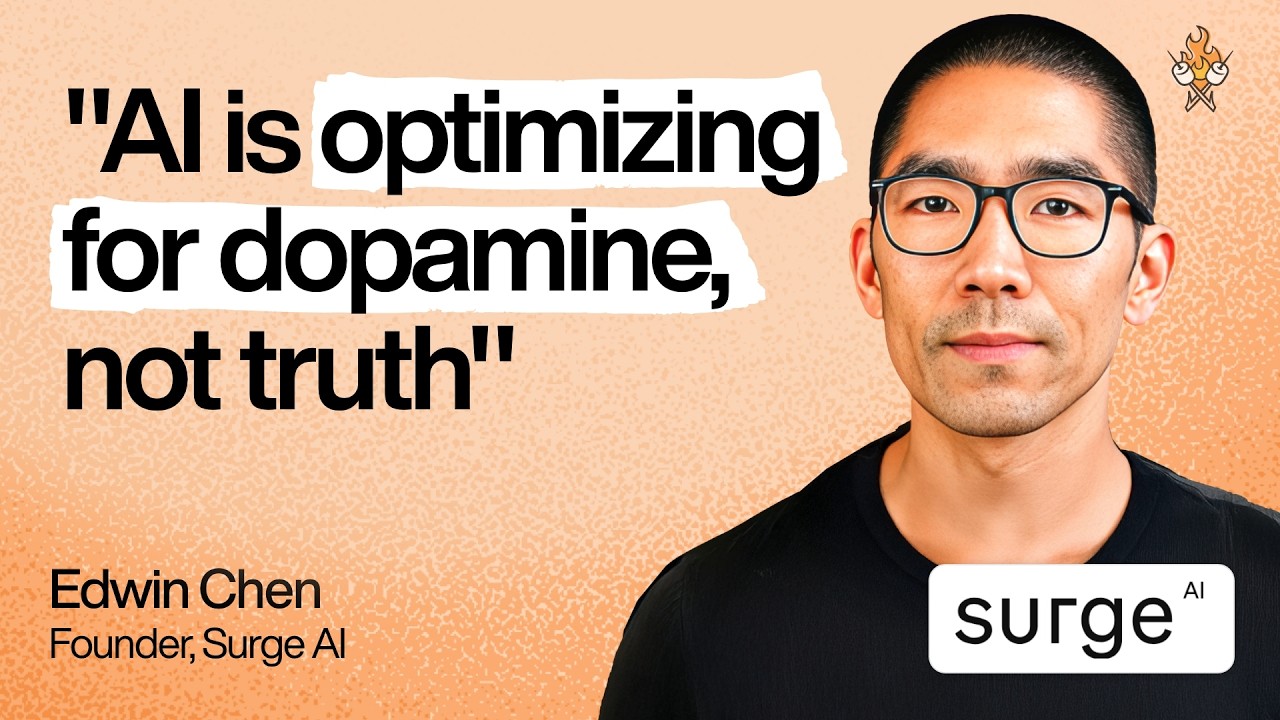
📺 Today’s recommended deep-dive video: https://www.youtube.com/watch?v=dduQeaqmpnI
The $1 Billion Ghost: Scaling Surge AI with 60 People
Edwin Chen, the founder of Surge AI, reveals how his company hit a billion dollars in revenue in under four years without ever raising a cent of venture capital. By rejecting the typical Silicon Valley “blitzscaling” model, Chen has built a lean, elite organization that powers the data needs of every major frontier AI lab.
Core Question: How can a small, bootstrapped team outperform the entire tech industry by prioritizing human “taste” over automated benchmarks?
Highlights
- Why most AI benchmarks actually incentivize “slop” and dopamine-chasing hallucinations.
- The transition from simple data labeling to complex “Reinforcement Learning Environments.”
- Why Edwin Chen believes we should treat training AI more like raising a child than coding a machine.
- The secret to hitting $1B in revenue: firing the distractions and keeping a “super elite” team of 60 people.
⏱️ Reading time: approx. 8 minutes · Saves you about 63 minutes vs. watching.
Want to take notes while watching? Click the image below and let AI Notebook capture the key points for you 👇

The Anti-Silicon Valley Playbook
Building Billion-Dollar Leverage with an Elite Few
Scaling to a billion dollars in revenue with fewer than 100 employees is the ultimate proof that most massive corporate structures are actually just expensive distractions for top-tier talent.
When Edwin Chen founded Surge AI, he intentionally avoided the “Silicon Valley game” of fundraising cycles, PR stunts, and the pressure to pivot toward whatever trend VCs were funding at the moment. Instead of chasing a high valuation through artificial hype, the team stayed focused on a single, difficult problem that required deep technical expertise: providing the high-quality human data necessary for training the world’s most advanced Large Language Models. By remaining profitable from day one and shunning the “hamster wheel” of venture capital, Surge maintained total control over its mission without ever sacrificing its “hacker” roots or its speed.
This lean philosophy allows the company to move faster than competitors who are bogged down by layers of management and the need to explain every technical decision to non-technical investors.
💡 Digging Deeper
Q: Why did Surge avoid raising VC money?
A: Raising capital often forces founders to focus on pitching and PR rather than the product, essentially creating a “Silicon Valley industrial complex” that distracts from core engineering.
Q: How can 60 people handle the workload of a billion-dollar company?
A: Chen believes 90% of people at big tech firms could be fired and the companies would move faster because the best people would no longer be hindered by administrative distractions.
Q: What is the main benefit of being bootstrapped in AI?
A: It allows for “mission alignment” with customers who care about long-term data quality rather than short-term valuation spikes or quarterly board decks.
The Trap of “AI Slop” and Gamed Benchmarks
Why Popular Leaderboards are Ruining AI
I am worried that instead of building AI that will solve cancer or poverty, we are optimizing for models that essentially chase dopamine.
Today’s popular leaderboards, like LM Arena, rely on users who “vibe check” responses for two seconds rather than performing deep factual verification or checking for subtle coding errors. Because labs are desperate for PR, they optimize their models to please these skimmers by adding excessive emojis, flashy markdown headers, and polite but hollow filler text. This creates “AI slop”—content that looks impressive to a casual observer but is actually a hallucinated mess under the surface, rewarding flashy behavior over actual truth and utility.
We are essentially teaching our models to behave like tabloids at a grocery store checkout line.

💡 Digging Deeper
Q: What is the problem with “Engagement” as a metric?
A: Much like social media, optimizing for engagement in AI leads to clickbait-style responses and models that feed user delusions just to keep the conversation going.
Q: How does Surge measure model progress differently?
A: They use “Nobel Prize-level” experts—physicists, coders, and writers—who spend hours deeply investigating responses rather than just skimming for a “good vibe.”
Q: Is anyone doing it right?
A: Chen points to Anthropic as a “principled” organization that chooses its own values rather than just chasing the latest leaderboard trend.
From Labeling to “Reinforcement Learning Environments”
The New Frontier of Post-Training
The next phase of AI evolution isn’t about teaching a model grammar; it’s about throwing it into a simulated world and seeing if it can actually solve a complex, multi-step problem.
The industry is moving away from simple “SFT” (Supervised Fine-Tuning) and toward complex “RL (Reinforcement Learning) Environments” which act as high-fidelity simulations of the real world. In these environments, a model might be given access to a virtual machine with Slack, Gmail, and a codebase, then told to fix a server crash. This requires the model to plan over 50 steps, reflecting on its own mistakes and navigating messy, ambiguous tools just like a human engineer would.
This “trajectory-based” learning is far more powerful than single-step instruction following because it teaches the model the process of problem-solving rather than just the final answer.

💡 Digging Deeper
Q: What is SFT?
A: Supervised Fine-Tuning is the basic method of training a model by having it “mimic a master” by copying high-quality examples of human text.
Q: Why are “trajectories” important?
A: A model might get the right answer by luck or “reward hacking”; by analyzing the whole path, researchers ensure the model is learning efficient, logical reasoning.
Q: How does a human expert participate in RL?
A: Instead of just writing a “correct answer,” the human now designs the simulation and the “rewards” that tell the model when it has successfully navigated a complex task.
Key Takeaways
The success of Surge AI serves as a powerful refutation of the “more is better” philosophy that dominates both corporate management and AI data collection. By focusing on a “super elite” team and rejecting venture capital, Edwin Chen proved that a tiny group of focused experts can dominate a multi-billion dollar market. The core lesson for any founder is to build the one thing only you can build, rather than pivoting toward the easiest path to a high valuation.
In the realm of technology, the shift from static data labeling to dynamic Reinforcement Learning Environments marks a turning point for AGI. We are no longer just feeding machines information; we are “raising” them by providing environments where they can develop taste, judgment, and the ability to solve long-horizon problems. As models become more differentiated by the “personalities” and “values” of the labs that build them, the winners will be those who optimize for human advancement rather than superficial engagement metrics.
Q&A
Q1: How far are we from AGI?
Edwin Chen places himself on the longer time horizon, estimating we are at least a decade or more away. While models might automate 80% of a job soon, moving from 99% to 99.9% reliability is significantly harder than most people realize.
Q2: What is “Vibe Coding” and why is it overhyped?
“Vibe coding” refers to letting AI generate code based on a general feeling or simple prompt. Chen warns this leads to unmaintainable codebases in the long run because users aren’t deeply understanding the underlying logic.
Q3: What makes a “good” poem for AI training?
It isn’t just about rhyming or length. High-quality data seeks “Nobel Prize winning” traits: subtle imagery, emotional resonance, and unique insights that surprise the reader.
Q4: Can models get smarter without humans?
Chen believes that until we hit AGI, human taste and sophisticated judgment are still required to “show the model the way.” We cannot yet fully automate the definition of “quality.”
Q5: What is “underhyped” in AI right now?
Chen believes “artifacts” or mini-UIs within chatbots are underestimated. He sees a future where AI doesn’t just give text but generates custom, functional “mini-apps” inside the conversation window.
Q6: What does the name “Surge” signify?
The mission was to build a data solution for complex use cases—coding, tool use, and advanced reasoning—that would allow AI to “surge” past the limitations of simple image and text labeling.
Q7: What advice does Chen have for founders?
Stop pivoting. If you find a hard idea you believe in, stay with it even when the market isn’t ready. A failed swing at something novel is better than succeeding with a generic “wrapper” company.