📺 Today’s recommended deep-dive video: https://www.youtube.com/watch?v=j0z4FweCy4M
Beyond the EV: How Tesla is Building the Silicon Brain of the Future
Tesla’s transformation from a car manufacturer into a real-world AI powerhouse is driven by a radical integration of custom hardware and neural networks. By reconstructing the physical world in a digital “vector space,” the company is moving toward a future where autonomous machines navigate human environments with superhuman precision.
Core Question: How does Tesla integrate custom silicon, neural vision, and massive-scale auto-labeling to solve the challenge of real-world autonomy?
Highlights
- The transition from image-space processing to a unified 3D “Vector Space” using Transformers and Spatial RNNs.
- A hierarchical planning system that combines discrete search with continuous optimization for complex navigation.
- The Dojo Supercomputer and D1 chip, engineered to shatter the bandwidth limitations of traditional GPU clusters.
- The reveal of the Tesla Bot (Optimus), a humanoid application of existing Full Self-Driving technology.
⏱️ Reading time: approx. 12 minutes · Saves you about 171 minutes vs. watching.
Want to take notes while watching? Click the image below and let AI Notebook capture the key points for you 👇

The Synthetic Visual Cortex
Moving from Pixels to Vector Space
Tesla’s vision stack has undergone a radical evolution, moving away from simple 2D image analysis to creating a high-fidelity 3D map of the environment.
This process begins with the “artificial retina,” where raw data from eight cameras is processed through RegNet residual blocks to extract features at multiple scales. These features are then fused using a BiFPN (Bidirectional Feature Pyramid Network), which allows high-resolution detail to communicate with global context. This hierarchical structure ensures that the system doesn’t just see a patch of gray, but understands that the patch is a curb located at the vanishing point of a highway.
To solve the “cockeyed” camera problem, Tesla introduces a rectification layer that projects all images into a virtual, common camera space.
By using a Transformer with multi-headed self-attention, the neural network maps these rectified features directly into “vector space.” This represents a 3D environment containing lane lines, curbs, traffic lights, and vehicles, effectively bypassing the inaccuracies of traditional C++ occupancy trackers.

💡 Digging Deeper
Q: Why use a Transformer for vision?
A: Transformers allow the network to dynamically decide which pixels in the camera feed are most relevant to specific 3D coordinates in the vector space, handling occlusions and sloping roads more effectively than fixed geometric projections.
Q: How does the car “remember” objects when they are hidden?
A: Tesla uses a Feature Queue that caches information based on both time and space. A spatial RNN lattice allows the car to “write” information to a 2D memory grid, ensuring it remembers a parked car even if it is currently occluded by a passing truck.
Q: What is the benefit of the “HydraNet” architecture?
A: It allows multiple “heads” (tasks like lane detection or object tracking) to share a common “trunk” (backbone), saving massive amounts of compute power while keeping tasks decoupled for easier engineering.
Neural Planning and the Simulation Engine
Solving the Non-Convex World
Navigation in a city is a “non-convex” problem, meaning there are multiple valid paths, but a standard optimization algorithm might get stuck in a bad local solution.
Tesla addresses this by using a hierarchical planner. First, a coarse search identifies a general “convex corridor” of safe movement, and then continuous optimization smooths the trajectory for passenger comfort. This allows the car to perform complex maneuvers, like back-to-back lane changes in heavy traffic, while maintaining a plan that spans 10 to 15 seconds into the future.
The system doesn’t just plan for itself; it runs the autopilot planner for every other actor on the road.
If a car is approaching in a narrow corridor, Tesla’s AI predicts whether the other driver will yield based on their velocity and yaw rate. This joint optimization prevents the car from being too timid, allowing it to assertively navigate tight spaces when it recognizes the other agent has room to pull over.

💡 Digging Deeper
Q: How does simulation fill the gaps in real-world data?
A: Simulation is used for “edge cases” that are dangerous or rare, such as a family running across a highway. Tesla can procedurally generate thousands of variations of a single failure to ensure the software never repeats a mistake.
Q: What is “Auto-Labeling”?
A: It is an offline pipeline that uses massive compute to reconstruct a 3D scene from fleet video with perfect hindsight. By looking at the “future” of a clip, the system can accurately label occluded objects and road geometry, which are then used to train the real-time car networks.
Dojo: The Training Supercomputer
Silicon Without Bottlenecks
Traditional supercomputers are limited not by their raw compute power, but by the bandwidth and latency between their nodes.
Tesla designed the D1 chip to solve this, packing 50 billion transistors into a machine learning asic with zero “dark silicon.” Each chip is a 2D mesh of 354 training nodes, each capable of over one teraflop of compute. The architecture is entirely modular, allowing chips to be connected without any “glue” logic, preserving massive I/O bandwidth across the entire plane.
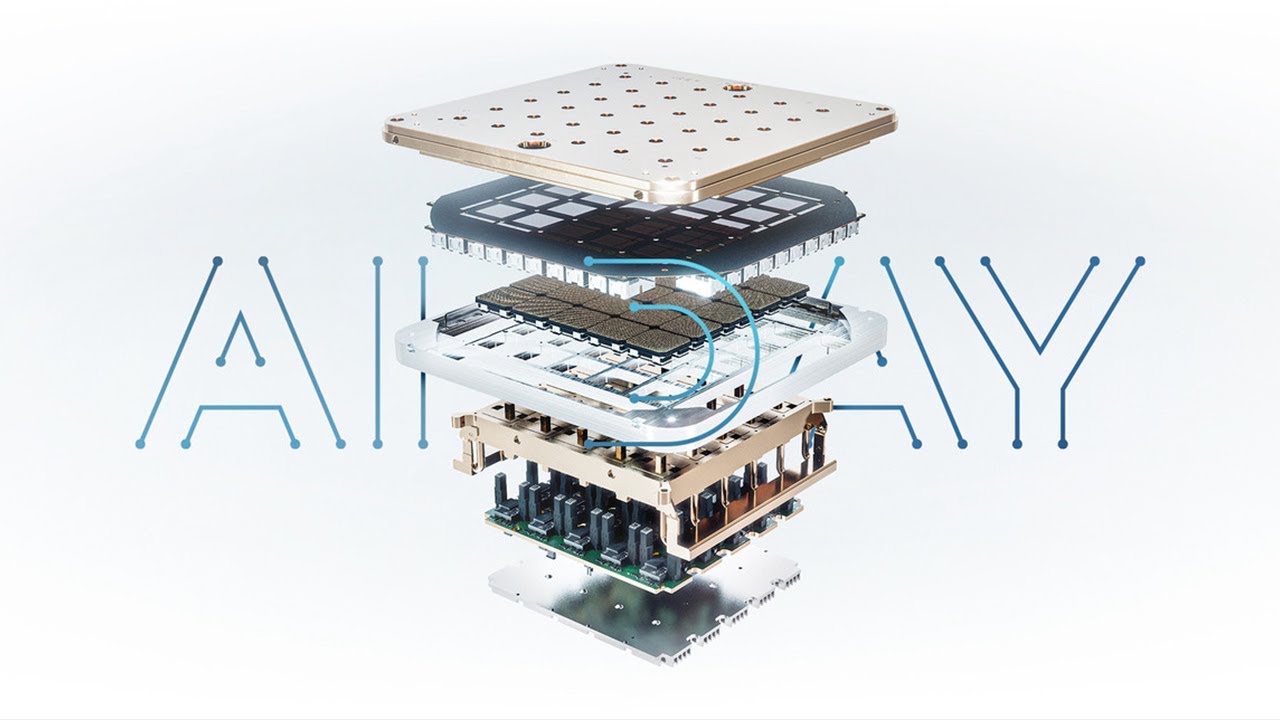
The “Training Tile” is the fundamental unit of the Dojo system, integrating 25 D1 dies into a single high-density module.
A single tile provides 9 petaflops of compute and 36 terabytes per second of off-tile bandwidth. By stacking these tiles into cabinets and eventually an “Exapod,” Tesla creates a system that delivers 1.1 exaflops of AI performance. This custom stack allows Tesla to train massive video-based neural networks much faster than a standard GPU cluster, accelerating the pace of innovation.

💡 Digging Deeper
Q: How does the Dojo compiler work?
A: It automatically partitions large neural networks across the compute plane. It handles model, data, and graph parallelism so that ML scientists can write code in PyTorch without worrying about the underlying hardware complexity.
Q: Is Dojo just for cars?
A: While its first task is training FSD video, it is a generalized neural network trainer. Tesla intends for it to be the most efficient AI training platform in existence, potentially open to outside users in the future.
Key Takeaways
Tesla is no longer just an automotive company; it is a vertically integrated AI firm that builds its own sensors, chips, and labeling infrastructure. By moving from 2D image processing to a time-aware 3D vector space, they have created a “synthetic animal” capable of navigating the unpredictable real world. The transition to auto-labeling has effectively automated the most tedious part of AI development, allowing the fleet to teach itself from millions of miles of driving data.
The reveal of the Tesla Bot, or Optimus, represents the logical conclusion of this work. If a car is a robot on wheels, a humanoid is simply the same AI in a different form factor designed to navigate a world built for humans. This shift suggests that Tesla’s long-term value lies in its ability to eliminate repetitive, dangerous, or boring labor, potentially fundamentally altering the global economy through universal automation.
Q&A
Q1: Will FSD work in countries outside the US?
A: Yes. While Tesla currently focuses on the US to reduce complexity, the underlying vision and planning components are country-agnostic. The car recognizes curbs and vehicles regardless of the local language or road signs.
Q2: Can the hardware 3.0 computer really handle full autonomy?
A: Elon Musk expressed high confidence that the current hardware can reach safety levels significantly higher than a human driver. Future hardware iterations (like HW 4.0) will simply push that safety margin even further.
Q3: How does Tesla handle “adversarial attacks,” like someone wearing a stop sign t-shirt?
A: The system is trained to recognize context. By using surround video and temporal memory, the car can distinguish between a stationary post-mounted sign and a person moving with a graphic on their shirt.
Q4: Is the Tesla Bot real or just a concept?
A: The prototype is expected to be real by next year. It will use the same FSD computer and camera suite as the cars, repurposed for humanoid movement and task completion.
Q5: Why doesn’t Tesla use LiDAR for depth sensing?
A: Tesla believes that vision is sufficient because the world’s road system was designed for biological vision. Their “pseudo-LiDAR” approach uses neural nets to extract high-accuracy depth from video, reaching radar-level precision without the extra hardware cost.
Q6: Does Dojo use standard GPUs?
A: No. Dojo uses the custom-designed D1 chip, which is an ASIC (Application-Specific Integrated Circuit) optimized purely for neural network training, offering much higher power efficiency and bandwidth than general-purpose GPUs.