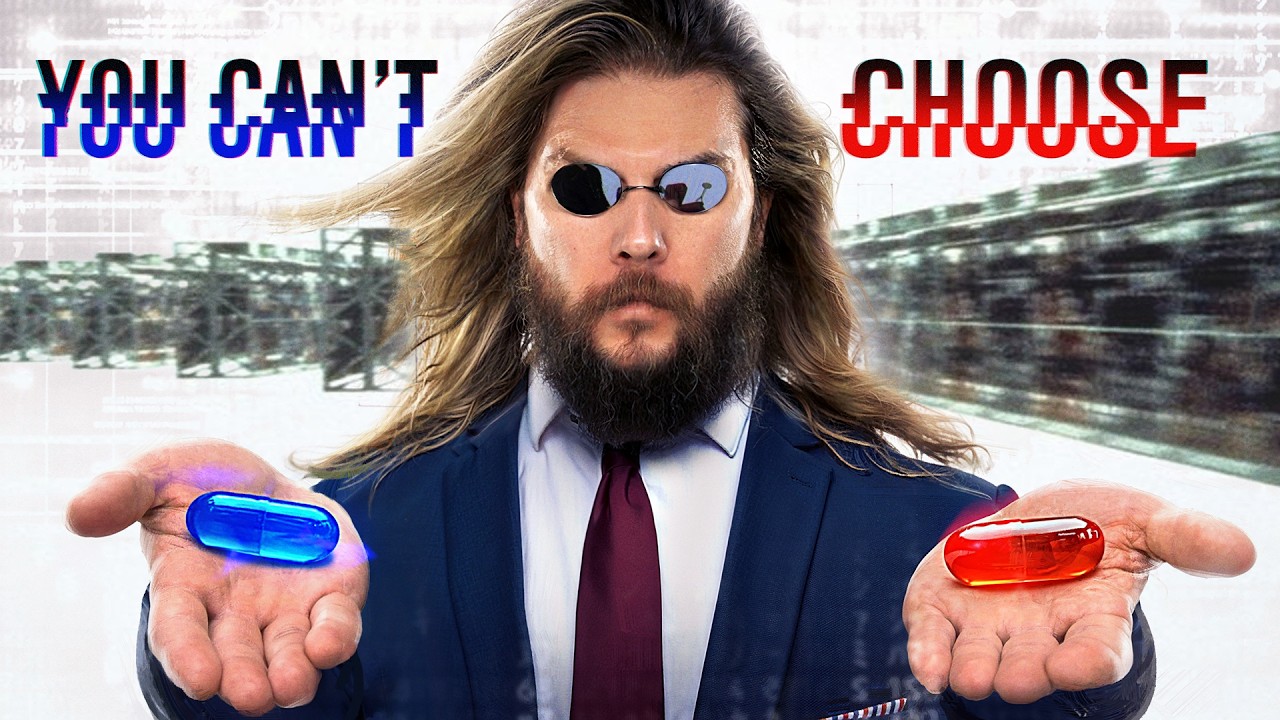
📺 Today’s recommended deep-dive video: https://www.youtube.com/watch?v=w2GCVsYc6hc
The End of Autonomy: Why Your Choices Are Already Made
You think you chose to read these words, but the reality of your neurology suggests a different story. The intuitive “feeling” of freedom is a sophisticated biological trick designed for social survival, not a reflection of cosmic agency or independent decision-making.
Core Question: If every human thought is the inevitable product of a causal chain reaching back to the dawn of time, can we truly claim to possess free will?
Highlights
- The Great Causal Chain: How your DNA and environment dictate your current preferences.
- The City Test: A simple cognitive experiment proving that thoughts “appear” rather than being chosen.
- The Brain as a Thunderstorm: Why neural activity is as deterministic as a lightning strike.
- The Case for Compassion: How accepting determinism can lead to a more moral and less vengeful society.
⏱️ Reading time: approx. 7 minutes · Saves you about 22 minutes vs. watching.
Want to take notes while watching? Click the image below and let AI Notebook capture the key points for you 👇

The Great Causal Chain
The Myth of the Independent Mind
You are not the author of your thoughts.
If you trace the “Great Causal Chain” back far enough, you realize that your preference for salmon over chicken isn’t a spontaneous act of will, but the inevitable result of your unique DNA, the nutrients your brain received in utero, the pollution in your childhood neighborhood, and the specific sequence of atoms colliding since the dawn of the universe. To say you could have chosen differently is to claim that the first atoms in the universe could have moved differently, or that your parents could have met at a different time; since they didn’t, your current brain state was effectively locked in at the Big Bang.
Every neuron firing in your skull right now is the product of billions of years of biological and physical history that you did not choose, yet you claim the result as “your” decision.

💡 Digging Deeper
Q: If I don’t choose my thoughts, who does?
A: No one “chooses” them in the way we usually mean; they emerge from the physical state of your brain, which is a result of prior causes.
Q: Isn’t this just fatalism?
A: Not exactly. While the outcome may be determined, your actions still matter as links in the causal chain; they just aren’t “free” from the laws of physics.
Q: Does this mean we should stop trying?
A: You can’t “choose” to stop trying unless your brain is already conditioned to react to this information by giving up.
The Illusion in Real Time
The City Test and Post-Hoc Rationalization
Consider the “City Test”: if you are asked to think of a random city, names like Dublin or Tokyo simply appear in your consciousness without your prior consent.
You did not choose to not think of Burundi, or Christchurch, or a thousand other cities you know exist; they simply failed to surface from the neurological abyss. We only feel like we are choosing because our consciousness acts as a historian, providing a “post-hoc rationalization” for why a certain thought appeared, creating a narrative of control where there is only cognitive chaos.
Much like a thunderstorm that strikes lightning based on atmospheric pressure, temperature, and moisture, your brain produces “flashes” of intention based on its current state. The cloud does not choose where the bolt lands, and your consciousness does not choose which thought surfaces from the billions of interconnected neurons firing in the dark.

💡 Digging Deeper
Q: What about “Flow State” where I feel most in control?
A: Interestingly, Flow State is when you feel least like an independent decider; actions happen automatically, proving that high-level performance doesn’t require a conscious “chooser.”
Q: Can’t I just change my mind to prove I’m free?
A: The impulse to “prove me wrong” is itself a reaction to this information, dictated by your personality and past experiences.
Biology as Fate
The Case of the Unlucky Brain
Biology is the only variable in the equation of human behavior.
When Charles Whitman committed a mass shooting from the University of Texas clock tower in 1966, an autopsy revealed a bean-sized tumor pressing against his amygdala, a region of the brain critical for emotional regulation. Most people would agree that Whitman was a victim of his biology, yet we fail to see that a “healthy” brain is just as much a product of biological luck as a diseased one. You are simply lucky enough to have a brain that doesn’t compel you to commit violence.
We extend this same logic to grizzly bears or sharks when they attack, recognizing that they are simply “being bears,” yet we struggle to accept that human architecture is just as constrained by its chemistry.
💡 Digging Deeper
Q: Does this mean we shouldn’t punish criminals?
A: We should still restrain dangerous people for societal safety, but the moral justification for causing them pain or “retribution” vanishes if they aren’t responsible for their wiring.
Q: Isn’t this “Nature vs. Nurture”?
A: That’s an outdated binary; Modern biology shows it’s both, and you chose neither your genes nor the environment that nurtured them.
The Compassion of Determinism
Finding Peace in the Machine
Relinquishing the belief in free will doesn’t lead to anarchy; instead, it fosters a radical form of empathy.
You cannot truly hate a hurricane for the damage it causes, nor can you logically hate a human for the “weather” occurring inside their skull. By viewing yourself and others as historians of feelings rather than masters of them, you can dissolve the crushing weight of regret. You are an organism that did what it was programmed to do in that moment.
This realization forces compassion into uncomfortable places, like the legal system or our personal grudges, demanding that we treat the “unlucky” with the same clinical care we would give to a patient with a broken limb.

Key Takeaways
The realization that free will is an illusion is often met with fear, yet it offers a profound release from the cycle of self-blame and social vengeance. If we accept that our thoughts and actions are the inevitable results of the “Great Causal Chain,” we can stop assaulting our own psyches with “what could have been.” We are the kind of organisms that do the things we do, and acknowledging this allows for a more honest engagement with the truth of the physical universe.
Ultimately, this shift in perspective doesn’t change the experience of life—the illusion of choice remains as strong as ever—but it changes the meaning we derive from it. It moves us toward a society built on understanding and rehabilitation rather than one built on the shaky ground of moral superiority. Whether or not you agree with this is, ironically, not a choice you are currently free to make.
Q&A
Q1: Does quantum mechanics provide a loophole for free will?
A1: No. Even if quantum randomness plays a role in the brain, randomness is not the same as conscious control. You have no more say over a random subatomic fluctuation than you do over a deterministic one.
Q2: If there’s no free will, why do we feel so much like we have it?
A2: Evolution likely hardwired this feeling into us because it facilitates social harmony and accountability, which helped our ancestors survive in complex groups.
Q3: Doesn’t this make the legal system obsolete?
A3: Not at all. We still need to separate dangerous people from society, much like we put fences around tigers. However, it makes cruel punishments like solitary confinement or the death penalty harder to justify morally.
Q4: If I decide to go to the gym tomorrow, isn’t that a choice?
A4: You as an organism are making a decision, but you didn’t “choose to choose” it. The desire to go to the gym arose from your current health, your personality, and the information you’ve recently consumed.
Q5: How can I be a “Kinder person” if I have no choice?
A5: Exposure to the idea of determinism can be the very “cause” that shifts your brain’s future “effects” toward more compassionate behavior.
Q6: What is the “homunculus” mentioned in the argument?
A6: It refers to the idea of a “little man” inside the brain that acts as an independent decider; science has found no evidence of such a separate, uncaused entity.
Q7: Can I use this as an excuse to be a bad person?
A7: You could try, but the social consequences of your actions will still be determined by the collective “biology” of the society you live in, which is wired to protect itself from “bad” behavior.