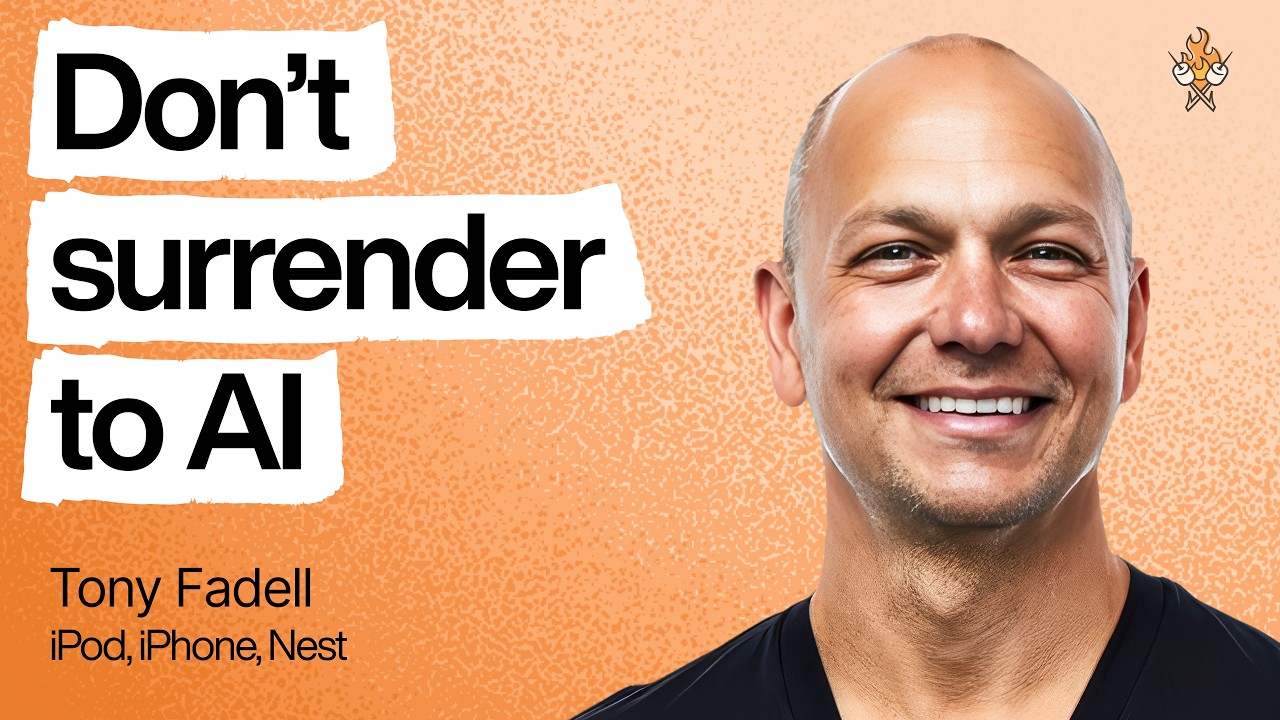
📺 Today’s recommended deep-dive video: https://www.youtube.com/watch?v=RJjl1TwyfWM
Beyond the Machine: Tony Fadell on the Art of Building Unforgettable Products
Tony Fadell, the visionary behind the iPod, iPhone, and Nest, reveals the unconventional tactics required to build category-defining products in an age of rapid AI development. He argues that the true differentiator in a saturated market isn’t just faster technology, but the marriage of human-led craftsmanship, opinionated leadership, and the relentless pursuit of storytelling.
Core Question: How can builders move beyond “cognitive surrender” to machines and leverage a mix of informed intuition, pain-based innovation, and the three-generation rule to create enduring products?
Highlights
- The Death of Data in 1.0: Why the most important product decisions must be opinion-based rather than data-driven.
- The Three-Generation Rule: A breakdown of how every successful product evolves from “Making it” to “Fixing the Business.”
- Marketing as the Product Lens: Why the press release and the customer journey are as critical as the code or the hardware.
- The Voice-First Flip: A prediction on how AI will eventually invert our interaction model from touch-primary to voice-primary.
⏱️ Reading time: approx. 12 minutes · Saves you about 83 minutes vs. watching.
Want to take notes while watching? Click the image below and let AI Notebook capture the key points for you 👇

The Battle of Opinion vs. Data
The iPhone Keyboard Saga
When you are building a version 1.0 of a new category, you have almost no relevant analogs to use for data-driven decisions.
This reality was most apparent during the development of the original iPhone, where the team spent months in a heated deadlock over the keyboard. One side argued for a physical BlackBerry-style keyboard to capture the existing professional market, while the other side pushed for a risky, unproven multi-touch virtual interface. Because multi-touch was still in its infancy—existing only on large, ping-pong table-sized prototypes—there was no consumer data to prove it could scale down to a pocketable device.
We had to run rigorous internal tests to see how fast we could type and how many errors we made compared to hardware. Eventually, it wasn’t the data that won; it was Steve Jobs’ informed opinion that a virtual keyboard was “good enough” to unlock the rest of the screen’s potential. If the data isn’t clear, you need a “benevolent dictator” to pick a path, or the product will die in committee.
💡 Digging Deeper
Q: How do you know when to ignore the experts?
A: You don’t ignore them; you gather their informed judgment to build your own “informed gut.” You ask “why” until you reach the root constraint.
Q: Is micromanagement always a negative trait?
A: Only if you are micromanaging the operations. Micromanaging the details of the customer experience is simply called excellence.
Q: Why do B2B products fail at innovation more than B2C?
A: B2B leaders often use user studies as a shield to avoid taking the personal risk required to make an opinion-based decision on a new category.
The Three-Generation Cycle of Success
The “Pain + Technology” Formula
Every great product idea starts by identifying a deep, habituated pain and pairing it with a “why now” technology.
For Nest, the pain was a $1,200 annual energy bill controlled by a device people hated to program; the “why now” was the emergence of low-power AI that could learn patterns without human intervention. You cannot just jam technology down a customer’s throat; the tech must be in service of solving the pain so effectively that the customer barely notices the machine doing the work.
Innovation isn’t just the gadget. It’s the full system—reinventing how the product is installed, how it’s purchased at Best Buy, and how the energy company rebates the cost.

💡 Digging Deeper
Q: Was the iPod an immediate success?
A: No, it took three generations and the addition of Windows connectivity before it actually took off beyond the 1% Mac user base.
Q: What is the “skunkworks” approach to leadership?
A: It involves keeping small projects alive (like the Apple Pencil or Windows iPod) even if the leader initially hates the idea, because you can see the need on the horizon.
Marketing is the Product
Storytelling as the “Why”
Builders often make the mistake of focusing on the “what” of a product, but customers only buy the “why.”
If you look at the customer journey, marketing is the very first lens through which a user experiences your creation. If the story doesn’t resonate emotionally or rationally within the first few seconds, the engineering quality becomes irrelevant. Steve Jobs didn’t just walk on stage and wing it; he spent years honing the story of the iPhone, refining the “three devices in one” pitch until it was a flawless narrative.
You should write the press release before you even start building the code.
This forces you to identify the three or four “tentpole” features that actually matter to a human being, preventing the “feature creep” that turns elegant tools into bloated, unusable “gobbledygook.” If you can’t describe the value in a simple story, the product is too complex to exist.

💡 Digging Deeper
Q: How do you refine a story?
A: Tell it to people who don’t care about your industry. If their eyes glaze over, you’re talking about “what,” not “why.”
Q: What can builders learn from late-night infomercials?
A: The “Virus of Doubt.” You must dramatically highlight the pain of the status quo before showing how your product is the only logical cure.
The Danger of Cognitive Surrender
Avoiding “Vibe Coding” and Tech Debt
As AI makes it easier to generate code and designs, the risk of “cognitive surrender”—letting the machine make all the architectural choices—is reaching a breaking point.
We are seeing a trend of “fast software” that mirrors fast fashion; it looks good on the surface but is structurally brittle and riddled with technical debt. A recent leak of a major AI company’s source code showed a “main loop” that was so disorganized it made veteran architects want to throw up. When you let an agent write code without human-led segmentation and security reviews, you are trading short-term speed for a long-term inability to maintain or scale the business.
Humans must stay in the loop to ensure “luxury” craftsmanship.
The most successful AI products of the next decade will be “Full Stack” innovators that combine hardware atoms with software bits. Whether it’s robotics for retail inventory or AI-powered drug design, the real value lies in using AI as a tool to solve physical-world problems, rather than just building chat interfaces that lack context.

💡 Digging Deeper
Q: Will screens disappear in the AI era?
A: Unlikely. Unless we have a direct neural link, humans need a display for high-bandwidth visual information like maps or data visualization.
Q: What is the next major shift in hardware?
A: Flipping the interface hierarchy so that Voice is primary, while Touch and Keyboard become the tertiary “crutches” we only use when necessary.
Key Takeaways
Building a great product requires a refusal to settle for “data-driven” mediocrity. Data is excellent for optimizing a product that already exists, but it is a terrible compass for exploring the unknown. To build something like the iPod or the Nest, you must start with a visceral pain point and have the courage to make opinion-based decisions that experts might initially mock. Success is rarely a straight line; it follows a three-generation path of making the product, fixing the flaws, and finally fixing the business model.
In the age of AI, the role of the “Builder” is more important than ever. We must resist the urge to hand over our critical thinking to LLMs and “vibe code” our way into technical debt. By focusing on the customer journey, mastering the art of storytelling, and maintaining a “Full Stack” view of both hardware and software, you can create products that aren’t just functional, but have the “luxury” feel of something truly cared for by humans.
Ultimately, the most successful companies will be those that prioritize ethics and human connection over addictive dopamine loops. As you build, ask yourself not just what the machine can do, but what should be done to benefit society. The world doesn’t need more “fast software”; it needs well-thought-through solutions that stand the test of time.
Q&A
Q: How do you know when a project is truly failing vs. just needing a Gen 2?
A: You only fail if you stop. If you can identify specific customer feedback that can be solved in a next iteration, you are learning, not failing.
Q: Why was the Nest Protect smoke alarm discontinued?
A: It became an “orphan” within Google. Crystalline products require constant love and attention; without a champion to protect the vision, they often get tossed aside in large corporations.
Q: What is the most important part of the “Working Backwards” method?
A: It’s the constraint. By limiting yourself to a press release, you prevent yourself from adding five extra features that don’t actually help you sell the product.
Q: Is AI hardware just a hype cycle?
A: We are seeing a return to “Atoms + Software.” You can’t reach the next level of software innovation without hardware that provides new sensors and context, like Waymo or robotics.
Q: How do you build a relationship with a customer through sales?
A: Sometimes by telling them not to buy your product. If you direct them to a competitor because it’s a better fit, you build a foundation of truth that lasts longer than a single transaction.
Q: What is “Cognitive Surrender”?
A: It is the act of letting a machine or a process take over the decision-making that requires human taste, ethics, and architectural foresight.
Q: Why does Tony Fadell focus on “Deep Tech” now?
A: Because deep tech—like chemical recycling or new chip architectures—is the only thing capable of fundamentally unseating incumbents rather than just competing on minor features.